Ambush Bug
Ambush bugs (subfamily Phymatinae) are primarily found in habitats where they can effectively conceal themselves to capture prey. They are most abundant in…
In what types of habitats are ambush bugs typically found?
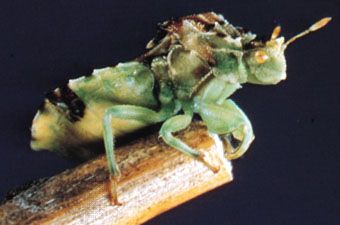
Ambush bugs (subfamily Phymatinae) are primarily found in habitats where they can effectively conceal themselves to capture prey. They are most abundant in the tropical regions of the Americas and Asia, where they typically hide on flowers or other plant parts.12
In North America, common representatives such as those in the genus Phymata are frequently observed lurking on garden plants. By positioning themselves on these structures, they wait for insects to approach closely enough to be grasped by their specialized front legs.1
What role do pheromones play in ambush bug communication and mating?
Sorry, the Britannica knowledge base does not contain information regarding the specific role of pheromones in the communication and mating of ambush bugs. While pheromones are widely used by many insects to facilitate sexual attraction, coordinate reproductive behavior, and maintain social structures, the provided search results do not address these mechanisms within the subfamily Phymatinae.4567
How do ambush bugs hunt and capture their prey?
Ambush bugs (subfamily Phymatinae) are specialized predators that rely on stealth to capture their prey. They typically hide on flowers or other plant parts, remaining motionless until an unsuspecting insect approaches within striking distance.18
Once the prey is close enough, the ambush bug lunges and grasps the victim using its greatly enlarged front legs. These forelegs are highly specialized for capture: the upper section (tibia) features teethlike structures that mesh perfectly into corresponding structures on the thickened lower section (femur), acting like a pair of pincers to secure the prey.18
After successfully pinning the victim, the ambush bug uses its short, three-segmented beak to pierce the prey’s body. It then injects enzymes to liquefy the internal tissues and sucks out the body fluids. Despite their small size—often less than 12 mm (0.5 inch)—these bugs are capable of capturing prey as large as bumblebees, wasps, or butterflies.18
How have ambush bugs evolved their specialized front legs for capturing prey?
Ambush bugs (subfamily Phymatinae) have evolved highly specialized front legs that function as powerful, viselike grasping organs to secure prey. This adaptation is a hallmark of their predatory strategy, allowing them to capture insects often much larger than themselves, such as bumblebees or wasps.110
The structural evolution of these forelegs involves several key features:
- Enlarged Femur: The lower section of the leg, the femur, is greatly thickened to house the musculature necessary for a strong, rapid strike.110
- Meshing Structures: The upper section (tibia) and the femur are equipped with interlocking teethlike structures. When the bug strikes, these surfaces mesh together like pincers, preventing the prey from slipping free.18
- Folding Mechanism: Like many Heteroptera, these legs are adapted to fold tightly, ensuring that once the prey is grasped, it is held securely against the bug’s body for the subsequent feeding process.8
These modifications enable the ambush bug to remain motionless on flowers or vegetation, waiting to lunge at passing insects with precision and force.110
Sources
- ambush bug — Encyclopædia Britannica
- masked hunter — Encyclopædia Britannica
- ambush bug — Merriam-Webster
- Chemoreception - Aphrodisiac pheromones — Encyclopædia Britannica
- Chemoreception - Primer pheromones — Encyclopædia Britannica
- pheromone — Encyclopædia Britannica
- Hormone - Pheromones — Encyclopædia Britannica
- assassin bug — Encyclopædia Britannica
- folding-door spider: Top Questions — Encyclopædia Britannica
- heteropteran - Legs — Encyclopædia Britannica
- homopteran - Legs — Encyclopædia Britannica
Published on · 2 min read