Serviceberry
The serviceberry (genus Amelanchier) is primarily found in North America, where the majority of its approximately 20 species are native.
Where is the serviceberry plant typically found in nature?
The serviceberry (genus Amelanchier) is primarily found in North America, where the majority of its approximately 20 species are native.1
While North America is the primary habitat for the genus, there are notable exceptions:
- The snowy mespilus (Amelanchier ovalis) is found across Europe.1
- The Asian serviceberry (A. asiatica) is native to East Asia.1
These deciduous shrubs and small trees are often found in wild settings, and certain species, such as the running serviceberry (A. spicata), are particularly useful for stabilizing soil on embankments. Because wild types of Amelanchier hybridize freely, they are frequently encountered in diverse, semiwild environments.1
What are some common names for serviceberry in different regions?
The serviceberry (genus Amelanchier) is known by several common names, which often reflect regional naming conventions or the plant’s seasonal behavior.
Common names for the genus include:
- Juneberry: Frequently used to describe the fruit or the plant itself, particularly A. alnifolia.13
- Shadbush and Shadblow: These names refer to the plant’s tendency to bloom in early spring at the same time that American shad swim upriver to spawn.13
- Saskatoon: Derived from the Cree word misâskwatômin, this name is commonly used for A. alnifolia, particularly in the northwestern United States and western Canada.4
- Snowy Mespilus: The common name for the European species A. ovalis.1
- Korean Juneberry: An alternative name for the Asian serviceberry (A. asiatica).1
It is important to note that while the name “service” is used in North America for Amelanchier, in Europe, the term “service” typically refers to a different genus of plants, Sorbus.3
How is the serviceberry plant used in gardening and landscaping?
Serviceberry plants (genus Amelanchier) are highly valued in gardening and landscaping for their aesthetic appeal and functional versatility. As members of the Rosaceae family, they are primarily cultivated as ornamental shrubs and small trees due to their profuse, showy white flowers that bloom in early spring.15
In landscape design, different species are selected based on their size and growth habits:
- Specimen Planting: Species like the shadblow serviceberry (A. canadensis), Allegheny serviceberry (A. laevis), and downy serviceberry (A. arborea) are popular for their height and elegant, nodding flower clusters.1
- Hybrid Varieties: The apple serviceberry (Amelanchier ×grandiflora) is often chosen for its larger blossoms, which can appear pinkish on some specimens.1
- Erosion Control: The running serviceberry (A. spicata) is a low-growing, spreading shrub that is particularly effective for stabilizing soil on embankments and in semiwild garden settings.1
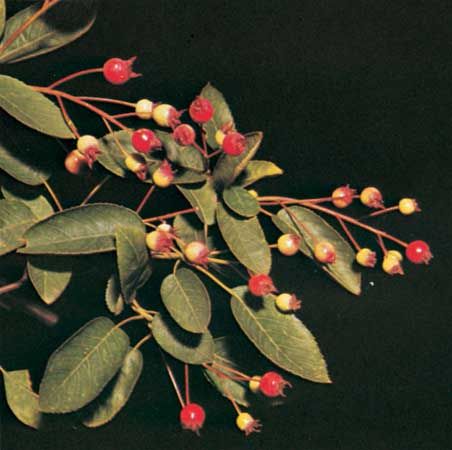
Beyond their visual beauty, these deciduous plants provide ecological benefits, as their reddish to purple-black fruits serve as a food source for birds and other wildlife.1
What are the different species of serviceberry and how do they differ?
The genus Amelanchier consists of approximately 20 species of deciduous shrubs and small trees within the Rosaceae family. While most are native to North America, the genus includes the European snowy mespilus (A. ovalis) and the East Asian A. asiatica.1
Species are often distinguished by their size, growth habit, and floral characteristics:
- Juneberry or Saskatoon (A. alnifolia): A shrub reaching approximately 3 metres (10 feet).1
- Shadblow serviceberry (A. canadensis): A tree growing up to 8 metres (26 feet).1
- Allegheny serviceberry (A. laevis): Similar to A. canadensis but taller, featuring distinctively nodding flower clusters.1
- Downy serviceberry (A. arborea): A vigorous species with larger, hanging flower clusters.1
- Apple serviceberry (Amelanchier ×grandiflora): A natural hybrid of A. arborea and A. laevis that reaches 9 metres (29.5 feet) and produces larger blossoms.1
- Running serviceberry (A. spicata): A low, spreading shrub (1 metre) used for soil stabilization.1
Because wild types hybridize freely, the taxonomy of the genus remains somewhat contentious.1
Sources
- serviceberry — Encyclopædia Britannica
- Amelanchier — Merriam-Webster
- serviceberry — Merriam-Webster
- saskatoon — Merriam-Webster
- snowberry — Encyclopædia Britannica
Published on · 3 min read