American Arborvitae
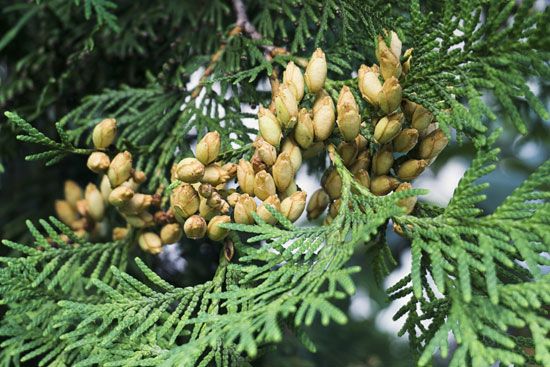
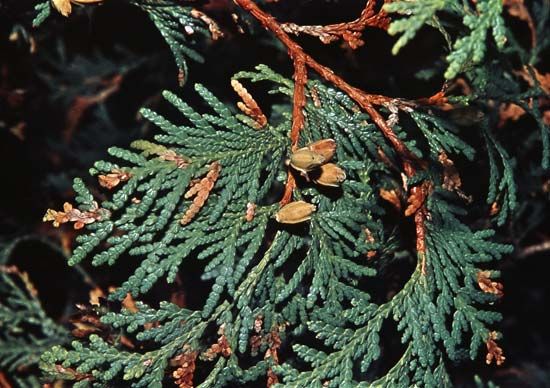
The American arborvitae (Thuja occidentalis) is a hardy evergreen conifer belonging to the cypress family (Cupressaceae), native to eastern North America.
What is American arborvitae?
The American arborvitae (Thuja occidentalis) is a hardy evergreen conifer belonging to the cypress family (Cupressaceae), native to eastern North America.12
Often reaching heights of 20 meters (65 feet), this tree is characterized by its reddish-brown bark, conical or columnar shape, and flattened branchlets with scalelike leaves. Its wood is notably soft and decay-resistant, leading to its use in the lumber trade under various names, including white cedar, eastern white cedar, and swamp cedar.12
Due to its hardiness, the American arborvitae is widely cultivated, with many varieties grown as dense, pyramidal ornamental shrubs that feature diverse foliage colors. It is considered the most common and robust species within the arborvitae genus.12
What are the main differences between conifers and deciduous trees?
The primary differences between conifers and deciduous trees involve their reproductive structures, leaf characteristics, and seasonal behaviors.
Reproductive Structures
Conifers are gymnosperms, meaning they produce “naked” seeds typically borne in cones rather than within a fruit or flower. In contrast, most deciduous trees are angiosperms, which produce seeds enclosed within a fruit or ovary, often following the development of flowers.34
Leaves and Foliage
- Conifers: Most conifers possess simple, needlelike or scalelike leaves that are often coated in a thick, waxy substance to minimize water loss. While there are exceptions, the majority of conifers are evergreen, meaning they retain their foliage throughout the year and into the following growing season.356
- Deciduous Trees: These trees typically have broader, thinner leaves that are shed annually, usually in the autumn or during a dry season. This shedding is a seasonal adaptation that allows the tree to enter a state of dormancy, protecting it from harsh conditions like winter cold or drought.76
Seasonal Adaptations
Deciduous trees undergo a distinct cycle of leaf abscission, where they lose their leaves to conserve resources and protect against environmental stress. While most conifers remain green year-round, some, such as the larch, bald cypress, and dawn redwood, are deciduous and shed their needles annually.73
Why is the wood of the American arborvitae considered decay-resistant?
The wood of the American arborvitae (Thuja occidentalis) is considered decay-resistant primarily due to the presence of natural toxic extractives within the wood.1
While decay is not an innate property of wood itself—occurring only when environmental conditions like moisture, air, and temperature are suitable for the growth of decay fungi—these extractives act as a significant delaying factor against biological degradation. Similar to other conifers often referred to as “cedars,” the American arborvitae produces aromatic, resinous wood that is durable even when in contact with soil or moisture. These chemical properties help protect the wood from insects and fungi, making it a valued material for various outdoor and structural applications.1111213
How do evergreen trees survive in cold winter climates?
Evergreen trees in cold climates survive the winter through specialized physical adaptations that protect their foliage from freezing and physical damage. Unlike deciduous trees, which shed their leaves to avoid the risk of cellular rupture and structural breakage, evergreens possess leaves that are typically thicker and more leathery, often shaped as needles or scales.1015
These leaves are coated in thick waxes and resins, which serve as a protective barrier against freezing temperatures and prevent the leaves from fracturing. By retaining these durable, specialized leaves, evergreens avoid the need to regrow their entire canopy each spring. Furthermore, the needlelike or scalelike shape of their foliage reduces the surface area exposed to wind and minimizes the accumulation of heavy snow, which helps maintain the tree’s physical integrity during harsh winter conditions.1510
Sources
- American arborvitae — Encyclopædia Britannica
- American arborvitae — Merriam-Webster
- gymnosperm - Pinophyta — Encyclopædia Britannica
- conifer - Leaves — Encyclopædia Britannica
- conifer - Distinguishing taxonomic features — Encyclopædia Britannica
- plant development - Seasonal adaptations — Encyclopædia Britannica
- conifer - Distribution and abundance — Encyclopædia Britannica
- tree - Adaptations — Encyclopædia Britannica
- plant reproductive system - Gymnosperms — Encyclopædia Britannica
- evergreen — Encyclopædia Britannica
- wood - Degradation — Encyclopædia Britannica
- Did you know? — Merriam-Webster
- wood - Preservation — Encyclopædia Britannica
- cedar — Encyclopædia Britannica
- Why Do Leaves Fall in Autumn? — Encyclopædia Britannica
Published on · 3 min read