Cycas
Yes, Cycas plants contain a toxic glucoside known as cycasin, which has the chemical formula C8H16N2O7C8H{16}N2O7.
Are there any toxic compounds found in Cycas plants, and how do they affect animals?
Yes, Cycas plants contain a toxic glucoside known as cycasin, which has the chemical formula C8H16N2O7C_8H_{16}N_2O_7.1
When ingested by mammals, this compound is highly dangerous. It is known to cause both toxic and carcinogenic effects, posing a significant health risk to animals that consume parts of the plant. Because of these severe health implications, it is essential to keep animals away from these plants to prevent accidental poisoning.1
How do Cycas plants differ from other gymnosperms?
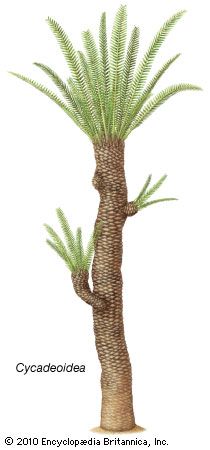
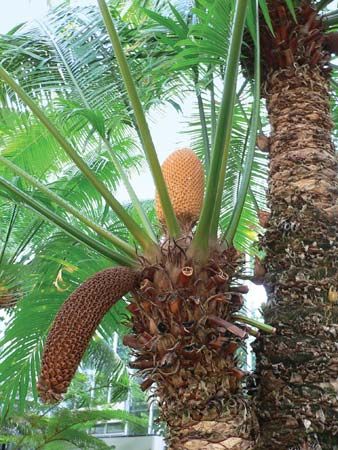
Cycas plants are distinguished from other gymnosperms primarily by their unique reproductive structures. While most gymnosperms, including other cycads, bear their ovules within organized, cone-like structures called megastrobili, the genus Cycas does not form true cones for its female reproductive organs.23
Instead, Cycas exhibits a more primitive arrangement where ovules develop on individual, leaflike megasporophylls arranged in whorls at the stem apex. These megasporophylls are often interposed between vegetative leaves and cataphylls, a feature considered to typify an ancestral seed fern condition.23
In contrast, other gymnosperms show different reproductive strategies:
- Other Cycads: Most other cycad genera (such as Zamia and Encephalartos) produce compact, spirally arranged cones for both male and female reproductive structures.2
- Conifers: Typically monoecious, conifers bear both male and female cones on the same tree, with ovules usually attached to scales within compound megastrobili.34
- Ginkgo: The ginkgo does not produce cones at all, bearing its ovules in pairs on stalks.34
- Gnetophytes: These plants possess unique reproductive specializations, such as double integuments on their ovules and the presence of vessel elements in their xylem, which differ from the tracheids found in other gymnosperms.34
How do Cycas plants reproduce, and what makes their reproductive process unique?
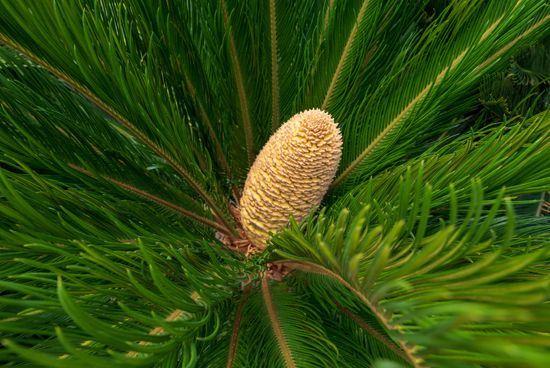
Cycas plants are dioecious, meaning male and female reproductive structures are produced on separate individual plants. Their reproductive process is unique among cycads due to the structure and arrangement of their female organs.2
Reproductive Structures
- Male: Male plants produce microsporophylls arranged in a spiral to form a cone. These bear numerous microsporangia on their lower surfaces, which release vast quantities of pollen.28
- Female: Unlike other cycads that form compact cones, Cycas females produce megasporophylls arranged in whorls at the stem apex. These leaflike structures, which bear ovules along their stalks, are considered to typify an ancestral seed fern condition.2
The Reproductive Cycle
The life cycle involves a complex, slow process:
- Pollination: While pollen production is massive, pollination often relies on insect vectors9. Once pollen reaches the ovule, it develops into a haustorial pollen tube.9
- Fertilization: Cycas produces large, multiflagellated spermatozoids that swim through the archegonial chamber to reach the egg.9
- Development: The resulting embryo remains attached to the female gametophyte for up to two years, absorbing nutrients before the seed matures.9
What type of leaves do Cycas plants have, and how are they arranged?
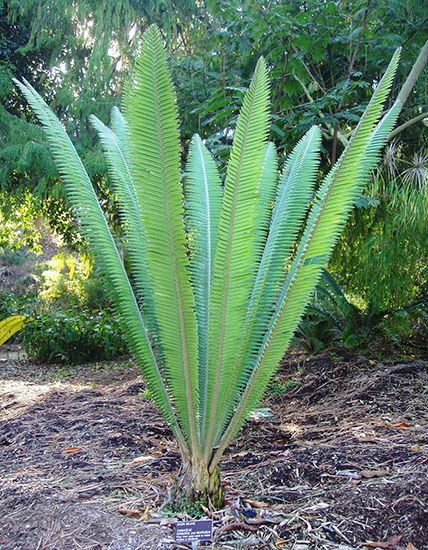
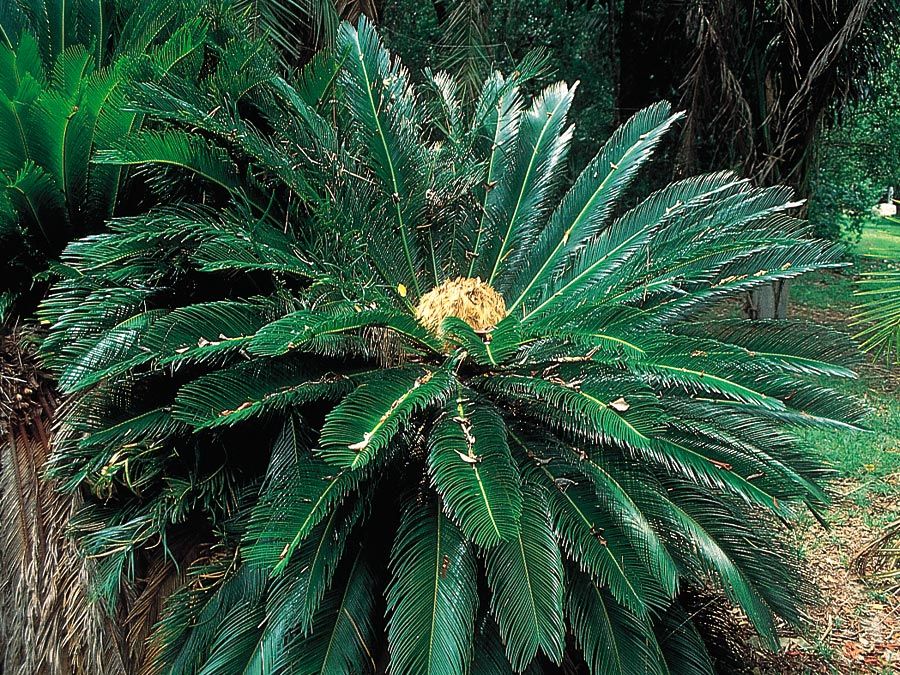
Cycas plants are characterized by large, dark green, once-pinnately compound leaves that grow in a whorl from the top of the trunk. These leaves are circinate, meaning they uncoil as they develop, similar to the growth pattern of fern fronds.1011
The individual leaflets, or pinnae, are distinct in their venation: while they possess a midrib, they lack the side veins found in other cycad genera. The size of these leaves can be quite significant, with some species reaching up to three metres in length.11
In addition to their vegetative foliage, Cycas plants produce modified leaves known as megasporophylls at the stem apex. These structures, which bear the plant’s seeds, are arranged in whorls and are often interspersed with cataphylls and regular foliage leaves, reflecting an ancestral seed fern condition rather than the compact cone structures seen in other cycads.102
Sources
- cycasin — Merriam-Webster
- cycadophyte - Sporophylls and strobili — Encyclopædia Britannica
- plant reproductive system - Gymnosperms — Encyclopædia Britannica
- gymnosperm - Annotated classification — Encyclopædia Britannica
- gymnosperm — Encyclopædia Britannica
- plant - Gymnosperms — Encyclopædia Britannica
- cycadophyte - Cycads — Encyclopædia Britannica
- cycadophyte - Gametophyte phase — Encyclopædia Britannica
- cycadophyte - Sporophyte phase — Encyclopædia Britannica
- Cycas — Encyclopædia Britannica
- cycadophyte - Leaves — Encyclopædia Britannica
- palm - Leaves — Encyclopædia Britannica
Published on · 3 min read