Cupressaceae
The Cupressaceae family, also known as the cypress family, comprises 30 genera and 133 species of evergreen trees and shrubs. Many of these species are…
Which well-known tree species belong to the Cupressaceae family?
The Cupressaceae family, also known as the cypress family, comprises 30 genera and 133 species of evergreen trees and shrubs. Many of these species are highly valued as ornamentals or as sources of timber.1
Well-known tree species and genera within this family include:
- Cypress (Cupressus), including the Italian and Monterey cypresses.12
- Redwood (Sequoia) and giant sequoia (Sequoiadendron).1
- Juniper (Juniperus).13
- Arborvitae (Thuja).13
- Bald cypress (Taxodium).1
- Dawn redwood (Metasequoia).1
- Japanese cedar (Cryptomeria).1
- Incense cedar (Calocedrus).1
- False cypress (Chamaecyparis).12
- China fir (Cunninghamia).1
Formerly, some of these trees were classified under the separate family Taxodiaceae, but modern molecular studies have confirmed they belong within the Cupressaceae.1
What are the economic and ecological importance of Cupressaceae trees?
The Cupressaceae family holds significant economic and ecological value, serving as vital resources for human industry and essential components of natural ecosystems.
Economic Importance
Members of this family are highly prized for their timber, which is valued for its durability and resistance to decay and termites. Historically and currently, species such as arborvitae, cypress, bald cypress, and juniper are utilized in construction and for lining chests to protect fabrics from insects. Additionally, these trees provide useful oils, resins, and tannins. Many species are also widely cultivated as ornamentals in public and private landscapes.14
Ecological Importance
Ecologically, these trees are foundational to their habitats. For example, the bald cypress acts as a dominant species in swamps and riverine ecosystems, where it:
- Provides critical habitat and breeding grounds for birds, amphibians, and other wildlife.5
- Maintains and improves water quality.5
- Helps mitigate floodwaters and reduces soil erosion.5
How have Cupressaceae trees been used historically in different cultures?
Throughout history, trees in the Cupressaceae family have held significant cultural, spiritual, and practical roles across various societies:
- Symbolism and Ritual: In some cultures, the cypress has been used as a symbol of both death and immortality. In Native American traditions, cedar is considered a sacred medicine used in smudging ceremonies to eliminate negative spirits and provide protection. It is also utilized in sweat lodge and fasting ceremonies, and its leaves are brewed into a tea for its restorative properties.678
- Culinary and Medicinal Uses: The berrylike cones of the common juniper have long been used to flavor foods, sauces, and alcoholic beverages, most notably gin. Additionally, oils distilled from juniper wood and leaves have been employed in perfumes and traditional medicines, such as diuretics.1
- Construction and Craft: The fragrant, durable wood of many species has been essential for human industry. For example, Japanese cedar has been used in eastern Asia to build ships, bridges, houses, and furniture, while its leaves are used to produce incense. Similarly, the wood of various juniper species is traditionally used for cabinets and cedar chests, valued for its ability to repel moths and other pests.21
What are the main characteristics of trees in the Cupressaceae family?
The Cupressaceae family, commonly known as the cypress family, consists of 30 genera and 133 species of evergreen trees and shrubs distributed globally.111
Key Characteristics
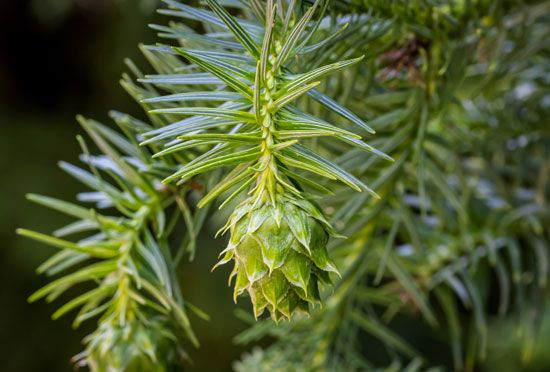
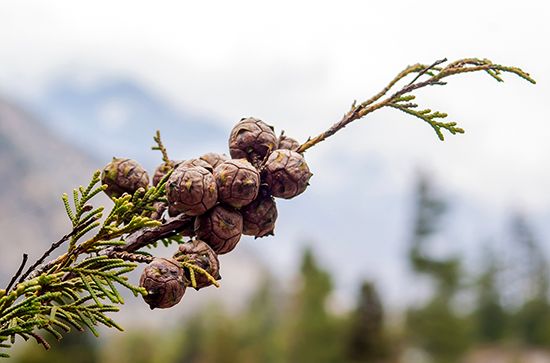
- Foliage: Leaves are typically small, scalelike, and pressed against the branchlets, often giving them a flattened appearance. Juvenile or transitional leaves may be awl-shaped or needlelike. The leaves are arranged in opposite pairs, whorls of three, or spirally.1112
- Reproductive Structures: Both male and female cones are usually borne on the same tree. The female cones are terminal and woody, characterized by scales that are intimately fused to the bracts.1112
- Growth and Bark: Many species are pyramidal in shape, particularly when young. Bark textures vary, with many species shedding in thin plates or strips.2
- Diversity: The family includes a wide range of notable trees, such as redwood, giant sequoia, bald cypress, juniper, and arborvitae.111
Sources
- Cupressaceae — Encyclopædia Britannica
- cypress — Encyclopædia Britannica
- Cupressaceae — Merriam-Webster
- conifer - Economic importance — Encyclopædia Britannica
- bald cypress — Encyclopædia Britannica
- Japanese cedar — Encyclopædia Britannica
- juniper — Encyclopædia Britannica
- four sacred medicines: Top Questions — Encyclopædia Britannica
- cypress — Merriam-Webster
- arborvitae — Merriam-Webster
- conifer - Annotated classification — Encyclopædia Britannica
Published on · 3 min read