Amphipod
Amphipods have developed several fascinating adaptations to thrive in diverse environments ranging from deep-sea trenches to terrestrial habitats:
What are some interesting adaptations that amphipods have developed?
Amphipods have developed several fascinating adaptations to thrive in diverse environments ranging from deep-sea trenches to terrestrial habitats:
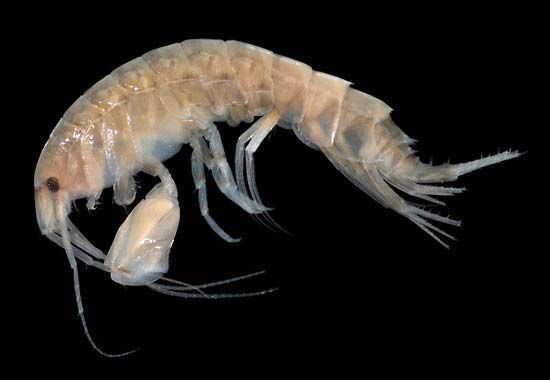
- Body Morphology: Their bodies are typically compressed from side to side, an adaptation that facilitates rapid movement through algal fronds.1
- Reproductive Structures: Females possess a ventral brood chamber called a marsupium, formed by plates known as oostegites, which protects their developing eggs. Males often feature enlarged claws, called gnathopods, used to grasp females during mating.12
- Feeding Specializations: While many are scavengers or herbivores, some species have evolved specialized piercing and sucking mouthparts to live on sedentary invertebrates like sponges and cnidarians. Others, such as members of the family Cheluridae, have adapted to chew wood.1
- Locomotion: Beyond active swimming, some species, such as sand fleas, are highly effective jumpers.1
- Respiration: Their gills are partially protected by long coxae, which are ventral extensions of their leg segments.1
Are there any amphipod species that are considered endangered or of conservation concern?
Sorry, the Britannica knowledge base does not contain specific information regarding which individual amphipod species are currently classified as endangered or of conservation concern.
While the provided information notes that amphipods inhabit diverse environments—including caves, lakes, and coastal regions—it does not list specific species facing extinction. However, it does highlight that habitat loss, which includes destruction, fragmentation, and degradation, is the leading cause of global biodiversity decline and poses a significant threat to the survival of many organisms.
What are the key characteristics that define amphipods as crustaceans?
Amphipods are classified as crustaceans because they share the fundamental characteristics of the subphylum Crustacea, including a body composed of segments (somites) and jointed appendages. Specifically, as members of the class Malacostraca, they adhere to a consistent body plan consisting of a head, a thorax, and an abdomen.67
Key characteristics that define amphipods within this group include:
- Body Segmentation: The head consists of five segments, the thorax of eight, and the abdomen typically of six.7
- Head Features: They possess paired compound eyes that are sessile (not on stalks) and two pairs of antennae.7
- Absence of Carapace: Unlike many other crustaceans, amphipods lack a carapace, the protective shell-like covering that extends over the thorax in groups like decapods.76
- Appendage Specialization: Their thoracic legs are uniramous (single-branched) because the outer branch is lost, an adaptation for their bottom-dwelling or subterranean lifestyles.7
- Abdominal Function: Respiration and swimming propulsion are increasingly centered in the abdomen, which bears biramous (two-branched) limbs.87
How do amphipods differ from other crustaceans like crabs or shrimp?
Amphipods are distinct from other crustaceans like crabs and shrimp (which belong to the order Decapoda) due to several key anatomical differences:
- Carapace: Unlike decapods, which possess a large carapace that covers the cephalothorax and encloses the gills, amphipods lack a carapace entirely.111213
- Eyes: Decapods typically have compound eyes borne on movable stalks. In contrast, amphipod eyes are sessile, meaning they are fixed directly to the sides of the head and are never stalked.1213
- Body Shape: Amphipods are generally compressed from side to side, meaning their height is greater than their width, which facilitates movement through environments like algal fronds. Decapods exhibit more varied body forms, ranging from elongated, shrimplike shapes to the flattened, laterally expanded bodies of crabs.139
- Thoracic Legs: In decapods, the first three pairs of thoracic appendages are modified into maxillipeds for feeding. Amphipods have thoracic legs that are uniramous (single-branched) because they have lost the outer branch, an adaptation for their specific lifestyles. Additionally, amphipod gills are protected by the coxae, which are extensions of the basal leg segments, rather than being enclosed by a carapace.9111213
Sources
- amphipod — Encyclopædia Britannica
- Animal reproductive system - Arthropods — Encyclopædia Britannica
- Biosphere - Salinity — Encyclopædia Britannica
- amphioxus — Encyclopædia Britannica
- habitat loss — Encyclopædia Britannica
- malacostracan — Encyclopædia Britannica
- crustacean - Distribution and abundance — Encyclopædia Britannica
- malacostracan - Evolution and paleontology — Encyclopædia Britannica
- malacostracan - Size range and diversity of structure — Encyclopædia Britannica
- crustacean - General features — Encyclopædia Britannica
- crustacean - Appendages — Encyclopædia Britannica
- crustacean - Annotated classification — Encyclopædia Britannica
- decapod — Encyclopædia Britannica
Published on · 3 min read