Centipede
Centipedes are classified as arthropods because they possess the fundamental characteristics that define the phylum Arthropoda. These defining features…
What are the main characteristics that define centipedes as arthropods?
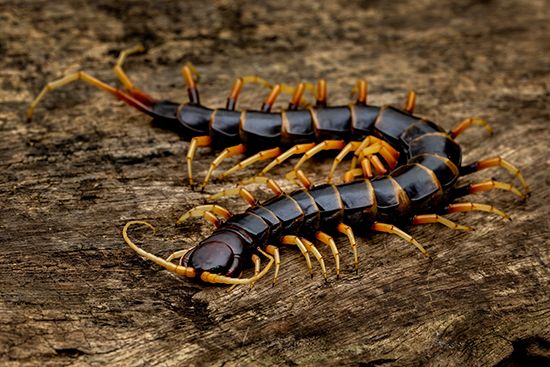
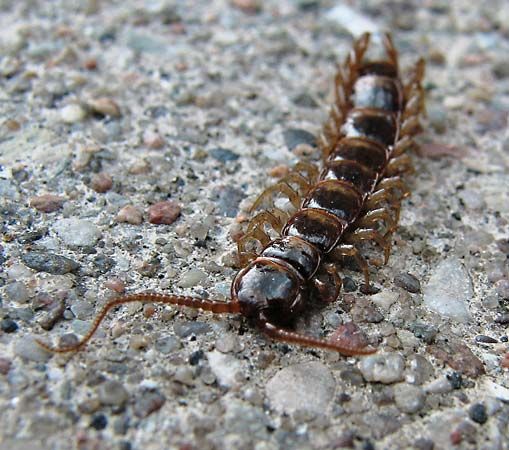
Centipedes are classified as arthropods because they possess the fundamental characteristics that define the phylum Arthropoda. These defining features include:
- Jointed Exoskeleton: Like all arthropods, centipedes have a rigid external skeletal covering composed of chitin and protein1. This exoskeleton provides structural support, protection, and a surface for muscle attachment.12
- Segmented Body: Their bodies are divided into distinct segments. In centipedes, this includes an elongate trunk with many segments, each typically bearing a single pair of jointed legs.314
- Jointed Appendages: The name “arthropod” means “jointed feet.” Centipedes feature paired, jointed appendages adapted for locomotion.32
- Lack of Cilia: Consistent with other members of the phylum, centipedes lack locomotory cilia throughout their life cycle.32
- Internal Anatomy: They exhibit a nervous system consisting of a dorsal brain and a ventral nerve cord, and they utilize tracheae for respiration.1
How many legs do centipedes typically have, and how does this relate to their name?
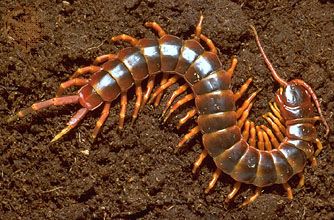
Centipedes typically have between 14 and 177 pairs of legs, with each body segment bearing exactly one pair. Despite the implication of their name—which is derived from the Latin words centum (hundred) and pedis (foot)—the number of legs varies significantly by species and does not strictly equal one hundred.2
While some species may possess a number of legs that approaches this figure, the total count is entirely dependent on the number of segments in the individual’s body. This naming convention is a general descriptor of their multi-legged appearance rather than a precise biological count.2
What are the main differences between centipedes and millipedes?
Centipedes and millipedes are both myriapods, but they exhibit significant biological and behavioral differences:
Physical Structure
- Body Segments: Centipedes have a flattened body with one pair of legs per segment. Millipedes possess diplosomites—double trunk segments formed by the fusion of two segments—resulting in two pairs of legs on most body segments.52
- Legs: Centipedes have between 14 and 177 pairs of legs. Millipedes can have up to 200 pairs of legs.52
- Head Features: Centipedes feature a pair of venomous, jawlike claws behind the head used for hunting. Millipedes have a simpler head structure with antennae, simple eyes, and only a single maxilla.52
Diet and Behavior
- Feeding Habits: Centipedes are active predators that hunt other small invertebrates at night. Most millipedes are detritivores that feed on decaying plant matter, though some are scavengers or predators.52
- Defense: When threatened, centipedes rely on speed and venomous bites. Millipedes generally do not bite; instead, they curl into a tight coil to protect their bodies and may secrete toxic liquids or gases from lateral glands.52
What are some of the largest and smallest species of centipedes?
Centipede sizes vary significantly across the nearly 3,000 known species, ranging from small, house-dwelling varieties to large tropical predators.
Largest Species
The largest centipedes belong to the order Scolopendromorpha, which inhabits tropical regions. The most notable example is Scolopendra gigantea, also known as the Amazonian giant centipede. This species can reach lengths of up to 280 mm (11 inches) and is capable of delivering a severe bite.2
Smallest Species
While many centipedes are relatively small, the house centipede (Scutigeromorpha) is a common example of a smaller species, typically measuring about 25 mm (1 inch) in length. These centipedes are characterized by their short, striped bodies and 15 pairs of very long legs, which allow them to move rapidly. Other groups, such as the little stone centipedes (Lithobiomorpha), are also noted for their short bodies and high speed.2
Sources
- arthropod — Encyclopædia Britannica
- centipede — Encyclopædia Britannica
- arthropod - Annotated classification — Encyclopædia Britannica
- arthropod - Muscles , appendages , and locomotion — Encyclopædia Britannica
- millipede — Encyclopædia Britannica
Published on · 3 min read