Branchiopod
Branchiopods are considered some of the most primitive members of the subphylum Crustacea. They differ from other crustaceans primarily through their…
How do branchiopods differ from other types of crustaceans?
Branchiopods are considered some of the most primitive members of the subphylum Crustacea. They differ from other crustaceans primarily through their specialized body structure and simple internal systems.12
Key distinguishing features include:
- Trunk Limbs: The defining structural characteristic of branchiopods is their flattened, paddlelike trunk limbs. These are typically lobed, broad, and fringed on the inner side, often serving as tools for filter feeding.32
- Simple Anatomy: Compared to more complex crustaceans, branchiopods possess small, simple mouthparts and a primitive nervous system.2
- Body Segmentation: They exhibit a high degree of structural diversity, with many body segments and a variable number of trunk limbs depending on the order.23
- Habitat: While most crustaceans occupy diverse marine environments, the vast majority of branchiopod species are found in fresh water, with many adapted to temporary pools where they survive dry periods as resting eggs.124
What are some common examples of branchiopod species?
The class Branchiopoda includes approximately 800 species of aquatic crustaceans. These animals are generally categorized into several distinct groups based on their morphology and habitat. Common examples include:
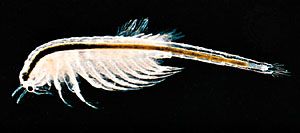
- Fairy Shrimp (Order Anostraca): These elongated crustaceans are known for their graceful swimming and lack of a carapace. Common species include Chirocephalus diaphanus in Europe and Eubranchipus vernalis in North America. The largest living branchiopod, Branchinecta gigas, also belongs to this group.
- Water Fleas (Order Anomopoda): These are small, often microscopic crustaceans found in fresh water worldwide. The most well-known genus is Daphnia, which serves as a vital food source for many fish species. Another notable member is the predatory Leptodora, which has a reduced carapace.
- Tadpole Shrimp (Order Notostraca): Named for their tadpole-like appearance, these crustaceans possess a large, domed carapace and a long, forked tail. They are represented by the genera Triops and Lepidurus.
- Clam Shrimp (Orders Spinicaudata and Laevicaudata): These branchiopods are characterized by a bivalved carapace that encloses their body, giving them a clam-like appearance.
What are the defining characteristics of branchiopod crustaceans?
Branchiopods are a diverse class of Crustacea comprising approximately 800 species, most of which inhabit freshwater environments. As some of the most primitive members of the arthropod subphylum, they exhibit a wide range of structural forms, yet they share several defining characteristics.123
Primary Defining Characteristics
- Trunk Limbs: The most consistent structural feature across both living and fossil branchiopods is the presence of flattened, paddlelike trunk limbs. These limbs are typically lobed, broad, and fringed on the inner side, functioning as multipurpose flaps used for filter feeding, locomotion, and respiration. In some specialized groups, such as the infraorders Onychopoda and Haplopoda, these limbs have evolved to grasp prey.32128
- Body Structure: Branchiopods possess compound eyes and a thin, flexible exoskeleton. While their body segmentation varies significantly—ranging from simple, elongated forms to compressed, short-bodied types—they generally feature multiple body segments and at least four pairs of trunk limbs.2123
- Carapace: Many species possess a protective plate, or carapace, though its form varies widely. It may enclose the entire body, only the trunk, or be reduced to a dorsal brood pouch. Notably, the order Anostraca (fairy shrimp) lacks a carapace entirely.238
- Internal Systems: These crustaceans are characterized by relatively simple mouthparts and a primitive nervous system.2
How are branchiopods used in scientific research or as indicators of environmental health?
Branchiopods, particularly water fleas of the genus Daphnia, are significant in scientific research and environmental management due to their ecological roles and sensitivity to environmental conditions.
Environmental Indicators and Utility
- Water Quality Management: Branchiopods are highly effective at filtering small particles, including bacteria, from the water column. Their ability to consume bacteria makes them essential for natural water purification in reservoirs, where their abundance helps maintain water clarity and quality.13
- Ecological Monitoring: Because many branchiopods are sensitive to environmental shifts, their population dynamics and morphological changes serve as indicators of ecosystem health. For instance, some Daphnia species exhibit seasonal changes in body shape—such as developing pointed heads—in response to water turbulence and temperature, which helps researchers track environmental stressors and predation pressure.13
- Aquaculture and Research: The brine shrimp Artemia is widely utilized in aquaculture, where its immature forms serve as a critical food source for the young of various commercial marine fish. Furthermore, the rapid maturation and unique reproductive strategies of branchiopods, such as parthenogenesis, make them excellent models for studying life-cycle adaptations to extreme or changing environments.41
Sources
- branchiopod — Encyclopædia Britannica
- branchiopod - Distinguishing taxonomic features — Encyclopædia Britannica
- branchiopod - Size range and diversity of structure — Encyclopædia Britannica
- branchiopod - Distribution and abundance — Encyclopædia Britannica
- crustacean - The respiratory system — Encyclopædia Britannica
- Respiratory system - Gills of invertebrates — Encyclopædia Britannica
- fairy shrimp — Encyclopædia Britannica
- branchiopod - Annotated classification — Encyclopædia Britannica
- tadpole shrimp — Encyclopædia Britannica
- water flea — Encyclopædia Britannica
- Cladocera — Merriam-Webster
- branchiopod - External features — Encyclopædia Britannica
- branchiopod - Ecology — Encyclopædia Britannica
- branchiopod - Reproduction and life cycles — Encyclopædia Britannica
Published on · 3 min read