Blue Crab
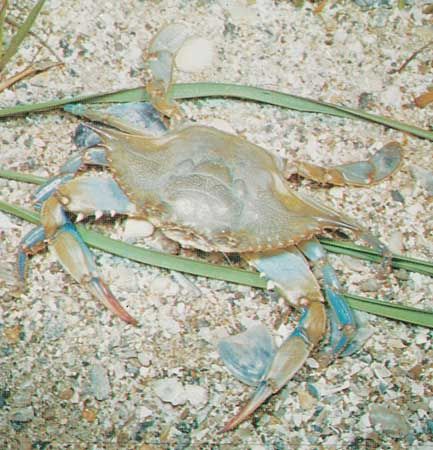
Blue crabs (Callinectes sapidus) are commonly found along the Atlantic and Gulf coasts of North America.
Where are blue crabs commonly found, and what type of habitat do they prefer?
Blue crabs (Callinectes sapidus) are commonly found along the Atlantic and Gulf coasts of North America.12
Regarding their preferred habitat, these crustaceans favor muddy shores, bays, and estuaries. As members of the family Portunidae, they are well-adapted for these environments, possessing a fifth pair of legs that are flattened to function as paddles, allowing them to swim with great dexterity.13
How are blue crabs important to human activities, such as fishing and cuisine?
Blue crabs (Callinectes sapidus) are highly significant to human activities, primarily serving as a major source of seafood and a valuable commercial commodity. Along the Atlantic coast of North America, they are prized as delicacies and are considered one of the most important and valuable species of crab harvested for human consumption.13
Their economic importance is shared by related species in the Indo-Pacific region, such as the swimming crabs of the genera Scylla and Portunus, which are also vital sources of seafood. Because of their status as a popular food source, these crustaceans are the focus of significant fishing efforts, supporting both local economies and broader culinary traditions.31
What is the scientific name of the blue crab, and why is it classified as a crustacean?
The scientific name of the blue crab is Callinectes sapidus.1
Blue crabs are classified as crustaceans because they belong to the subphylum Crustacea, a diverse group of arthropods that includes crabs, lobsters, and shrimp. As members of the order Decapoda, they share the fundamental characteristics of this group, which include a body organized into three distinct regions—the head, thorax, and abdomen—and the presence of five pairs of thoracic legs.45
Their classification is further defined by their developmental biology and physical structure, such as the possession of a carapace (a protective shell covering the cephalothorax) and jointed appendages. While crustaceans exhibit a wide range of forms, they are united by these shared anatomical features and their complex life histories, which typically involve passing through specific larval stages.5617
How do blue crabs use their specialized legs for swimming?
Blue crabs (Callinectes sapidus) are members of the family Portunidae, a group commonly known as swimming crabs. Their ability to swim is primarily due to a specialized adaptation of their anatomy: the fifth, or hindmost, pair of thoracic legs is flattened into paddlelike structures.81
These modified legs serve as the primary means of propulsion, allowing the crab to move through the water effectively. While many other malacostracans rely on abdominal pleopods for swimming, the swimming crabs utilize these paddlelike thoracic appendages to generate the necessary thrust for movement.9
Sources
- blue crab — Encyclopædia Britannica
- blue crab — Merriam-Webster
- crab — Encyclopædia Britannica
- decapod — Encyclopædia Britannica
- List of crustaceans — Encyclopædia Britannica
- crustacean - Size range and diversity of structure — Encyclopædia Britannica
- crustacean - General features — Encyclopædia Britannica
- swimming crab — Encyclopædia Britannica
- malacostracan - Locomotion — Encyclopædia Britannica
- skeleton - Buoyancy devices — Encyclopædia Britannica
Published on · 2 min read