Barnacle
Although barnacles are highly modified for a sedentary life, they are classified as crustaceans based on several key biological and developmental…
What are the main characteristics that define barnacles as crustaceans?
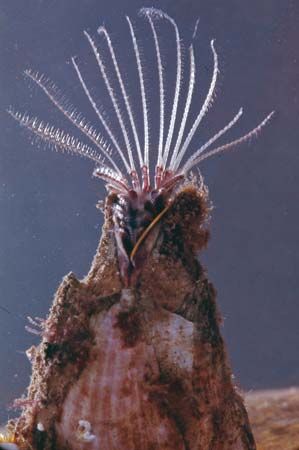
Although barnacles are highly modified for a sedentary life, they are classified as crustaceans based on several key biological and developmental characteristics:
- Larval Stages: Like many other crustaceans, barnacles hatch as free-swimming larvae called nauplii. These larvae possess characteristic cephalic limbs used for swimming and feeding.12
- Metamorphosis: Following the naupliar stages, they undergo a profound metamorphosis into a nonfeeding, free-swimming cyprid larva. This stage is a hallmark of their development, during which they use specialized antennules to explore and eventually cement themselves to a substrate.12
- Appendages: The feathery, retractile organs known as cirri, which adult barnacles use to trap food, are modified thoracic swimming legs typical of crustaceans.12
- Body Plan: While adults are often encased in calcareous plates, these structures are derived from a modified carapace that forms a mantle, a feature common to many crustaceans.3
How did Charles Darwin’s study of barnacles contribute to his theory of evolution?
Charles Darwin’s extensive study of barnacles between 1846 and 1854 was instrumental in establishing his scientific credibility, which was essential before he could publicly present his controversial theory of evolution. By producing four detailed monographs on this diverse group, he transformed his reputation from a mere speculator into a respected expert on species, eventually earning the Royal Society’s Royal Medal in 1853.7
Beyond building his professional standing, the research provided direct biological insights that informed his thinking. Darwin was particularly intrigued by the sexual differentiation he observed, specifically discovering that some female barnacles carried tiny, degenerate males. This observation sparked his interest in the evolutionary transition from original hermaphrodite creatures to diverging male and female forms. This rigorous, hands-on work with a specific group of organisms allowed him to observe the mechanisms of variation and adaptation firsthand, providing a solid empirical foundation for his broader arguments regarding natural selection.7
What are some common misconceptions about barnacles?
Common misconceptions about barnacles often stem from their unusual appearance and historical folklore. Here are some of the most notable misunderstandings:
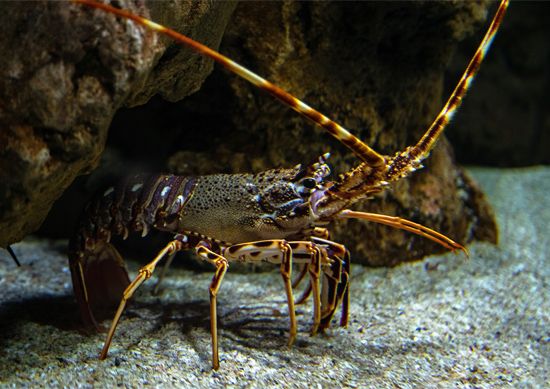
- They are not mollusks: Because barnacles are encased in hard, calcareous shells and are sessile (permanently attached to a surface), they are frequently mistaken for mollusks. In reality, they are highly modified crustaceans, related to crabs and lobsters, a fact confirmed by their larval stages and internal anatomy.12
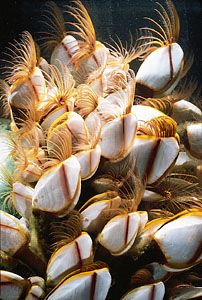
- The “Goose” Myth: During the Middle Ages, a prevalent myth suggested that certain geese developed from goose barnacles found on driftwood. Because the geese’s breeding grounds were unknown, people believed the birds grew out of the wood, with the barnacles’ feathery feeding appendages (cirri) mistaken for goose feathers. This belief was so widespread that the geese were sometimes classified as “shellfish” and permitted to be eaten on religious fasting days.3
- They are not all sessile: While most people recognize the stationary acorn or goose barnacles, the subclass Cirripedia also includes highly specialized parasitic species. For example, members of the order Rhizocephala, such as Sacculina, lack shells, appendages, and guts as adults, instead living as rootlike parasites inside other crustaceans.12
What are some interesting examples of symbiotic relationships involving barnacles?
Barnacles exhibit a fascinating range of symbiotic relationships, spanning from harmless commensalism to highly specialized parasitism. Because they are sedentary, many species have evolved to live on or within other organisms to secure food, protection, or a stable substrate.
Commensalism
Many barnacles are commensal, meaning they benefit from a host without harming it. A well-known example involves barnacles that attach to the bodies of large marine mammals, such as humpback and gray whales. These barnacles gain a mobile platform that transports them through nutrient-rich waters, facilitating easier filter feeding. Similarly, the pseudo-stalked barnacle Xenobalanus globicipitis attaches to the appendages of cetaceans, including dolphins, while other stalked species may even settle on the exposed teeth or tusks of beaked whales.1
Parasitism
Some barnacles have evolved into complex parasites that actively exploit their hosts:
- Rhizocephala: This group, which includes the genus Sacculina, parasitizes decapod crustaceans like crabs. The female barnacle inserts rootlike structures into the host’s body to absorb nutrients. This intrusion often leads to “parasitic castration,” where the host’s reproductive development is inhibited to redirect energy toward the parasite.103
- Burrowing Barnacles: Members of the order Acrothoracica burrow into hard materials, including the shells of mollusks and living coral. For instance, the genus Trypetesa is found exclusively inside snail shells that are already occupied by hermit crabs.103
- Ascothoracica: These primitive parasites embed themselves within cnidarians (such as corals) and echinoderms, maintaining a cypris-like form even as adults.103
Sources
- barnacle — Encyclopædia Britannica
- cirripede - Reproduction and life cycles — Encyclopædia Britannica
- cirripede - Diversity and distribution — Encyclopædia Britannica
- decapod — Encyclopædia Britannica
- crustacean - General features — Encyclopædia Britannica
- cirripede - The reproductive system — Encyclopædia Britannica
- Charles Darwin - The squire naturalist in Downe — Encyclopædia Britannica
- cirripede - Evolution and paleontology — Encyclopædia Britannica
- cirripede - Importance to humans — Encyclopædia Britannica
- cetacean - Diseases and parasitism — Encyclopædia Britannica
Published on · 4 min read