Amphitrite
In Greek mythology, Amphitrite is recognized as the goddess of the sea and the consort of Poseidon.
How was Amphitrite depicted in ancient Greek art and literature?
In Greek mythology, Amphitrite is recognized as the goddess of the sea and the consort of Poseidon.12
Depictions in Art
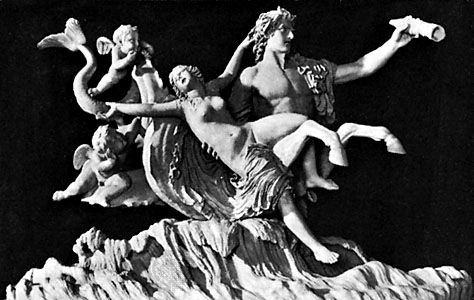
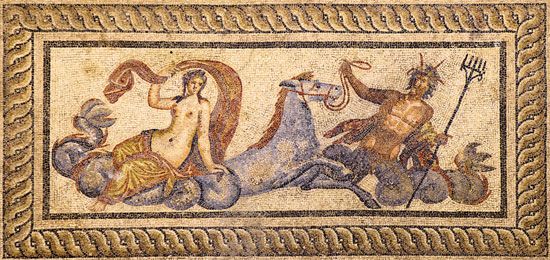
In ancient artistic representations, Amphitrite is typically shown in the company of her husband. Common depictions include:
- Enthroned: She is often portrayed seated on a throne beside Poseidon.1
- Chariot Scenes: She is frequently depicted riding in a chariot alongside Poseidon, which is drawn by sea horses or other mythical marine creatures.1
- Ceremonial Roles: She appears in significant mythological scenes, such as the wedding of Peleus and Thetis, as seen on the famous 6th-century BCE François Vase.1
- Statuary: Some scholars have suggested that the famous Venus de Milo may represent Amphitrite rather than Aphrodite, given its discovery on the island of Melos.3
Depictions in Literature
Amphitrite is identified as one of the Nereids, the daughters of Nereus and Doris. Literature recounts her initial flight from Poseidon’s marriage proposal and her eventual return after being retrieved by a dolphin, an act for which Poseidon honored the creature by placing it among the constellations.12
How did Amphitrite’s role compare to that of other female Olympian goddesses?
Amphitrite’s role differs significantly from that of the major female Olympian goddesses, such as Hera, Athena, or Demeter, primarily because she is not considered an Olympian herself. While she is a powerful deity of the sea, her status is defined by her lineage as a Nereid—a daughter of the sea god Nereus—and her role as the consort of Poseidon.14
Unlike the Olympian goddesses who often hold distinct domains of governance over human affairs, civilization, or the natural order of the earth and sky, Amphitrite’s identity is inextricably linked to her husband’s marine realm. While goddesses like Hera or Athena are central figures in the political and social power struggles of the Olympian pantheon, Amphitrite is typically depicted in a secondary or supportive capacity, often appearing in art enthroned beside Poseidon or accompanying him in his chariot.16
Furthermore, while Olympian goddesses are frequently the subjects of complex myths involving their own independent actions, conflicts, and cult worship, Amphitrite’s narrative is largely centered on her marriage to Poseidon and her role as the mother of their offspring, such as Triton.16
How did the worship of Amphitrite evolve over time in ancient Greek culture?
The available information does not provide a detailed historical account of how the worship of Amphitrite specifically evolved over time within ancient Greek culture.
While we know that Amphitrite was a significant figure in Greek mythology as the sea-goddess consort of Poseidon, the provided records focus primarily on her mythological origins as a Nereid and her depictions in art alongside her husband. There is also evidence of her later identification with the Roman goddess Salacia, who was originally associated with fresh water before being equated with Amphitrite as the Roman pantheon adopted Greek marine deities.
Beyond these mythological and comparative associations, the Britannica knowledge base does not contain specific details regarding the chronological evolution of her cult or religious practices in ancient Greece.
How did Amphitrite’s relationship with Poseidon affect the lives of sailors and fishermen in ancient Greece?
In ancient Greek culture, the relationship between Amphitrite and Poseidon served as a foundational element of the mythological framework that sailors and fishermen navigated. While Poseidon was the primary deity governing the sea, earthquakes, and storms, Amphitrite was recognized as his consort and a powerful sea goddess in her own right, often depicted accompanying him in his chariot or enthroned by his side.17
For those who relied on the sea for their livelihood, the divine couple represented the unpredictable and often volatile nature of the marine environment. Poseidon’s power was absolute and frequently dangerous; his enmity, as famously depicted in the Odyssey, could result in shipwrecks, long delays, and disaster for sailors. Because the Greeks believed in a reciprocal relationship with their gods, sailors and fishermen performed sacrifices and rituals to appease these deities, seeking to secure safe passage and bountiful catches through piety and offerings.79
While Amphitrite was considered a Nereid—a group generally viewed as benign toward humanity—her union with the formidable Poseidon placed her at the center of the divine authority that controlled the dangers of the deep.4
Sources
- Amphitrite — Encyclopædia Britannica
- Aphrodite — Encyclopædia Britannica
- Amphitrite — Merriam-Webster
- Nereid — Encyclopædia Britannica
- Venus de Milo — Encyclopædia Britannica
- Nereus — Encyclopædia Britannica
- Poseidon — Encyclopædia Britannica
- Neptune — Encyclopædia Britannica
- Atlantis: Top Questions — Encyclopædia Britannica
- Greek religion — Encyclopædia Britannica
- Greek religion - Religious art and iconography — Encyclopædia Britannica
Published on · 3 min read