Nereus
In Greek religion, Nereus is a sea god often referred to as the "Old Man of the Sea." He is recognized for his wisdom, his gift of prophecy, and his ability…
What is Nereus?
In Greek religion, Nereus is a sea god often referred to as the “Old Man of the Sea.” He is recognized for his wisdom, his gift of prophecy, and his ability to shapeshift.12
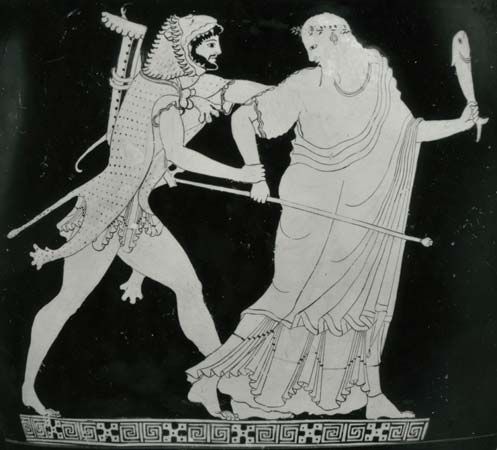
The son of Pontus (a personification of the sea) and Gaea (the Earth goddess), Nereus resided in the depths of the sea with his daughters, the Nereids. He is famously associated with the hero Heracles, who had to wrestle Nereus through his various forms to obtain directions during his quest for the golden apples of the Hesperides. Additionally, Nereus served as a teacher to Aphrodite, the goddess of love. In artistic depictions, such as vase paintings, he is typically portrayed as a dignified spectator.1
Who are the Nereids and what role do they play in mythology?
In Greek religion, the Nereids are the daughters of the sea god Nereus and the Oceanid Doris. Numbering either 50 or 100, these water nymphs were traditionally depicted as young girls who inhabited both salt and fresh water.24
The Nereids were viewed as benign figures toward humanity and were popular subjects in Greek literature. They lived in the depths of the sea, particularly the Aegean, alongside their father. Several Nereids hold significant roles in mythology:24
- Amphitrite: The consort of Poseidon, the god of the sea and earthquakes.2
- Thetis: The wife of Peleus and mother of the legendary hero Achilles.2
- Galatea: A figure from Sicily who was loved by the Cyclops Polyphemus.2
How does Nereus differ from Poseidon as a sea god?
While both are associated with the sea in Greek religion, Nereus and Poseidon represent distinct roles and origins within mythology.
Nereus is known as the “Old Man of the Sea,” a primordial figure who embodies the wisdom and prophetic nature of the deep. He is the son of Pontus (the personification of the sea) and Gaea, and he is primarily characterized by his ability to shapeshift and his role as a source of knowledge for heroes like Heracles. He is typically depicted as a dignified, stationary figure residing in the depths of the Aegean.1
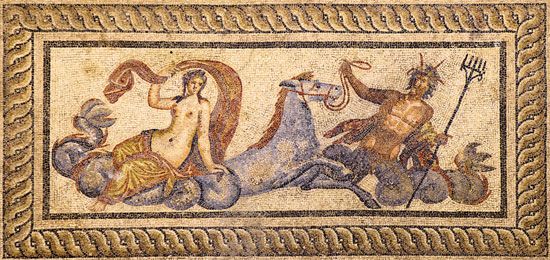
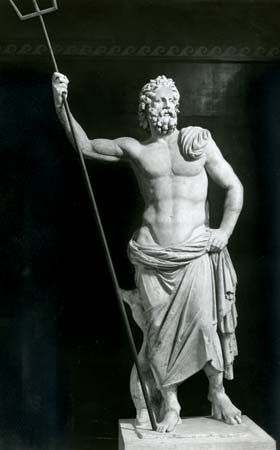
Poseidon, by contrast, is one of the 12 Olympians and a powerful, active deity who governs not only the sea but also earthquakes and horses. Unlike the more localized Nereus, Poseidon is a central figure in the divine order, having helped overthrow Cronus to claim dominion over the waters. He is frequently involved in conflicts with other gods and mortals, wielding a trident as his primary symbol of power.62
What other shapeshifting figures appear in Greek myths?
Shapeshifting is a recurring theme in Greek mythology, often serving as a means for gods to deceive others, escape capture, or protect themselves.
Divine Shapeshifters
- Proteus: Like Nereus, Proteus is a prophetic “Old Man of the Sea.” He famously resisted those seeking his knowledge by rapidly cycling through various forms until he was held fast, at which point he would return to his true shape to provide answers.89
- Zeus: The king of the gods frequently used animal disguises to pursue his interests. He famously appeared as a cuckoo to approach Hera, a swan to woo Leda, and a bull to abduct Europa.1011
- Poseidon: The sea god once assumed the form of a stallion to sire the mythical horses Arion and Pegasus.11
Metamorphosis of Mortals
Transformations were also frequently imposed upon mortals, often as punishment or protection:
Sources
- Nereus — Encyclopædia Britannica
- Nereid — Encyclopædia Britannica
- Nereus — Merriam-Webster
- Nereid — Merriam-Webster
- Nereids — Merriam-Webster
- Poseidon: Top Questions — Encyclopædia Britannica
- Poseidon — Encyclopædia Britannica
- Proteus — Encyclopædia Britannica
- Did you know? — Merriam-Webster
- Greek mythology - Other types — Encyclopædia Britannica
- Zeus - Zeus’s lovers — Encyclopædia Britannica
- Greek mythology - Myths involving animal transformations — Encyclopædia Britannica
Published on · 3 min read