Poseidon
In ancient Greek religion, Poseidon was a powerful deity whose symbols and attributes reflected his dominion over the sea, earthquakes, and horses.
What were Poseidon’s main symbols and attributes, and how were they significant?
In ancient Greek religion, Poseidon was a powerful deity whose symbols and attributes reflected his dominion over the sea, earthquakes, and horses.
Key Symbols and Attributes
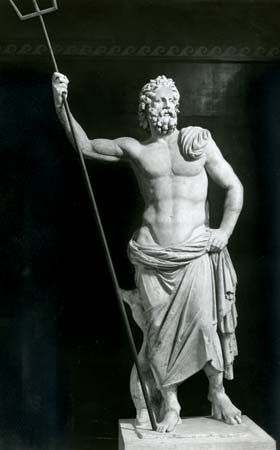
- The Trident: Poseidon’s primary weapon and symbol, said to have been fashioned by the Cyclopes. It likely originated as a fish spear, symbolizing his authority over the marine realm.1
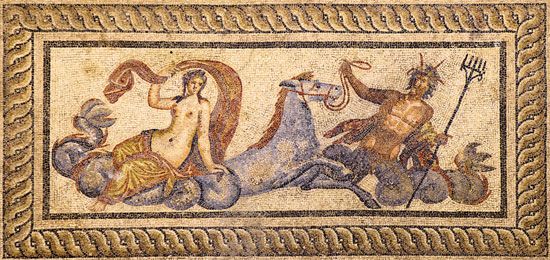
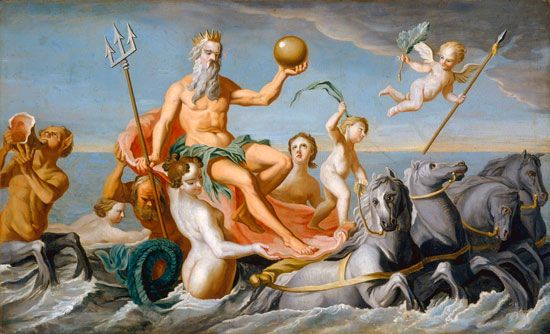
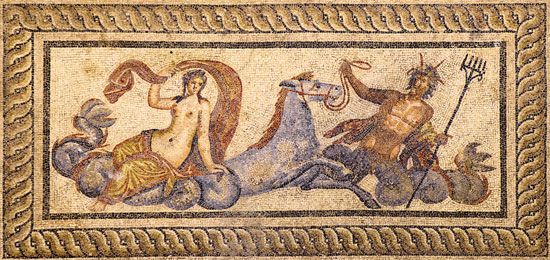
- Horses: As the god of horses, he was often depicted in a chariot drawn by hippocampi (mythical sea-horses). He was frequently worshipped as hippios (“of horses”) and was credited with the creation of the horse in various myths.1
- Marine Life: He was closely associated with dolphins and other sea creatures, which often accompanied his depictions in art.1
- Bulls: Poseidon maintained a strong connection to bulls, often using them as instruments of his divine wrath or power.1
Significance
These attributes defined his volatile nature. As the “earth-shaker” (enosichthōn), he held power over the land, while his role as a sea god made him a formidable force for sailors and heroes like Odysseus. His symbols were central to his worship, particularly at the Isthmia, where athletic contests and horse races honored his influence.1
What were some of the creatures associated with Poseidon?
In Greek mythology, Poseidon was associated with a wide variety of creatures, ranging from common animals to legendary monsters. These associations often reflected his dual nature as a god of the sea and of horses.
Mythical Creatures
- Hippocampi: These were mythical, horse-like sea creatures often depicted pulling Poseidon’s chariot.1
- Triton: The son of Poseidon and Amphitrite, he is a well-known sea creature often associated with his father.1
- Pegasus: The famous winged horse was born from the union of Poseidon and Medusa.1
- Arion: An immortal and extraordinarily swift horse sired by Poseidon when he took the form of a stallion to pursue Demeter.1
- Sea Monsters: Poseidon was known to command various sea monsters, such as the one he sent to ravage Troy after King Laomedon broke his promise.1
Animals and Other Beings
- Horses: Poseidon is widely recognized as the god of horses and is credited in some myths with their creation.1
- Dolphins: These marine animals were frequent companions in his artistic depictions and were said to have been created by him for his wife, Amphitrite.1
- Bulls: Poseidon maintained a strong connection to bulls, often using them as symbols of his power or as instruments of divine retribution, such as the bull that led to the birth of the Minotaur.1
- Other Land Animals: In some traditions, he was associated with the creation of the hippopotamus, zebra, donkey, and camel.1
What are some famous myths or stories involving Poseidon?
Poseidon, the Greek god of the sea, earthquakes, and horses, is central to many foundational myths. His stories often highlight his volatile nature and his complex relationships with both gods and mortals.51
Notable Myths and Stories
- Contest for Athens: Poseidon competed against Athena for patronage of the city. He struck a rock to create a spring of salt water (or, in some versions, the first horse), but the citizens chose Athena’s gift of the first olive tree.16
- The Odyssey: After the Trojan War, Poseidon sought vengeance against Odysseus for the blinding of his son, the Cyclops Polyphemus. He delayed the hero’s return to Ithaca for ten years, causing numerous shipwrecks and disasters.1
- Medusa’s Transformation: Poseidon assaulted Medusa in a temple dedicated to Athena. Enraged by the desecration, Athena transformed Medusa into a monster with snakes for hair.57
- Atlantis: According to Plato, Atlantis was Poseidon’s domain. He protected the island and established laws for the descendants of his union with the mortal woman Cleito.8
- The Walls of Troy: After a failed coup against Zeus, Poseidon was sentenced to serve the mortal King Laomedon by building the walls of Troy. When the king refused to pay, Poseidon sent a sea monster to ravage the city.1
How did Poseidon’s influence extend to earthquakes and horses?
In ancient Greek mythology, Poseidon’s influence over earthquakes and horses was deeply rooted in his identity as a powerful deity whose domain extended beyond the sea to the land itself.15
God of Earthquakes
As the god of earthquakes, Poseidon was known by the epithets enosichthon and ennosigaios, both meaning “earth-shaker.” His connection to the land was significant, and many of his oldest places of worship were located inland, often centered around pools, streams, or other water sources. Despite his destructive potential as an earth-shaker, he was also worshipped as asphalios, or “stabilizer,” reflecting a belief in his power to both cause and calm seismic activity.1
God of Horses
Poseidon’s association with horses is believed to have been introduced to Greece by the earliest Hellenes, who brought the first horses to the region. He was frequently linked to the creation of horses, with some myths suggesting he created them to win the favor of the goddess Demeter. He was also a divine progenitor, fathering famous horses like Pegasus and Arion. In Attica, he was specifically worshipped as hippios (“of horses”), and horse races were a prominent feature of the Isthmian Games, a major festival held in his honor.1
Sources
- Poseidon — Encyclopædia Britannica
- bull cult — Encyclopædia Britannica
- hippocamp — Merriam-Webster
- hippocampus — Merriam-Webster
- Poseidon: Top Questions — Encyclopædia Britannica
- Athena - Punishment of Medusa — Encyclopædia Britannica
- Atlantis: Top Questions — Encyclopædia Britannica
- Athena - Patron of Athens — Encyclopædia Britannica
Published on · 4 min read