Neptune
In Roman religion, Neptune was originally worshipped as a god of fresh water. By 399 BCE, he became identified with the Greek god Poseidon, which…
Who was Neptune in Roman mythology and what was his role among the gods?
In Roman religion, Neptune was originally worshipped as a god of fresh water. By 399 BCE, he became identified with the Greek god Poseidon, which transitioned his role to that of a deity of the sea.1
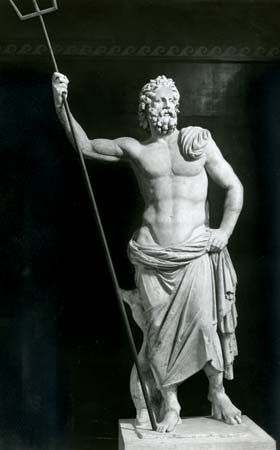
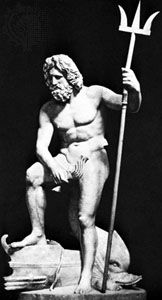
As a sea god, Neptune is traditionally depicted with a trident and a dolphin. His significance in Roman life was marked by the Neptunalia, a festival held on July 23 during the height of summer. Because this period was characterized by water scarcity, the festival likely served to propitiate the god in his original capacity as a provider of fresh water.1
In mythology, Neptune is recognized as a son of the Titan Cronus and a brother to Jupiter. His female counterpart was Salacia, who was associated with leaping springwater and later equated with the Greek goddess Amphitrite.21
How does Neptune compare to his Greek counterpart, Poseidon?
While Neptune and Poseidon are often equated, their origins and roles in their respective mythologies differ significantly.
Neptune was originally a Roman god of fresh water. It was not until 399 BCE that he was identified with the Greek Poseidon, leading to his adoption as a deity of the sea. His Roman festival, the Neptunalia, held during the heat of summer when water was scarce, reflects his primary role as a provider of fresh water rather than a maritime ruler.4
In contrast, Poseidon was a central figure in Greek religion as one of the 12 Olympians. Beyond the sea, he was widely worshipped as the god of earthquakes and horses. His mythology is extensive, featuring complex relationships with other gods, such as his rivalry with Zeus and Athena, and his role in epic tales like the Odyssey. While the Romans adopted Poseidon’s artistic attributes—such as the trident and dolphin—they largely ignored the broader, more volatile aspects of his Greek character.154
What were the main symbols and attributes associated with Neptune?
In Roman mythology, Neptune is primarily associated with symbols that reflect his role as a deity of the sea and water. Following his identification with the Greek god Poseidon, his artistic representations became largely synonymous with those of his Greek counterpart.6
The main symbols and attributes associated with Neptune include:
- The Trident: This three-pronged spear is his most iconic symbol. Historically used for spearing fish, the trident serves as a powerful emblem of his authority over the waters. Its significance was such that it was even adopted by the retiarius, a type of Roman gladiator who fought using a trident and a net to mimic a fisherman.16
- The Dolphin: Often depicted alongside him in art, the dolphin serves as a visual marker of his dominion over marine life and the sea.6
- Marine Deities: Neptune is frequently portrayed in the company of other sea-related figures, such as his son Triton, who is also often shown carrying a trident and riding in a chariot drawn by seahorses.67
How did the Romans depict Neptune in their art and architecture?
In Roman art and architecture, Neptune was primarily depicted through the lens of his Greek counterpart, Poseidon. Following his identification with the Greek god in 399 BCE, Roman artistic conventions adopted the established iconography of the sea deity.1
Artistic Depictions
In visual arts, Neptune is consistently portrayed with the attributes of the Greek sea god, most notably the trident and the dolphin. Artists frequently depicted him as a powerful figure of the sea, often shown in a chariot drawn by hippocampi—mythical horse-like sea creatures—and accompanied by various marine life.14
Architectural Context
Architectural representations of Neptune were often integrated into sacred spaces dedicated to his worship. A notable example was his temple located in the Circus Flaminius in Rome. A defining feature of this temple was a sculptural group depicting a collection of marine deities, with Neptune and Thetis serving as the central figures.1
Sources
- Neptune — Encyclopædia Britannica
- Nereus — Encyclopædia Britannica
- Neptune — Encyclopædia Britannica
- Poseidon — Encyclopædia Britannica
- Poseidon: Top Questions — Encyclopædia Britannica
- Did you know? — Merriam-Webster
- triton and Mermaids — Merriam-Webster
Published on · 3 min read