Aneurophyton
Aneurophyton is a genus of extinct plants that existed during the Middle and Late Devonian epochs, approximately 398 to 359 million years ago. It is widely…
What is Aneurophyton?
Aneurophyton is a genus of extinct plants that existed during the Middle and Late Devonian epochs, approximately 398 to 359 million years ago. It is widely regarded as a basal member of the progymnosperms, a group considered the likely ancestors of seed plants.1
Structurally, Aneurophyton featured an upright, nonwoody stem with spirally arranged lateral branches. While some branches bore terminal clusters of sporangia and others were specialized for photosynthesis, the plant lacked true leaves, as tissue had not yet filled the spaces between its branches. Its basic design shares similarities with earlier Devonian plants like Psilophyton and Pertica and is believed to have contributed to the evolutionary development of ferns, horsetail relatives, and seed plants.1
What are progymnosperms?
Progymnosperms (division Progymnospermophyta) are an extinct group of fossil plants that are widely considered the probable ancestors of seed plants. They flourished during the Devonian Period, approximately 398 to 359 million years ago.12
Key characteristics of progymnosperms include:
- Evolutionary Significance: They represent a critical link in plant evolution, possessing a combination of features that bridge the gap between earlier, simpler vascular plants and the later, more complex seed-bearing plants.12
- Structural Features: The best-known member, Archaeopteris, is often cited as the first true tree. It featured wood composed of tracheids and vascular rays, similar to that of modern conifers.12
- Reproduction: While they were spore-bearing, at least some species were heterosporous—meaning they produced two distinct types of spores (microspores and megaspores)—a necessary evolutionary precursor to the development of the seed habit.2
- Diversity: The group included a range of forms, from the relatively simple, nonwoody Aneurophyton to the more complex, tree-like Archaeopteris.12
How did early plants evolve into modern trees?
The evolution of modern trees from early land plants was a gradual process marked by significant structural and reproductive innovations that allowed plants to overcome size limitations and colonize diverse environments.6
Early Colonization and Vascular Development
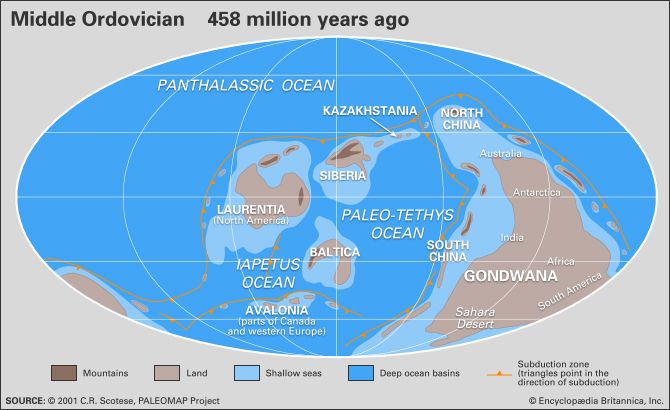
The earliest land plants, appearing by the Ordovician Period, were small, nonvascular, or simple vascular organisms like Cooksonia. These early plants lacked true roots, stems, and leaves, relying on simple forking axes to survive in moist habitats. The evolution of tracheids—specialized water-conducting cells—was a critical breakthrough that defined tracheophytes and enabled the development of larger plant bodies.67
Overcoming Size Limitations
Early vascular plants were restricted in height because they lacked the ability to thicken their stems. The transition to tree-like forms required two major evolutionary developments:6
- Secondary Growth: The evolution of the vascular cambium allowed plants to produce wood (secondary xylem), which provided the structural support necessary for vertical growth.68
- Rooting Systems: The independent evolution of downward-growing central rooting systems provided the anchorage and water-harvesting capacity required to support massive tree canopies.6
Reproductive Innovations
While early plants relied on a homosporous life cycle that required water for fertilization, the evolution of heterospory and eventually seeds allowed plants to reproduce independently of standing water. This shift enabled gymnosperms to colonize drier habitats, leading to the rise of vast forests by the Carboniferous Period. Later, the emergence of angiosperms (flowering plants) in the Cretaceous Period introduced further complexity, such as specialized pollination and seed dispersal, leading to the modern dominance of flowering trees.69
What was the Devonian Period like for plant life?
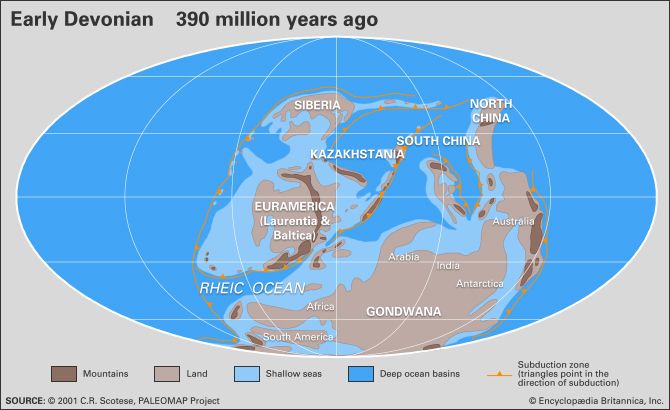
The Devonian Period (approximately 419.2 to 358.9 million years ago) was a transformative era for plant life, marked by the rapid diversification and dominance of vascular plants.1314
Key Developments in Devonian Flora
- Colonization of Land: While simple vascular plants like Cooksonia appeared in the Late Silurian, the Devonian saw a remarkable initiation of diverse plant types. This period is widely considered the time when the exploitation of land environments truly began.13
- Rise of Forests: The first known evidence of in-place forests dates to the Middle Devonian. By the Late Devonian, large trees such as Archaeopteris—which could reach diameters of up to 1.8 meters—had emerged, establishing the earliest forest ecosystems.1513
- Evolutionary Diversity: The period featured a wide array of plant groups, including bryophytes, pteridophytes (such as the primitive Psylotophytopsida), and early gymnosperms. These plants evolved from simple, naked-stemmed forms to more complex structures with lateral branching and leafy stems.13
The warm, equable climate of the Devonian supported this terrestrial expansion, with fossil evidence preserved in unique sites like the Rhynie Chert of Scotland.1613
Sources
- Aneurophyton — Encyclopædia Britannica
- gymnosperm - Evolution and paleobotany — Encyclopædia Britannica
- progymnosperm — Merriam-Webster
- gymnosperm - Annotated classification — Encyclopædia Britannica
- plant - Gymnosperms — Encyclopædia Britannica
- plant - Evolution of land plants from the Ordovician Period through the middle Devonian — Encyclopædia Britannica
- plant - Evolution of seed plants and plant communities — Encyclopædia Britannica
- gymnosperm - Appearance of gymnosperm divisions — Encyclopædia Britannica
- tree - General features of the tree body — Encyclopædia Britannica
- tree - Tree height growth — Encyclopædia Britannica
- phylogeny - Evolution of land plants — Encyclopædia Britannica
- plant - Evolution and paleobotany — Encyclopædia Britannica
- Devonian Period - Devonian life — Encyclopædia Britannica
- Devonian Period - Paleoclimate — Encyclopædia Britannica
- Devonian Period - Plants — Encyclopædia Britannica
- Devonian Period — Encyclopædia Britannica
Published on · 3 min read