Archaeopteris
Archaeopteris is a genus of extinct plants that lived during the Late Devonian Period, approximately 385 to 359 million years ago. It is widely considered…
What is Archaeopteris?
Archaeopteris is a genus of extinct plants that lived during the Late Devonian Period, approximately 385 to 359 million years ago. It is widely considered the first true tree to form forests.1
While Archaeopteris possessed a woody trunk and branching patterns reminiscent of modern conifers, it featured fernlike foliage and reproduced via spores rather than seeds. Its reproductive system involved two distinct spore sizes—megaspores and microspores—which has led some researchers to suggest a close evolutionary relationship with seed plants. These plants typically inhabited river floodplains and coastal lowlands before going extinct at the end of the Devonian. Although historically classified as ferns, they are now often associated with the order Cycadofilicales.12
What defines the Devonian Period?
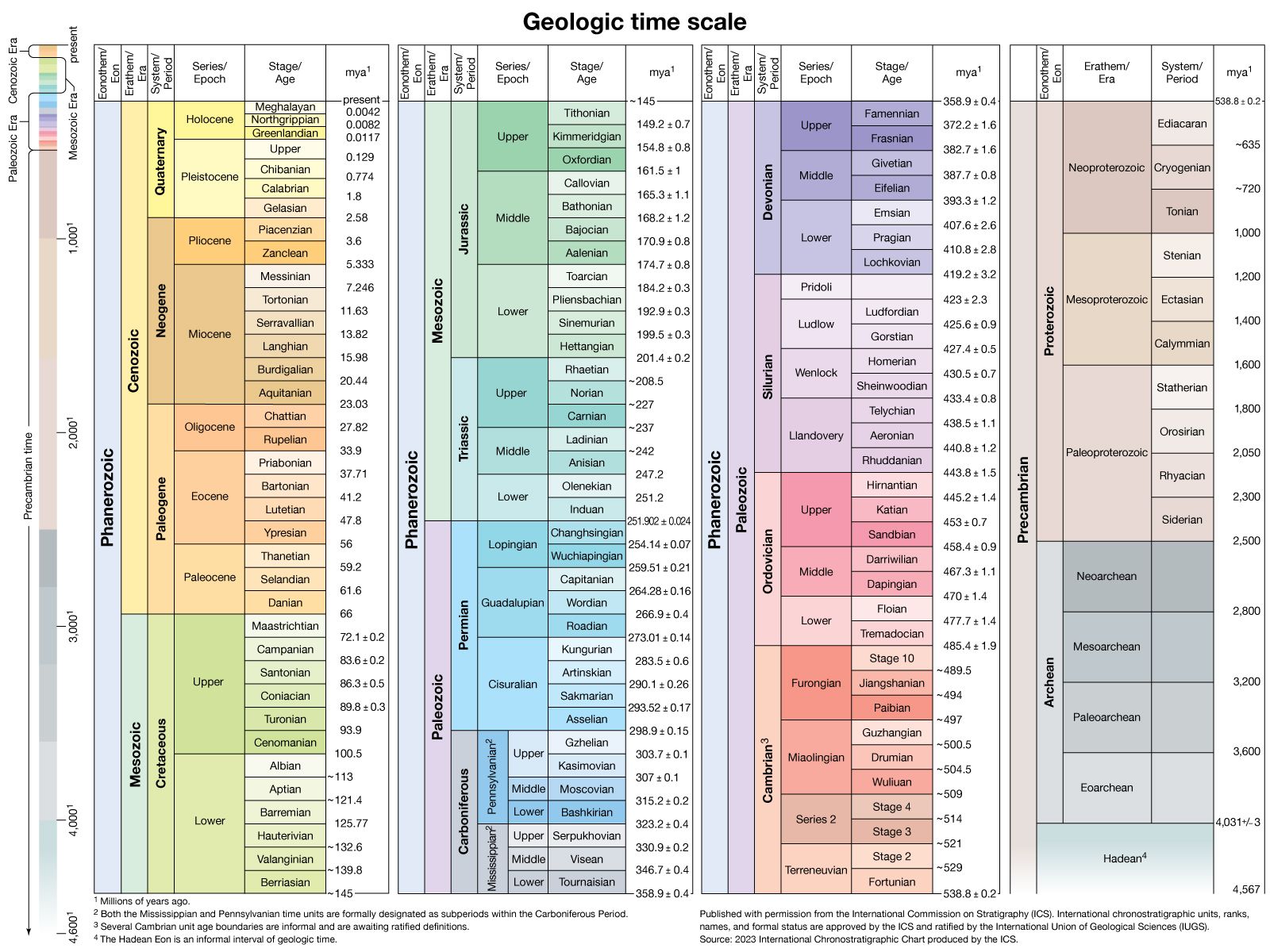
The Devonian Period is a major interval of the Paleozoic Era spanning approximately 419.2 to 358.9 million years ago. Often called the “Age of Fishes,” it is defined by the following key characteristics:34
Biological Milestones
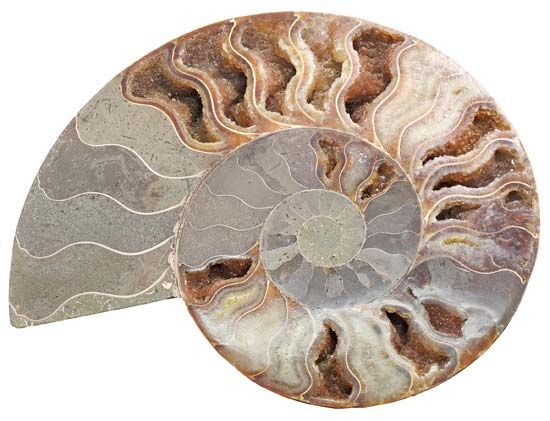
- Evolutionary Radiation: The period saw the first appearance of forests and ammonites.34
- Vertebrate Colonization: By the late Devonian, the first four-legged amphibians emerged, marking the transition of vertebrates onto land.34
- Marine Life: The seas were dominated by diverse and abundant fish, though the period also experienced significant extinction events that eliminated 70 to 80 percent of marine species due to oxygen-depleted (anoxic) waters.35
Geography and Climate
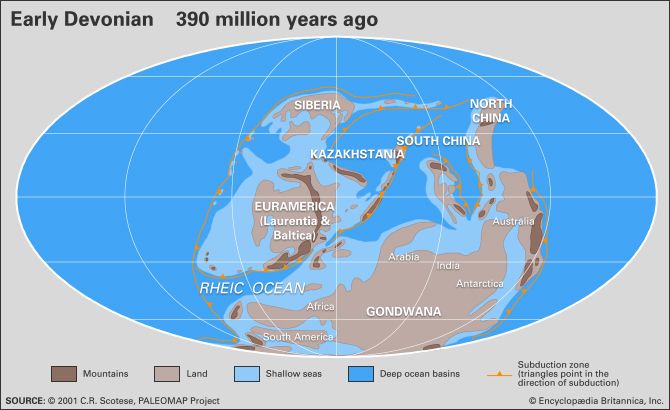
- Continental Configuration: The Northern Hemisphere landmass of Laurussia (or Euramerica) formed through the collision of Laurentia and Baltica, while the southern continents were united as Gondwana5.4
- Environment: Approximately 85 percent of the globe was covered by oceans. The climate was generally warm and equitable, with limited evidence of polar ice caps.346
- Geology: The period is noted for the Old Red Sandstone, a vast sequence of terrestrial deposits documenting early land colonization.74
How do spores differ from seeds?
Spores and seeds are both reproductive units, but they differ significantly in their structure, function, and evolutionary complexity.
Key Differences
- Composition: A spore is a single reproductive cell capable of developing into a new individual. In contrast, a seed is a complex structure containing an embryonic plant (sporophyte), a supply of food-storage tissue, and a hardened protective covering known as the seed coat.89
- Survival and Dispersal: Seeds represent a major evolutionary advancement over spores. Because they contain stored nutrients and a protective coat, seeds have a much higher capacity for survival and can remain dormant until conditions are favorable for growth. Spores generally have a more limited capacity for survival in harsh environments.9
- Life Cycle: In non-seed plants like ferns and mosses, spores are released to grow into a free-living gametophyte. In seed plants (gymnosperms and angiosperms), spores are not released; they develop into microscopic gametophytes that remain entirely dependent on the parent plant.89
- Reproductive Strategy: Spores are agents of asexual reproduction, whereas seeds are the product of sexual reproduction, facilitating genetic recombination and the distribution of species.8910
What are the main differences between ferns and conifers?
Ferns and conifers represent two distinct evolutionary strategies in the plant kingdom. The primary differences between them lie in their reproductive methods, life cycles, and structural complexity.
Reproductive Differences
- Spores vs. Seeds: Ferns are seedless vascular plants that reproduce via spores, which are single cells with limited survival capacity. Conifers are gymnosperms that reproduce using seeds. A seed is a complex structure containing an embryonic plant, food-storage tissue, and a protective coat, allowing for greater survival and dispersal.98
- Life Cycle: In ferns, the gametophyte is a free-living, independent plant body that requires moisture for fertilization, as the sperm must swim to the egg. In conifers, the gametophyte is microscopic and entirely dependent on the parent sporophyte. Furthermore, conifers utilize pollen to transport sperm, eliminating the need for external water for fertilization.912
Structural and Growth Differences
- Leaf Morphology: Fern leaves (pteridophylls) typically expand from a curled “fiddlehead” (circinate vernation) and often feature a central midrib with lateral veins. Conifer leaves are typically simple, needlelike, or scalelike, often lacking a complex midrib.13
- Vascular Tissue: Conifers exhibit secondary growth, which produces wood (secondary xylem) via vascular cambium, allowing the stem to increase in width. While some ferns can grow into trees, they generally lack this specific type of secondary wood production.914
Sources
- Archaeopteris — Encyclopædia Britannica
- Archaeopteris — Merriam-Webster
- A Journey Through Time Since the Precambrian - Devonian Period: 419.2 million to about 359 million years ago — Encyclopædia Britannica
- Devonian Period - Paleoclimate — Encyclopædia Britannica
- Devonian Period - Significant geologic events — Encyclopædia Britannica
- Devonian Period - Extinction events — Encyclopædia Britannica
- Devonian Period — Encyclopædia Britannica
- spore — Encyclopædia Britannica
- plant - Seed plants — Encyclopædia Britannica
- seed dispersal — Encyclopædia Britannica
- seed - The shape of dispersal units — Encyclopædia Britannica
- fern - Comparisons with leaves of other plant groups — Encyclopædia Britannica
- tree - Phylogenetic classifications — Encyclopædia Britannica
- fern - Ecology — Encyclopædia Britannica
- plant reproductive system - Ferns — Encyclopædia Britannica
- conifer - Sporophyte phase — Encyclopædia Britannica
Published on · 3 min read