Ordovician Period
Advancements in geochronological techniques have significantly refined our understanding of the Ordovician Period, moving beyond traditional fossil-based…
How has our understanding of the Ordovician Period changed with advancements in geochronological techniques?
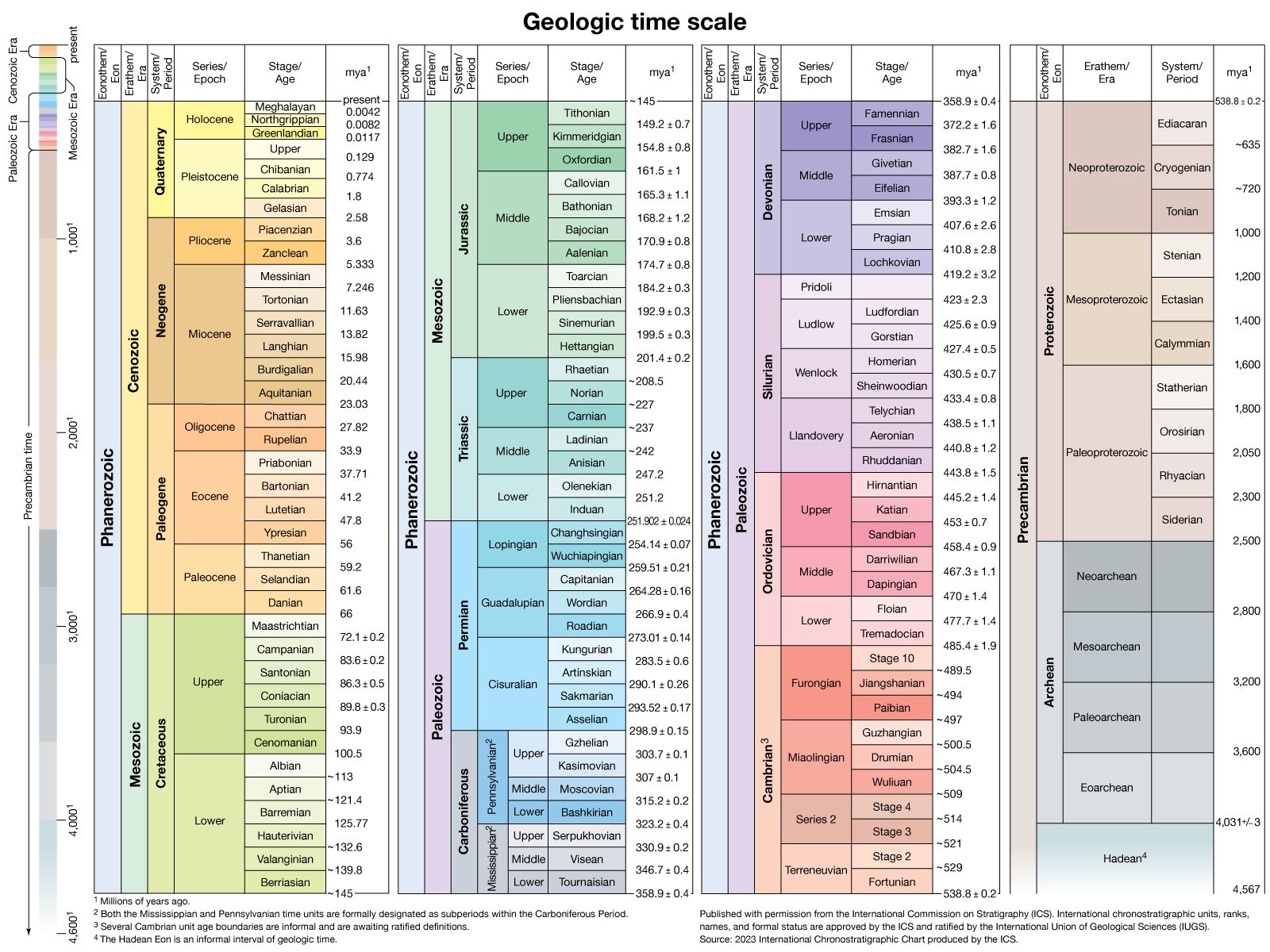
Advancements in geochronological techniques have significantly refined our understanding of the Ordovician Period, moving beyond traditional fossil-based correlation toward more precise, absolute dating and geochemical analysis.
Historically, correlation of Ordovician strata relied heavily on fossils, such as graptolites and conodonts, which were often limited by geographic provinciality. Modern geochronology has improved this through:1
- High-Precision Isotopic Dating: The use of uranium-lead dating on zircon grains—facilitated by breakthroughs like isotope dilution and mass spectrometry—allows for more accurate absolute ages of volcanic ash beds, which serve as critical temporal markers.123
- Geochemical Correlation: Scientists now use oxygen and carbon isotopes to track global climate shifts, helping to resolve the timing of glacial events and sea-level changes that were previously difficult to synchronize globally.145
- Micro-Analysis: Techniques like the sensitive high-resolution ion microprobe (SHRIMP) and laser ablation allow researchers to date individual mineral grains in place, providing insights into the complex history of rock formation and secondary reheating events.23
These tools have helped clarify the timing of the Ordovician’s major environmental and biological shifts, including the duration of its terminal glaciation.5
What role do index fossils play in Ordovician geochronology?
In Ordovician geochronology, index fossils serve as essential tools for defining geologic time boundaries and correlating strata across different regions9. To be effective, these fossils must be abundant, easily recognizable, widely distributed, and possess a short temporal range, allowing them to act as markers for specific intervals of geologic time.92
In the context of the Ordovician System, the following organisms are particularly significant:
- Graptolites: These small, colonial planktonic animals are the most widely used fossils for intercontinental correlation and are currently employed to define most global Ordovician stage boundaries.10
- Conodonts: These toothlike remains of primitive chordates are critical for correlating strata, with specific species marking the boundary between the Cambrian and Ordovician periods.10
- Shelly Fossils: Groups such as brachiopods and trilobites are highly useful for regional correlation within individual continents.10
Despite their utility, the use of index fossils in the Ordovician is often complicated by intense faunal provincialism, which can limit the geographic range of certain species and hinder global correlation. Consequently, geologists increasingly integrate fossil data with other methods, such as sequence stratigraphy and geochemical analysis of volcanic ash beds, to refine the geologic time scale.1039
What were some of the key evolutionary developments during the Ordovician Period?
The Ordovician Period (485.4 million to 443.8 million years ago) was a transformative era for life on Earth, defined primarily by the Ordovician radiation, an intense period of marine diversification.1213
Key Evolutionary Developments
- Marine Invertebrate Diversification: This period saw a fourfold increase in the number of marine genera. By the end of the period, almost every modern phylum of marine invertebrate had evolved. Dominant groups included brachiopods, bryozoans, trilobites, mollusks, echinoderms, and graptolites.1412131
- Rise of New Life Habits: Ecosystems became more complex as organisms began exploiting new niches. This included the emergence of deep-deposit feeders and both mobile and pelagic carnivores.1415
- Biological Tiering: Unlike the relatively flat communities of the Cambrian, Ordovician life grew up to 50 cm above the seafloor, creating distinct vertical tiers similar to modern forests. Invertebrates also began burrowing up to one meter into the seafloor.1415
- Early Vertebrates and Land Life: The period marked the rise of fish, the appearance of the first plants on land, and potentially the first invasion of terrestrial arthropods.1213
How has the study of Ordovician sedimentary rocks helped in understanding Earth’s past climate?
The study of Ordovician sedimentary rocks has been instrumental in reconstructing the Earth’s past climate, revealing a period of significant environmental complexity.
Evidence of Warm Climates
Geologists identify evidence of widespread warmth through extensive limestone deposits containing features analogous to modern tropical coral reefs. Furthermore, the presence of bauxite and evaporite minerals across various continents suggests a warm, low-latitude climate. The sedimentary record also preserves “tempestites”—deposits formed by strong currents and large waves—which provide a detailed history of tropical cyclones that thrived in these warm conditions.6
Evidence of Cooling and Glaciation
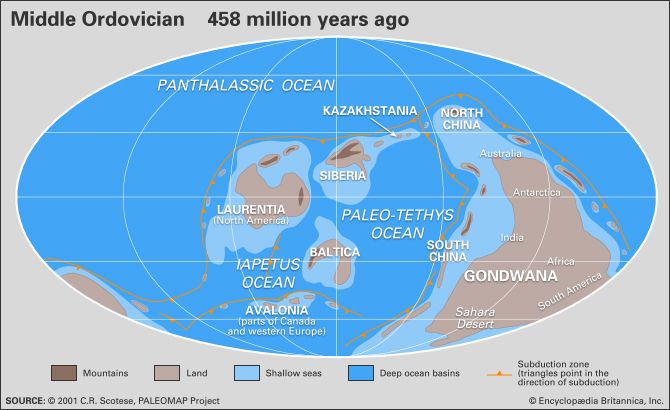
Conversely, sedimentary rocks have provided critical evidence for cooler climates and glaciation, particularly in higher latitudes. The presence of unweathered mica and cold-water faunas in regions like North Africa and South America indicates that these areas were positioned near the South Pole. Additionally, glacial deposits and isotopic signatures in strata confirm that major continental glaciation occurred during the Late Ordovician.6
Integrating Data
By analyzing carbon isotopes within these rocks, scientists have linked these climatic shifts to fluctuations in atmospheric carbon dioxide. This research helps explain the paradox of how glaciation occurred despite generally high CO2 levels, highlighting the interplay between volcanism, silicate weathering, and continental positioning.6
Sources
- Ordovician Period — Encyclopædia Britannica
- Ordovician Period - Correlation of Ordovician strata — Encyclopædia Britannica
- Ordovician Period - Major subdivisions of the Ordovician System — Encyclopædia Britannica
- Silurian Period - Geochemical analyses — Encyclopædia Britannica
- Silurian Period - Isotope stratigraphy — Encyclopædia Britannica
- Ordovician Period - Paleoclimate — Encyclopædia Britannica
- dating - Importance of zircon in uranium-lead dating — Encyclopædia Britannica
- dating - Technical advances — Encyclopædia Britannica
- index fossil — Encyclopædia Britannica
- dating - Principles and techniques — Encyclopædia Britannica
- Tertiary Period - Correlation of Tertiary strata — Encyclopædia Britannica
- A Journey Through Time Since the Precambrian - Ordovician Period: 485.4 million to 443.4 million years ago — Encyclopædia Britannica
- Ordovician radiation — Encyclopædia Britannica
- Ordovician Period - Invertebrates — Encyclopædia Britannica
- Ordovician Period - Exploitation of habitats — Encyclopædia Britannica
- Ordovician Period - Mass extinction at the end of the Ordovician — Encyclopædia Britannica
- Ordovician Period - Faunal provinces — Encyclopædia Britannica
Published on · 4 min read