Deep-scattering Layer
The deep-scattering layer is a horizontal zone of living organisms, typically schools of fish, found beneath the ocean surface. It is named for its ability…
What is deep-scattering layer?
The deep-scattering layer is a horizontal zone of living organisms, typically schools of fish, found beneath the ocean surface. It is named for its ability to scatter or reflect sound waves, which creates echoes on depth sounders.1
Early researchers sometimes mistook these layers for the ocean floor. However, observations revealed that the layer exhibits a daily vertical migration: it rises toward the surface in the evening and sinks again at dawn. This behavior led scientists to hypothesize that the layer consisted of living organisms, a theory later confirmed through net tows and direct observation from submersibles. The detection of such underwater objects relies on sonar, a technique that uses acoustic waves to determine the distance and direction of targets.12
What is diel vertical migration?
Diel vertical migration, also known as diurnal vertical migration, is a behavioral pattern in which marine organisms—including zooplankton, fish, and squid—move throughout the water column on a daily cycle.34
Typically, these organisms remain in the dim light or darkness beneath the photic zone during the day to avoid visual predators. At sunset, they ascend toward the surface to feed in nutrient-rich waters under the cover of darkness. Before dawn, they return to deeper daytime depths.34
This migratory behavior is influenced by various factors, including latitude, seasons, and meteorological conditions. While light levels are the primary stimulus, the specific timing can vary; for instance, some animals may briefly return to depth at midnight if there is no optical stimulus, such as moonlight, before approaching the surface again just before dawn.34
How do marine animals use bioluminescence in the deep ocean?
In the deep ocean, bioluminescence—a chemical process involving the oxidation of luciferin catalyzed by the enzyme luciferase—is a vital survival tool used for a variety of purposes.567
Predation and Feeding
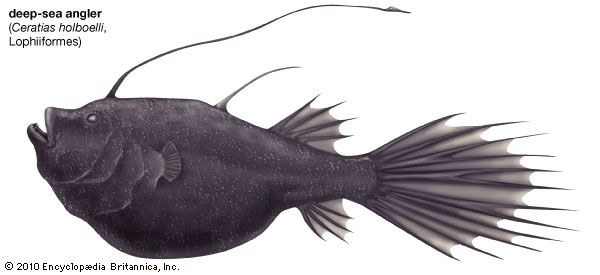
Many deep-sea predators use light to secure food. The anglerfish, for example, utilizes a modified dorsal spine that acts as a fishing rod, dangling a glowing lure in front of its mouth to attract unsuspecting prey.87
Defense and Camouflage
Bioluminescence serves as a critical defense mechanism in the dark:
- Counter-illumination: Many fish, such as lanternfishes and hatchetfishes, possess photophores on their ventral surfaces. By matching the intensity of sunlight filtering from above, they eliminate their own silhouettes, effectively hiding from predators lurking below.87
- Distraction: When threatened, many squids and jellyfish release luminous clouds of ink or mucus to confuse predators and facilitate an escape.687
Communication and Mating
Light organs are often arranged in distinct patterns that allow individuals to recognize members of their own species or potential mates. These signals are essential for maintaining social structures, such as schools, and for successful reproduction in the vast, dark environment of the deep sea.876
What are the different zones of the ocean based on depth?
The ocean is divided into distinct zones based on depth and the availability of sunlight, which significantly influences the distribution of marine life.9
Light-Based Zones
The ocean is primarily categorized by its light penetration:
- Photic Zone: The sunlit upper layer of the ocean. It is subdivided into the euphotic zone (the uppermost layer, typically 80–100 meters deep, where enough light penetrates to support photosynthesis) and the disphotic zone (extending to roughly 700 meters, where light is insufficient for photosynthesis).109
- Aphotic Zone: The region of perpetual darkness lying beneath the photic zone. It occupies the vast majority of the ocean’s volume, where no sunlight penetrates.109
Pelagic Zones (Water Column)
The pelagic environment is divided by depth into the following provinces:
- Epipelagic Zone: The uppermost layer, roughly equivalent to the photic zone.
- Mesopelagic Zone: Extends from 200 to 1,000 meters.
- Bathypelagic Zone: Extends from 1,000 to 4,000 meters.
- Abyssalpelagic Zone: Encompasses the deepest waters from 4,000 meters down to the deep-sea trenches.9
Benthic Zones (Ocean Floor)
The benthic environment refers to the seafloor and is also zoned by depth:
- Littoral (Intertidal) Zone: The area between high-tide and low-tide marks.9
- Sublittoral Zone: Extends from the low-tide mark across the continental shelf.9
- Bathyal Zone: Occurs at depths of 150 to 4,000 meters, covering the continental slope and rise.9
- Abyssal Zone: Found between 4,000 and 6,000 meters.9
- Hadal Zone: The deepest region, found at depths greater than 6,000 meters in deep-sea trenches.9
Sources
- deep-scattering layer — Encyclopædia Britannica
- sonar — Encyclopædia Britannica
- plankton - Zooplankton — Encyclopædia Britannica
- Marine ecosystem - Migrations of marine organisms — Encyclopædia Britannica
- Bioluminescence: Top Questions — Encyclopædia Britannica
- Marine bioluminescence — Encyclopædia Britannica
- Bioluminescence - The role of bioluminescence in behavior — Encyclopædia Britannica
- Everything’s Illuminated: 6 Bioluminescent Organisms — Encyclopædia Britannica
- photic zone — Encyclopædia Britannica
- pelagic zone — Encyclopædia Britannica
- Marine ecosystem - Geography, oceanography, and topography — Encyclopædia Britannica
- seawater - Optical properties — Encyclopædia Britannica
- seawater - Temperature distribution — Encyclopædia Britannica
- ocean current - Pressure gradients — Encyclopædia Britannica
Published on · 3 min read