Barracudina
A barracudina is any of approximately 50 species of marine fishes belonging to the family Paralepididae. These fish are found in deep waters across the globe…
What is barracudina?
A barracudina is any of approximately 50 species of marine fishes belonging to the family Paralepididae. These fish are found in deep waters across the globe and are characterized by their long, slender bodies, large eyes, pointed snouts, and mouths equipped with both small and fanglike teeth.1
Typically growing to about 60 cm (2 feet) in length, barracudinas are mid-water predators that are rarely seen, though they are occasionally drawn to bright lights at the surface. They are believed to serve as a significant food source for larger predatory fish, such as tuna and swordfish.1
It is important to distinguish the barracudina from the barracuda, which belongs to an entirely different family (Sphyraenidae) and is known for being a larger, swifter, and more aggressive predator often found in warmer, shallower waters.2
How do deep-sea fish adapt to living in the dark?
Deep-sea fish have evolved remarkable physiological and behavioral adaptations to survive in the extreme darkness of the ocean depths. These adaptations primarily focus on finding food, attracting mates, and avoiding predators in an environment where sunlight cannot penetrate.3
Bioluminescence
Many mid-water species utilize marine bioluminescence, a chemical process that produces light. This light is often used for:
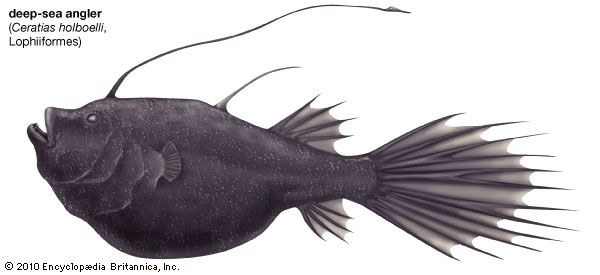
- Luring Prey: Species like the anglerfish possess a modified dorsal fin spine that acts as a luminous bait to attract unsuspecting prey toward their large jaws.43
- Communication: Light organs, or photophores, allow fish to signal potential mates or maintain schools.54
- Camouflage: Some fish use photophores on their ventral surfaces to match the intensity of faint sunlight from above, effectively concealing their silhouette from predators lurking below.4
Sensory Systems
Because vision is limited, deep-sea fish rely on specialized sensory adaptations:
- Enhanced Vision: Many mid-water species have evolved enlarged eyes to capture whatever minimal light is available.3
- Lateral Line System: This system consists of canals along the body containing sensory organs that detect changes in water pressure and currents, helping fish orient themselves and sense movement in the dark.6
- Non-Visual Sensing: Bottom-dwelling species often have reduced eyes and rely more heavily on touch and taste to navigate their environment.36
What is the difference between a barracudina and a barracuda?
A barracudina is a member of the family Paralepididae, consisting of approximately 50 species of slender, long-bodied marine fishes that inhabit deep waters worldwide. They typically grow to about 60 cm (2 feet) in length and are characterized by large eyes, pointed snouts, and mouths featuring both small and fanglike teeth. As mid-water predators, they are rarely seen, though they are occasionally attracted to bright lights at the surface.1
In contrast, the barracuda belongs to an entirely different family, Sphyraenidae. While the provided search results do not detail the specific characteristics of the barracuda, it is distinct from the deep-sea barracudina in its classification and ecological niche.1
What are some other examples of mid-water predators?
Mid-water predators are highly specialized to thrive in the extreme conditions of the deep ocean. Beyond the barracudina, several other groups of fish have evolved unique traits to hunt in this dark, high-pressure environment:
- Anglerfishes: These predators are well-known for their specialized dorsal fin spines, which they dangle like bait to lure prey directly toward their large, tooth-filled mouths.5
- Viperfishes: Members of the family Chauliodontidae, these fish are formidable predators characterized by their numerous, prominent fanglike teeth, which allow them to secure prey in the open water.5
- Bristlemouths: Belonging to the family Gonostomatidae, these are among the most abundant fish species on the planet and serve as significant mid-water predators within their ecosystem.5
These species typically share common evolutionary adaptations, such as huge mouths, enlarged eyes, and the presence of light-producing organs that help them attract prey or mates in the absence of sunlight.5
Sources
- barracudina — Encyclopædia Britannica
- barracuda — Encyclopædia Britannica
- Marine bioluminescence — Encyclopædia Britannica
- Bioluminescence - The role of bioluminescence in behavior — Encyclopædia Britannica
- deep-sea fish — Encyclopædia Britannica
- Photoreception - Lens eyes — Encyclopædia Britannica
- fish - Other senses (touch, pain, and special senses) — Encyclopædia Britannica
- paracanthopterygian - Ecology and behavior — Encyclopædia Britannica
- fish - Structural diversity — Encyclopædia Britannica
- scorpaeniform - Annotated classification — Encyclopædia Britannica
- fish - Locomotion — Encyclopædia Britannica
Published on · 3 min read