Ankobra
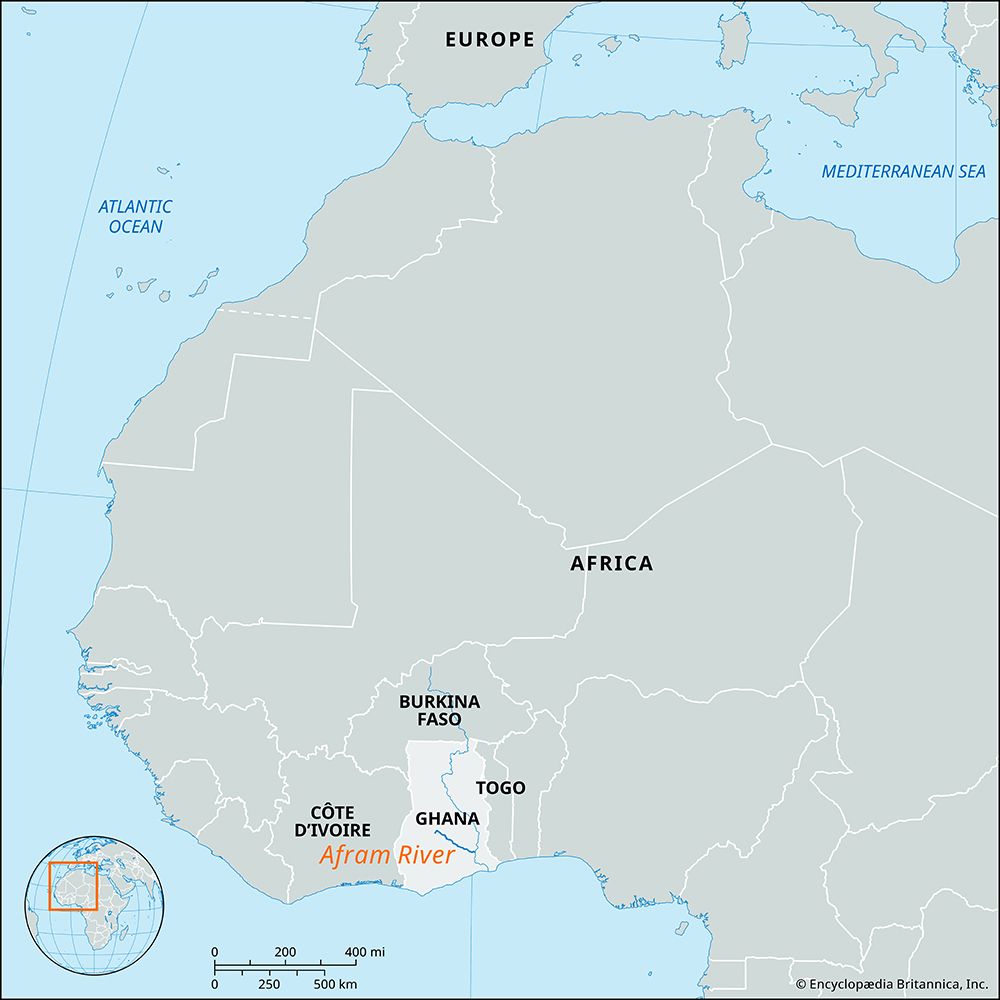
The Ankobra is a river located in southern Ghana, western Africa.
What is Ankobra?
The Ankobra is a river located in southern Ghana, western Africa.1
Rising northeast of Wiawso, the river flows approximately 120 miles (190 km) southward before emptying into the Gulf of Guinea near Axim, which serves as the commercial center for the river basin. While the upper reaches of the river contain rapids, it is navigable for 50 miles (80 km) upstream from its mouth. The river is tidal as far as Tomento, experiencing a tidal range of about 2 feet (0.6 meters). Its primary tributaries include the Mansi and Bonsa rivers, and it shares much of its basin with the Tano River to the west.1
What are the main tributaries of the Ankobra River?
The main tributaries of the Ankobra River are the Mansi and Bonsa rivers.1
How does the Tano River compare to the Ankobra?
The Tano River and the Ankobra are parallel rivers in western Ghana that share a common basin, which is economically significant for its production of gold, bauxite, timber, copra, palm oil, and rubber.21
The two rivers differ primarily in length, course, and navigation:
- Length and Course: The Tano is significantly longer, flowing 250 miles (400 km) from its source near Techiman to the Gulf of Guinea, where its lower course forms the international boundary between Ghana and Côte d’Ivoire. In contrast, the Ankobra is shorter, flowing approximately 120 miles (190 km) from its source northeast of Wiawso to its mouth near Axim.21
- Navigation: The Tano is navigable for about 60 miles (95 km) upstream to Tanoso, where it is blocked by the Sutre Falls. The Ankobra is navigable for 50 miles (80 km) upstream and is tidal as far as Tomento.21
What is the significance of the Gulf of Guinea to Ghana?
The Gulf of Guinea is of significant importance to Ghana, serving as a vital resource for the nation’s economy, food security, and infrastructure.
Economic and Natural Resources
The gulf is a critical source of wealth for Ghana, providing both marine and mineral resources:
- Oil and Gas: Ghana has developed significant offshore oil and natural gas reserves in the gulf. Production at major fields, such as the Jubilee field, has substantially increased the country’s output, supporting its energy sector and export economy.3
- Fisheries: The offshore waters are rich in marine life, including tuna, mackerel, and barracuda. Seasonal coastal upwelling off the central gulf coast of Ghana enhances the productivity of these fisheries, which are essential for both local consumption and overseas export.45
- Minerals: The continental shelf contains deposits of hard minerals, and the sea and coastal lagoons are used for salt production, in which Ghana is self-sufficient.43
Maritime Infrastructure
Because the coast of Ghana is less irregular than other parts of the region, it supports productive fisheries and facilitates maritime trade. The country’s primary ports, Takoradi and Tema, are located on the gulf and serve as the main gateways for goods entering and leaving the country, including the export of oil, gas, and cocoa.46
Sources
- Ankobra — Encyclopædia Britannica
- Tano River — Encyclopædia Britannica
- Gulf of Guinea — Encyclopædia Britannica
- Ghana - Resources and power — Encyclopædia Britannica
- Ghana - Climate — Encyclopædia Britannica
- Ghana - Agriculture, forestry, and fishing — Encyclopædia Britannica
- Ghana - Transportation and telecommunications — Encyclopædia Britannica
Published on · 2 min read