Anole
There are more than 250 species of anoles, which are small, tree-dwelling lizards related to iguanas. While they share common traits like specialized toe…
What different species of anole lizards exist, and how do they vary?
There are more than 250 species of anoles, which are small, tree-dwelling lizards related to iguanas. While they share common traits like specialized toe pads for climbing and the ability to change color, they exhibit significant variation to coexist in shared environments.12
Variation and Niche Partitioning
To accommodate high species density—sometimes up to 10 species in a single restricted area—anoles have evolved to occupy precise ecological niches. They vary in:2
- Size: Species differ in body length, which typically ranges from 12 to 45 cm (5 to 18 inches).12
- Habitat: Some species reside in tree crowns, while others prefer trunks or grass.2
- Environmental Preference: They vary in their tolerance for light, ranging from open sun to filtered light or deep shade.2
- Diet: Different species specialize in consuming different sizes of prey.2
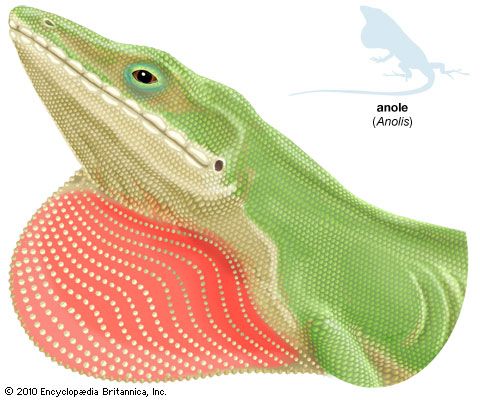
A well-known example is the green anole, which is native to the southern United States and features a pink dewlap.1
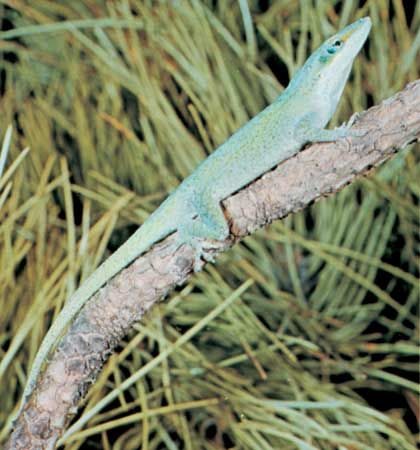
How have anole lizards been used in scientific research, particularly in the study of evolution?
Anole lizards serve as essential models in scientific research, particularly for understanding evolution and ecology. Because they exhibit high species density—with up to 10 species often coexisting in a single restricted area—they provide a unique opportunity to study how competition drives the development of specialized niches.1
Researchers use anoles to investigate how species partition their environments to survive together. By observing how these lizards adapt to different structural and climatic niches—such as residing in tree crowns versus grass, or preferring sun versus shade—scientists can analyze the patterns of biodiversity and the role of evolutionary history in shaping where and how species live. Furthermore, studies of species that are ecologically similar yet closely related suggest that evolutionary history is a primary factor in determining these niche separations. Additionally, their physiological responses to environmental cues, such as the photoperiod adaptations seen in the green anole, offer insights into how species evolve to survive seasonal changes.12
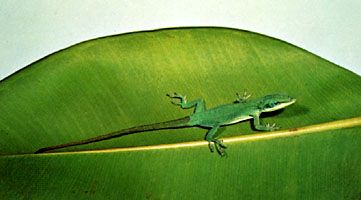
How do anole lizards use their dewlaps, and what purpose do they serve?
Anole lizards possess a dewlap, which is a large, extensible, and often brightly colored flap of skin located on the throat. Primarily found in males, this structure serves as a vital tool for social communication.4
The dewlap functions in two main ways:
- Territorial Signaling: Males use the dewlap to signal their possession of a territory to other males.4
- Mate Attraction: The display is used to attract females for mating.4
These visual signals are often coordinated with other behaviors, such as “push-up” displays. Interestingly, the evolution of these signals is linked to the sensory systems of the lizards. For example, tropical anoles have evolved specialized motion detectors in their eyes to distinguish the jerky movements of their insect prey from the swaying of foliage. Because these lizards are already highly sensitive to such jerky motions, male display behaviors—including the extension of the colorful dewlap—have evolved to exploit these existing sensory biases, ensuring the signals are highly visible and effective.1
Where are anole lizards typically found in their natural habitats?
Anole lizards (genus Anolis) are primarily found throughout the warmer regions of the Americas, with particularly high concentrations in the West Indies and northern South America. While they are diverse across these tropical areas, some species, such as the green anole, are native to the southern United States.12
These lizards are specialized tree-dwellers that occupy highly specific microhabitats to avoid competition with other species. Depending on the species, anoles may be found in various structural environments, including:16
- Tree crowns
- Trunks
- Grass
Within these areas, they further partition their environment based on light preference, ranging from open sun to “filtered” sun or deep shade. Their physical adaptations, such as clinging toe pads and sharp claws, allow them to navigate these diverse vertical habitats with great agility.61
Sources
- anole — Encyclopædia Britannica
- lizard - Niche partitioning — Encyclopædia Britannica
- lizard - Water loss and other variables — Encyclopædia Britannica
- dewlap — Merriam-Webster
- Animal communication - Evolution of signals — Encyclopædia Britannica
- reptile - Central and South America — Encyclopædia Britannica
Published on · 3 min read