Black Caiman
The black caiman (Melanosuchus niger) is a large reptile native to the Amazon River basin and other freshwater environments across northern South America. It…
What is a black caiman?
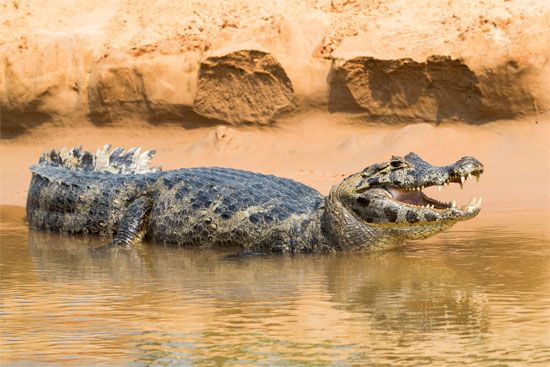
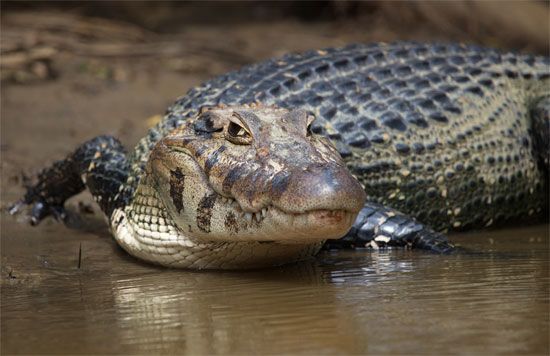
The black caiman (Melanosuchus niger) is a large reptile native to the Amazon River basin and other freshwater environments across northern South America. It is the largest member of the alligator family (Alligatoridae) and serves as a dominant apex predator in its ecosystem.12
Adults typically measure 4 to 5 meters (13 to 16 feet) in length and weigh approximately 350 kg (770 pounds), though some individuals can exceed 6 meters (20 feet) and weigh over 400 kg (882 pounds). Physically, the species is characterized by charcoal-to-black coloration, a long rounded snout, and powerful jaws containing 72 to 76 teeth.12
As an apex predator, the black caiman consumes a broad diet including fish, mollusks, capybaras, and other livestock. While the species was once hunted to near extinction for its hide, populations have shown signs of recovery. It remains a formidable animal that can be dangerous to humans.23
Where does the black caiman live?
The black caiman (Melanosuchus niger) is native to various freshwater environments across northern South America. Its primary habitat is the Amazon River basin, where it thrives in wetlands, flooded savannas, and rivers.3
The species occupies a wide geographic range that includes the following regions:3
- North: Eastern Ecuador, southeastern Colombia, Guyana, French Guiana, and northern Brazil.
- South: Eastern Peru, northern Bolivia, and central Brazil.3
Within these areas, they are typically found along the edges of water bodies, often basking on steep riverbanks during the day and hunting in the water at night.35
What does the black caiman eat?
The black caiman is an apex predator with a varied diet that changes as it matures. Its feeding habits are as follows:
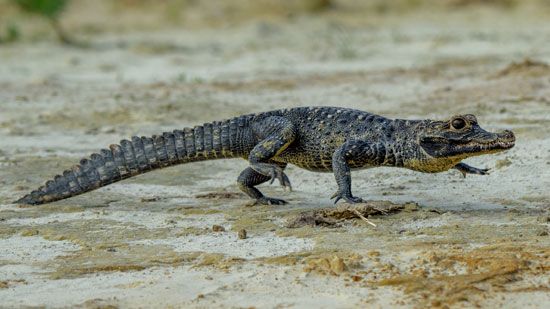
- Adults: These large predators primarily consume mollusks and fish, such as catfish and piranhas. However, their diet is broad and also includes capybaras, deer, boars, dogs, snakes, and livestock.3
- Juveniles: Younger black caimans prey on smaller items, including crustaceans, various invertebrates, and small fish.3
Black caimans typically hunt at night, striking their prey from the water.3
How does the black caiman hunt its prey?
The black caiman is an apex predator that primarily hunts at night. Its hunting strategy relies on stealth and its position within its ecological niche, as it typically strikes its prey directly from the water.3
Equipped with powerful jaws and 72 to 76 teeth, the black caiman is capable of subduing a wide variety of prey. While adults favor mollusks and fish—such as catfish and piranhas—they are also opportunistic hunters that consume larger land animals, including capybaras, deer, boars, and livestock. During the day, these animals are less active, often choosing to bask on steep riverbanks.3
Sources
- Are black caimans larger than alligators? — Encyclopædia Britannica
- black caiman — Merriam-Webster
- black caiman — Encyclopædia Britannica
- 7 Crocodilian Species That Are Dangerous to Humans — Encyclopædia Britannica
- caiman — Encyclopædia Britannica
Published on · 2 min read