Black Snake
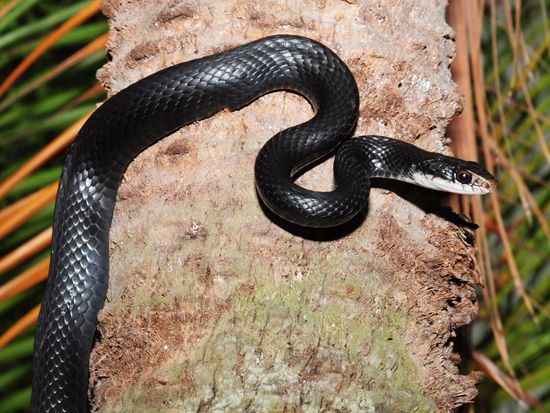
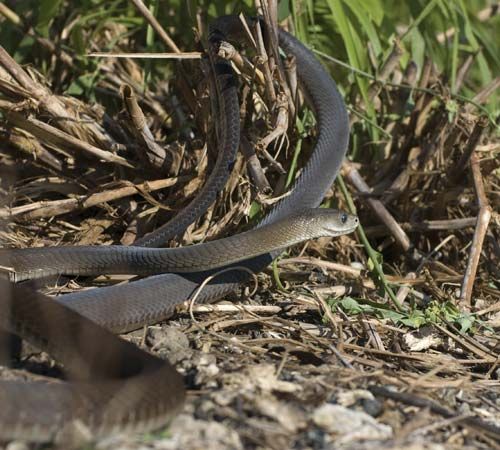
The term "black snake" does not refer to a single species but is a common name applied to various snakes across the globe that share a predominantly black…
What are the defining characteristics of black snakes?
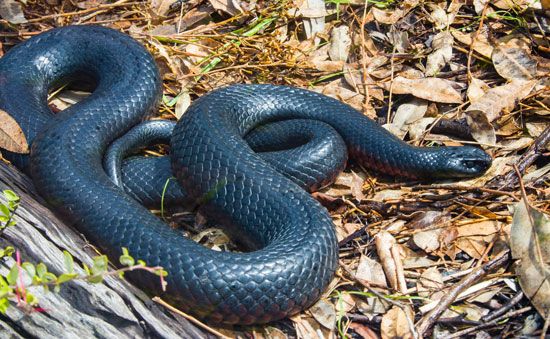
The term “black snake” does not refer to a single species but is a common name applied to various snakes across the globe that share a predominantly black coloration. Because these snakes belong to different families, their characteristics vary significantly:1
- Australian Black Snakes: Species such as Pseudechis porphyriacus (the red-bellied black snake) are members of the cobra family. They are venomous, with venom that is primarily hemorrhagic, and they are known to expand their necks when annoyed.1
- North American Rat Snakes: The black rat snake (Pantherophis obsoletus) is a heavy-bodied, nonvenomous species. Adults typically feature a glossy black back with a white underside. They are proficient climbers that kill prey through constriction. When threatened, they may mimic rattlesnakes by shaking their tails against vegetation, though they are not venomous.23
Because “black snake” is a colloquial term, it is important to identify the specific species to understand its behavior and potential danger to humans.
Which species of snakes are commonly referred to as ‘black snakes’?
The term “black snake” is a common name applied to approximately a dozen species worldwide that are predominantly or entirely black in coloration. Because this is a colloquial designation rather than a scientific classification, it refers to several distinct species across different regions.1
Commonly referred to as “black snakes” include:
- Australian Black Snakes: This group includes Pseudechis porphyriacus (the red-bellied black snake) and P. guttatus. The red-bellied black snake is a member of the cobra family (Elapidae). It is a venomous species, typically blue-black with a red belly, known for expanding its neck when threatened.1
- North American Rat Snakes: The black rat snake (Pantherophis obsoletus) is a heavy-bodied, nonvenomous species found in the eastern and central United States. It is often called a “black snake” or “pilot black snake,” the latter being a misnomer based on the false belief that it leads other snakes to overwintering sites.12
- North American Racers: The black racer (Coluber constrictor constrictor), also known as the black pilot snake, is another species that features black-colored forms, particularly in eastern North America.1
Because these names are used for multiple species, it is important to identify the specific snake by its region and physical traits to understand its behavior and potential danger.
What are the typical habitats and geographical distribution of black snakes?
Because “black snake” is a colloquial term applied to various species globally, their habitats and geographical distributions are diverse. Below are the details for the most common snakes referred to by this name:
North American Species
- Black Rat Snake (Pantherophis obsoletus): This species is primarily found in the eastern and central United States. Its range extends from southern Louisiana and Texas northward to Oklahoma, Kansas, Nebraska, Iowa, and Minnesota. They occupy a wide variety of habitats, ranging from swamps and marshes to forests and fields. They are also known to inhabit human-made structures like barns and houses, using hollow logs, rock cliffs, and abandoned burrows as overwintering sites.12
- Black Racer (Coluber constrictor constrictor): These snakes are found in eastern North America. They are highly active, swift snakes that frequent various environments, including bushes and open ground.17
Australian Species
- Red-bellied Black Snake (Pseudechis porphyriacus): This venomous member of the cobra family is native to Australia. Like other snakes identified as “black snakes,” they are adapted to specific regional environments within that continent.1
It is important to note that some snakes, such as the black mamba, are named for the color of their mouths or other features rather than their external body color, and they inhabit distinct regions like sub-Saharan Africa, specifically in rocky savannas and lowland forests.8
What are some common misconceptions about black snakes?
Common misconceptions about snakes often stem from fear and a lack of understanding of their natural behaviors. Because many species are colloquially called “black snakes,” these myths frequently overlap across different types.
Common Misconceptions
- The “Pilot” Myth: The name “pilot black snake,” often applied to the black rat snake, is a misnomer. It originated from the false belief that these snakes lead rattlesnakes and other species to safe overwintering sites. In reality, this behavior is simply a result of different species sharing the same suitable habitats for hibernation.1
- Aggression and Attacks: Many people believe certain snakes are inherently aggressive. While the black mamba has a reputation for being a dangerous aggressor, unprovoked attacks on humans have not been proven. Most snakes, including those labeled “black snakes,” are shy and prefer to retreat; they only strike when they feel trapped, cornered, or molested.11121
- “Poisonous” vs. “Venomous”: In common parlance, people often refer to dangerous snakes as “poisonous.” Technically, this is incorrect; “poisonous” applies to organisms that are harmful when consumed. Snakes that inject toxins through fangs are “venomous”.12
- Mimicry of Rattlesnakes: When threatened, some nonvenomous snakes, such as the black rat snake, may vibrate their tails against vegetation to create a rattling sound. This defensive behavior is often misinterpreted as an attempt to mimic a rattlesnake to threaten humans, though it is simply a natural reaction to perceived danger.1
Sources
- black snake — Encyclopædia Britannica
- Black rat snake — Encyclopædia Britannica
- Black rat snake: Top Questions — Encyclopædia Britannica
- Black-and-yellow mangrove snake: Top Questions — Encyclopædia Britannica
- brown snake — Encyclopædia Britannica
- reptile - Display of colour — Encyclopædia Britannica
- racer — Encyclopædia Britannica
- red-bellied snake — Merriam-Webster
- black-tailed rattlesnake — Encyclopædia Britannica
- black mamba — Encyclopædia Britannica
- 9 of the World’s Deadliest Snakes — Encyclopædia Britannica
- mamba — Encyclopædia Britannica
- snake - Snakes and humans — Encyclopædia Britannica
- What eats snakes? — Encyclopædia Britannica
Published on · 4 min read