Antlike Flower Beetle
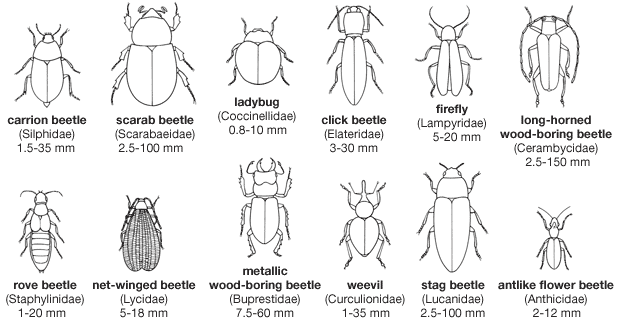
An antlike flower beetle is any of the approximately 1,000 species of insect belonging to the family Anthicidae within the order Coleoptera.
What is antlike flower beetle?
An antlike flower beetle is any of the approximately 1,000 species of insect belonging to the family Anthicidae within the order Coleoptera.1
These beetles are characterized by their resemblance to ants and typically range in length from 2 to 12 millimeters (up to 1/2 inch). They are commonly found in various environments, including around flowers, foliage, refuse, and dead wood, as well as in debris or under stones and logs.1
It is important to distinguish these beetles from other insects that may share similar names or habitats. For instance, the flower bug (family Anthocoridae) is a different group of predatory insects, and the flower chafer (subfamily Cetoniinae) refers to a group of herbivorous scarab beetles known for their association with flowering plants.23
Why do some beetles evolve to look like ants?
Some beetles evolve to resemble ants as a survival strategy known as Batesian mimicry. In this form of biological resemblance, a harmless organism (the mimic) gains protection by appearing like a noxious or dangerous one (the model).56
Because ants are often aggressive, possess painful stings, and defend their colonies collectively, many predators avoid them. By evolving to look like ants, these beetles deceive potential predators into mistaking them for a more formidable or unpalatable target, thereby increasing their chances of survival.7586
This mimicry often involves more than just physical appearance; some species also adopt the movements and behaviors characteristic of ants to complete the deception. For example, certain beetles that live within ant nests have evolved to closely resemble their hosts, allowing them to integrate into the colony environment. This evolutionary adaptation is a powerful example of how natural selection favors traits that provide a defensive advantage against predation.8756
What are the main differences between beetles and true bugs?
Beetles and true bugs are both members of the class Insecta, but they belong to different taxonomic orders and exhibit fundamental differences in their development, mouthparts, and wing structures.1213
Key Differences
Feature
Beetles (Order: Coleoptera)
True Bugs (Order: Hemiptera)
Metamorphosis
Holometabolous
(complete): egg, larva, pupa, and adult.
Hemimetabolous
(gradual): egg, nymph, and adult.
Mouthparts
Adapted for
biting and chewing
.
Adapted for
piercing and sucking
plant or animal juices.
Forewings
Hardened, stiff covers called
elytra
that protect the hindwings.
Often thickened at the base with a membranous tip (hemelytra).
Development
Larvae differ greatly from adults; pupal stage is a nonfeeding transformation.
Nymphs resemble smaller, wingless versions of adults.
Detailed Distinctions
- Developmental Cycles: Beetles undergo complete metamorphosis, meaning they pass through a distinct pupal or chrysalis stage where they transform from a larva into an adult. True bugs undergo gradual metamorphosis; they hatch as nymphs that look like miniature adults and mature through several molts without a pupal stage.1214
- Feeding Mechanisms: Beetles are characterized by their ability to chew and gnaw, utilizing mandibles. In contrast, true bugs possess specialized mouthparts called stylets, which function like a straw to pierce and extract fluids.121513
- Wing Structure: While both have wings, the beetle’s forewings (elytra) are typically hard and rigid, serving as protective armor for the delicate flight wings folded underneath. True bugs (specifically the suborder Heteroptera) have forewings that are leathery at the base and membranous at the tip, which overlap when the insect is at rest.12161713
How do insects use mimicry to protect themselves from predators?
Insects utilize various forms of mimicry as a sophisticated survival strategy to protect themselves from predators. This deceptive resemblance generally falls into a few key categories:
- Batesian Mimicry: In this form, a harmless or edible insect evolves to resemble a noxious, distasteful, or dangerous species. Predators that have learned to avoid the “model” (the dangerous species) will also avoid the “mimic,” providing the latter with protection despite its lack of actual defenses.192021
- Müllerian Mimicry: This occurs when multiple unrelated, noxious species evolve to share the same conspicuous warning coloration. By standardizing their appearance, these species collectively educate predators more efficiently; the cost of “teaching” the predator that they are inedible is spread across the entire group, reducing the number of individuals sacrificed.192221
- Mimesis (Protective Coloration): Unlike mimicry that targets a predator’s learned avoidance, mimesis involves an insect blending into its environment to avoid detection entirely. For example, stick insects and certain caterpillars resemble twigs or leaves, allowing them to remain hidden from view.2021
- Aggressive Mimicry: While primarily a predatory tactic, some insects use deceptive signals to mimic non-threatening species or even the prey of their own targets to launch surprise attacks or gain access to resources.2324
These adaptations are driven by natural selection, as insects that successfully deceive predators or signal their unpalatability are more likely to survive and reproduce.2124
Sources
- antlike flower beetle — Encyclopædia Britannica
- heteropteran - Annotated classification — Encyclopædia Britannica
- Coleoptera - Special ecological relationships — Encyclopædia Britannica
- flower chafer — Encyclopædia Britannica
- Batesian mimicry — Encyclopædia Britannica
- Coleoptera - Protection — Encyclopædia Britannica
- Nine Incredible Jumping Spiders - Jumping ant spider: A masterful mimic — Encyclopædia Britannica
- myrmec- — Merriam-Webster
- mimicry - Batesian mimicry — Encyclopædia Britannica
- Reproductive behaviour - Insects — Encyclopædia Britannica
- Myrmecobius — Merriam-Webster
- The Difference Between 'Bug,' 'Insect,' and 'Beetle' — Merriam-Webster
- Metamorphosis — Encyclopædia Britannica
- heteropteran - Wings — Encyclopædia Britannica
- Coleoptera - Size range and diversity of structure — Encyclopædia Britannica
- Coleoptera - Adult features — Encyclopædia Britannica
- heteropteran - Distinguishing taxonomic features — Encyclopædia Britannica
- Coleoptera - Distinguishing taxonomic features — Encyclopædia Britannica
- mimicry - Müllerian mimicry — Encyclopædia Britannica
- aggressive mimicry — Encyclopædia Britannica
- insect - Protection from enemies — Encyclopædia Britannica
- mimicry - Müllerian mimicry — Encyclopædia Britannica
- mimicry - The importance of the signal receiver — Encyclopædia Britannica
- mimicry - The effects of selective pressure — Encyclopædia Britannica
Published on · 4 min read