Nine Incredible Jumping Spiders
"Nine Incredible Jumping Spiders" is a curated list featured by Britannica that highlights the remarkable diversity, unique behaviors, and specialized…
What is Nine Incredible Jumping Spiders?
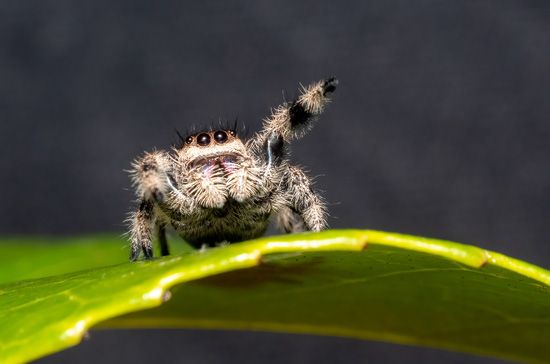
“Nine Incredible Jumping Spiders” is a curated list featured by Britannica that highlights the remarkable diversity, unique behaviors, and specialized adaptations found within the jumping spider family, Salticidae.12
As the largest and most diverse family of spiders, Salticidae includes over 6,000 species known for their exceptional eyesight, intelligence, and agility. The list serves as an educational resource to explore these fascinating arachnids, which are renowned for being active, daytime ambush predators that do not rely on webs to capture prey. By showcasing specific examples, the collection illustrates the wide range of evolutionary traits within the group, such as complex mating rituals, mimicry, and unique dietary habits.12
You can view the full list and learn more about these tiny hunters by visiting the Nine Incredible Jumping Spiders page.
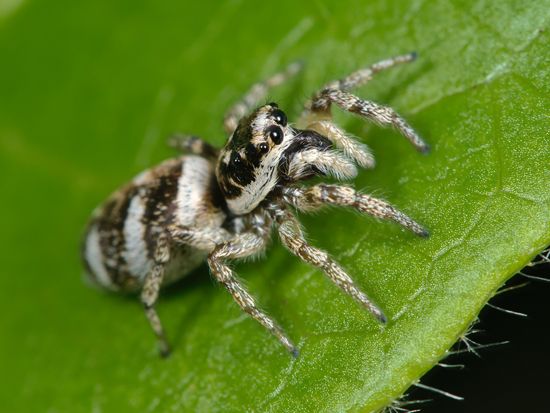
How do jumping spiders use their hydraulic system to leap?
Jumping spiders are capable of leaping many times their body length by utilizing an internal hydraulic system. This mechanism functions by rapidly increasing the pressure of hemolymph—the invertebrate equivalent of blood and lymph—within their bodies. This sudden surge in fluid pressure is used to explosively straighten the spider’s fourth set of legs, providing the necessary force to propel them into the air.1
What makes the genus Portia considered one of the most intelligent arthropods?
Members of the genus Portia are widely considered among the most intelligent arthropods on Earth due to their sophisticated hunting strategies and cognitive abilities. Unlike many other spiders, Portia species exhibit a remarkable combination of instinctual and learned behaviors, allowing them to effectively prey on other web-building spiders.16
Key factors contributing to their reputation for intelligence include:
- Aggressive Mimicry: Portia spiders use trial and error to learn the specific web-plucking patterns that mimic trapped insects. By vibrating the webs of their prey in precise ways, they lure the web-building spiders into a surprise attack.6
- Cognitive Flexibility: They demonstrate the ability to remember and employ different mimicry techniques tailored to the specific responses of various prey species.6
- Advanced Planning and Memory: These spiders show evidence of spatial memory, object permanence, and the capacity for advance planning. For instance, they can assess the risk of a target—such as a spitting spider—and adjust their attack strategy based on the prey’s current state, such as whether it is encumbered by an egg sac.6
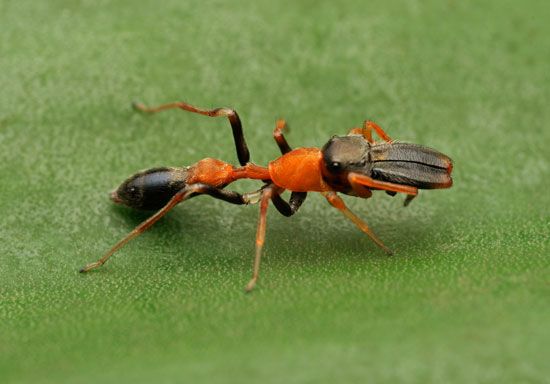
Why do some jumping spiders mimic the appearance of ants?
Some jumping spiders, such as the jumping ant spider, mimic the appearance and behavior of ants as an effective defensive strategy to avoid predators like birds, wasps, and other spiders.89
This adaptation is a form of Batesian mimicry, where a defenseless organism gains protection by resembling a species that is dangerous or unpalatable. Because ants often defend their colonies aggressively with bites, stings, and formic acid, many predators avoid them, making the ant an ideal model for mimicry.1089
To achieve this disguise, the spider has evolved several specialized traits:
- Physical Modification: Its body is shaped to mimic the three-segmented appearance of an ant, including a narrowed cephalothorax that resembles an ant’s waist.89
- Behavioral Deception: The spider frequently raises its front legs above its head to act as fake antennae, concealing the fact that it has eight legs instead of an insect’s six.810
- Movement: It mimics the winding, ambling gait of an ant following a pheromone trail.89
Research indicates that these mimics are three times less likely to be eaten than non-mimicking jumping spiders.89
Sources
- jumping spider — Encyclopædia Britannica
- jumping spider — Merriam-Webster
- Nine Incredible Jumping Spiders — Encyclopædia Britannica
- arachnid - Locomotion — Encyclopædia Britannica
- spider - External features — Encyclopædia Britannica
- spider wasp — Encyclopædia Britannica
- Nine Incredible Jumping Spiders - Portia : The brainiacs — Encyclopædia Britannica
- Nine Incredible Jumping Spiders - Jumping ant spider: A masterful mimic — Encyclopædia Britannica
- jumping ant spider — Encyclopædia Britannica
- mimicry - Batesian mimicry — Encyclopædia Britannica
Published on · 3 min read