Aoudad
The aoudad (Ammotragus lervia), a mammal native to the dry, mountainous regions of North Africa, has been introduced to the southwestern United States…
How have aoudads been introduced to other parts of the world, and what impact have they had?
The aoudad (Ammotragus lervia), a mammal native to the dry, mountainous regions of North Africa, has been introduced to the southwestern United States, northern Mexico, and Spain.
These introductions were primarily conducted for hunting purposes. While the species is considered vulnerable to extinction within its natural range, it has established thriving populations in these new environments.12
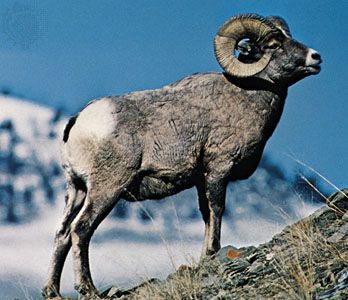
This expansion has had a negative ecological impact: in the southwestern United States and northern Mexico, the aoudad has outcompeted indigenous ungulates, such as the desert bighorn sheep, for resources. The introduction of non-native species into fragile ecosystems often disrupts local biodiversity, and it is ethically important to consider the long-term consequences of such actions on native wildlife populations.1
What cultural significance do aoudads have in North African countries?
The provided search results do not contain information regarding the cultural significance of aoudads in North African countries. While the aoudad (Ammotragus lervia) is native to the dry, mountainous regions of North Africa and its name is derived from the Berber word audad, the available documentation focuses on its biological classification, physical characteristics, and its status as an introduced species in other parts of the world.13
Sorry, the Britannica knowledge base does not contain this information.
What is an aoudad and where is it native to?
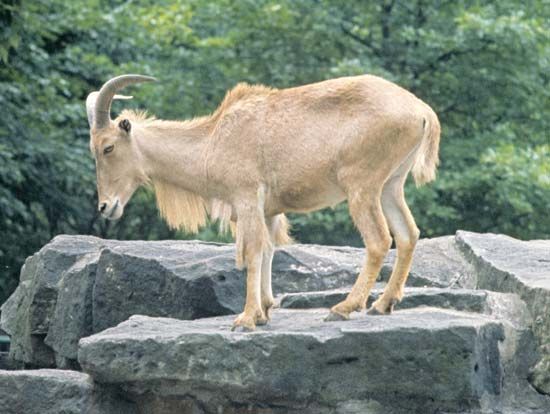
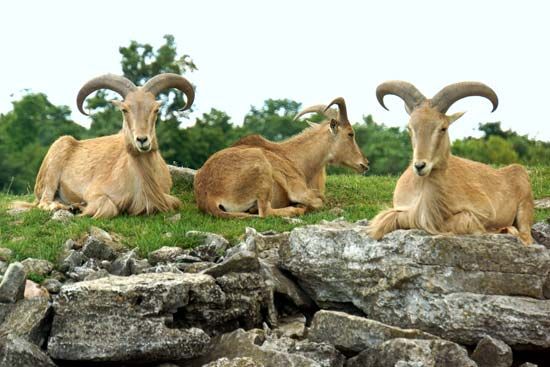
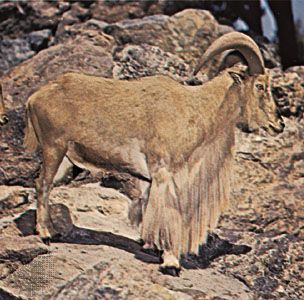
The aoudad (Ammotragus lervia), also known as the Barbary sheep, is a goatlike mammal belonging to the family Bovidae. Although it has historically been referred to as a sheep, genetic evidence indicates that it is more closely related to wild goats.13
Physically, the aoudad stands approximately 102 cm (40 inches) at the shoulder and is characterized by a tawny brown coat that provides camouflage in rocky terrain. Males are distinguished by semicircular horns that curve outward and backward, as well as a prominent fringe of long, soft hair hanging from the throat and forequarters. These animals are well-adapted to arid environments, capable of surviving for up to five days without water.13
The aoudad is native to the dry, rocky, and mountainous regions of North Africa. Currently, the species is considered vulnerable to extinction within its natural range, with only small, scattered populations remaining.13
How do aoudads compare to other wild sheep species in terms of size and adaptations?
The aoudad (Ammotragus lervia) is often misidentified as a sheep, but genetic evidence confirms it is more closely related to wild goats. While it shares the Bovidae family with other wild sheep, such as the bighorn sheep, its physical adaptations are uniquely suited to its native arid, rocky environments.1
Regarding size and adaptations, the aoudad stands approximately 102 cm (40 inches) at the shoulder. Unlike many other wild sheep, it possesses a distinctive fringe of long, soft hair hanging from its throat and forequarters, which is more pronounced in males. Its semicircular horns curve outward, backward, and inward over the neck.12
A key physiological adaptation is its remarkable water efficiency; the aoudad can survive for up to five days without water. Furthermore, it utilizes a “freeze” response when threatened, relying on its tawny brown coat to blend into rocky terrain. In regions where it has been introduced, such as the southwestern United States, these hardy traits allow it to successfully outcompete native ungulates like the bighorn sheep.1
Sources
- aoudad — Encyclopædia Britannica
- aoudad — Merriam-Webster
- Barbary sheep — Merriam-Webster
Published on · 3 min read