Banteng
The banteng (Bos banteng) is a species of wild cattle belonging to the family Bovidae, native to the hill forests of Southeast Asia. Often described as a shy…
What is banteng?
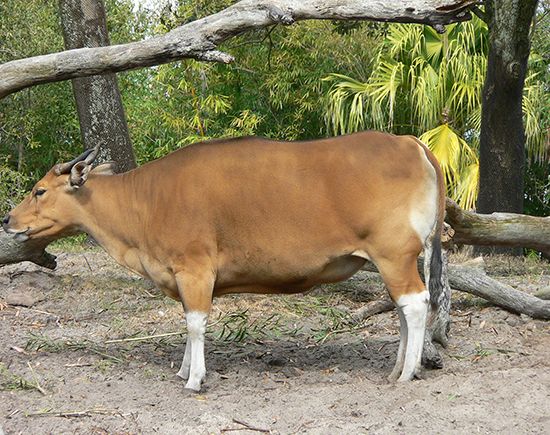
The banteng (Bos banteng) is a species of wild cattle belonging to the family Bovidae, native to the hill forests of Southeast Asia. Often described as a shy animal that resembles a domestic cow, the banteng typically reaches a shoulder height of 1.5 to 1.75 meters (60–69 inches).1
Physically, the species is characterized by a slight ridge on its back, a distinctive white rump, and white “stockings” on its legs, complemented by slender, curving horns. Sexual dimorphism is evident in their coloration: bulls are generally dark brown or black, while cows and young bantengs are reddish brown.1
While they exist as wild populations in regions ranging from Myanmar south to Borneo and Java, they are also kept as domestic animals in certain areas.12
What are the main differences between a banteng and a gaur?
The gaur and the banteng are both members of the family Bovidae and share similar physical traits, such as white “stockings” on their legs, high ridges on their backs, and curved horns. However, they differ significantly in size and distribution:
- Size: The gaur is the largest of all wild cattle, reaching a shoulder height of 1.8 meters (6 feet) or more. In contrast, the banteng is smaller, typically standing between 1.5 and 1.75 meters (60–69 inches) at the shoulder.
- Physical Features: While both species exhibit sexual dimorphism where bulls are darker than cows, the gaur is noted for being particularly heavy-bodied and often blue-eyed.
- Distribution: The gaur is primarily found in the mountain forests of India, Southeast Asia, and the Malay Peninsula. The banteng has a broader range across Southeast Asia, extending from Myanmar to Borneo and Java, and is also found in domesticated populations.
How does the banteng’s habitat compare to other wild cattle in Asia?
The banteng (Bos banteng) is primarily a resident of hill forests in Southeast Asia. Its habitat preferences reflect its classification as a member of the tribe Bovini, a group noted for its ability to exploit a wide variety of biomes and habitats compared to other bovids.14
When compared to other wild cattle in Asia, the banteng’s habitat usage shows both similarities and distinct ecological niches:
- Kouprey: Like the banteng, the kouprey is an inhabitant of Indochina. Its preferred habitat consists of dry open forests and tree or orchard savannas, though it seeks the shelter of dense forests during extreme heat and moves to higher elevations during the rainy season.5
- Wild Water Buffalo: Unlike the banteng, the wild water buffalo is specifically adapted to swampy environments. It spends much of its time in water or wallowing in mud to regulate body temperature and avoid insects, utilizing splayed hooves to navigate deep mud in forests and wetlands.6
- General Bovid Adaptation: While many bovids are strictly categorized into either closed-habitat (forest/bush) or open-habitat (plains/mountains) groups, the wild Bovini—which includes the banteng, gaur, and kouprey—are exceptions that occupy a broader range of ecological conditions.74
Why are some banteng populations considered endangered?
The provided information does not contain details regarding the specific reasons why some banteng populations are considered endangered.
Sources
- banteng — Encyclopædia Britannica
- Asia - Mammals — Encyclopædia Britannica
- gaur — Encyclopædia Britannica
- Water buffalo — Encyclopædia Britannica
- kouprey — Encyclopædia Britannica
- bovid - Social organization — Encyclopædia Britannica
- banteng — Merriam-Webster
- bovid - Evolution and diversification — Encyclopædia Britannica
Published on · 2 min read