Apodiform
Within the order Apodiformes, swifts and hummingbirds exhibit distinct feeding strategies adapted to their respective ecological niches.
How do the feeding habits of swifts differ from those of hummingbirds within the apodiform order?
Within the order Apodiformes, swifts and hummingbirds exhibit distinct feeding strategies adapted to their respective ecological niches.12
Feeding Habits of Swifts
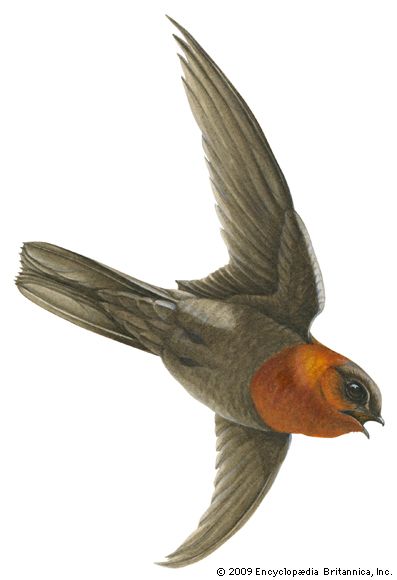
Swifts are insectivores that forage on the wing. They possess wide gapes, allowing them to capture insects mid-flight as they course tirelessly through the air. Their feeding is highly dependent on the availability of flying insects, which influences their distribution; consequently, they are most abundant in the tropics where such prey is plentiful.342
Feeding Habits of Hummingbirds
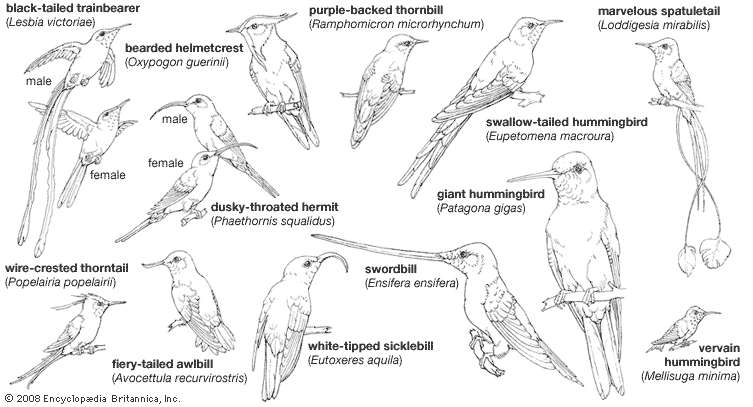
Hummingbirds are more specialized, feeding primarily on nectar from flowers. Their long, tubular bills are often evolutionarily correlated with the specific shapes of the flowers they utilize. To access this food source, they rely on their unique wing structure, which allows them to hover in front of blossoms. They also consume insects, often extracting them from the same flowers they visit for nectar. Because they are restricted to floral resources, their distribution is closely tied to flowering periods.256
What are some of the smallest and largest species of apodiform birds?
Within the order Apodiformes, which includes both hummingbirds and swifts, there is a significant range in size.96
Hummingbirds (Family Trochilidae)
Hummingbirds are generally small, with some being minute.10
- Smallest: The bee hummingbird (Mellisuga helenae) of Cuba is the smallest living bird, measuring approximately 5.5 to 6.2 cm (about 2.2 to 2.5 inches) in length and weighing about 2 grams.91011
- Largest: The giant hummingbird (Patagona gigas) and its relative, the northern giant hummingbird (Patagona chaski), are the largest species, reaching lengths of about 20 cm (7.8 inches) and weighing between 21 and 22 grams.910
Swifts (Family Apodidae)
Swifts exhibit a broader size range than hummingbirds.9
- Smallest: The pigmy swiftlet (Collocalia troglodytes) of the Philippines is one of the smallest species, weighing only 5 grams.9
- Largest: Some members of the Old World genus Apus are significantly larger, weighing up to 30 times more than the smallest swiftlets. Overall, swifts range in length from approximately 9 to 23 cm (3.5 to 9 inches).92
How do swifts, another group of apodiform birds, build their nests and care for their young?
Swifts are remarkable for their specialized nest-building techniques, which rely heavily on the use of their own saliva as a binding agent.213
Nest Construction
Swifts typically construct their nests in sheltered locations such as chimneys, caves, rock crevices, or hollow trees. They gather materials like twigs, buds, moss, or feathers and use their sticky saliva to glue these items together and attach the structure firmly to a vertical surface. In some species, the use of saliva is even more extreme; for example, certain Asian swifts construct their entire nests out of hardened saliva, which is famously harvested for birds’ nest soup. A few species, such as the Asian palm swift, take a different approach by gluing their eggs directly to a tiny, flat feather nest attached to a palm leaf.21413
Care for Young
Swifts generally lay a clutch of one to six white eggs. A unique aspect of their parental care is the ability of both the eggs and the nestlings to cool toward the environmental temperature during periods of food scarcity; this physiological adaptation slows the development of the young, helping them conserve energy until conditions improve. The young remain in or near the nest for 6 to 10 weeks, depending on food availability, and are capable of adept flight immediately upon fledging.2
What unique adaptations do hummingbirds, a type of apodiform bird, possess for their specialized feeding habits?
Hummingbirds possess several specialized adaptations that allow them to thrive on a diet primarily consisting of flower nectar and small insects:
- Flight Capabilities: Hummingbirds have a unique wing structure that connects to the body only at the shoulder joint. This allows for a full range of motion, enabling them to hover, fly forward, backward, sideways, and even straight up and down. This agility is essential for maneuvering around flowers to extract nectar efficiently.816
- Specialized Bills and Tongues: Their bills are typically long and slender, adapted for reaching deep into specific types of flowers. The shape of the bill is often closely correlated with the shape of the flowers they visit. Additionally, they possess a long, tubular tongue used for sucking up nectar, as well as dew or rainwater.166
- Metabolic Management: Because they have an extremely high metabolic rate, hummingbirds are capable of entering a state of torpor—a form of energy conservation where they reduce their body temperature—typically while roosting at night.17
- Visual Acuity: Hummingbirds rely on powerful vision and color sense to locate food. They are particularly sensitive to the red part of the spectrum, which is why many bird-pollinated flowers are pure red.18
Sources
- Apodiform — Encyclopædia Britannica
- Swift — Encyclopædia Britannica
- Bird - Feeding habits — Encyclopædia Britannica
- 11 Questions About Birds Answered — Encyclopædia Britannica
- Apodiform - Ecology — Encyclopædia Britannica
- Hummingbird — Encyclopædia Britannica
- Apodiform - Reproduction and life cycle — Encyclopædia Britannica
- How fast do hummingbirds fly? — Encyclopædia Britannica
- Apodiform - Size range and diversity of structure — Encyclopædia Britannica
- bee hummingbird — Merriam-Webster
- Bird - Annotated classification — Encyclopædia Britannica
- swift — Encyclopædia Britannica
- Bird - Nesting — Encyclopædia Britannica
- Nest — Encyclopædia Britannica
- Falconiform - The fledging period — Encyclopædia Britannica
- pollination - Birds — Encyclopædia Britannica
- Apodiform - Torpor — Encyclopædia Britannica
- Apodiform - Behaviour and locomotion — Encyclopædia Britannica
Published on · 4 min read