Chuck-will’s-widow
The chuck-will’s-widow (Caprimulgus carolinensis) is a nocturnal bird belonging to the family Caprimulgidae family Caprimulgidae. Found primarily in the…
What is Chuck-will’s-widow?
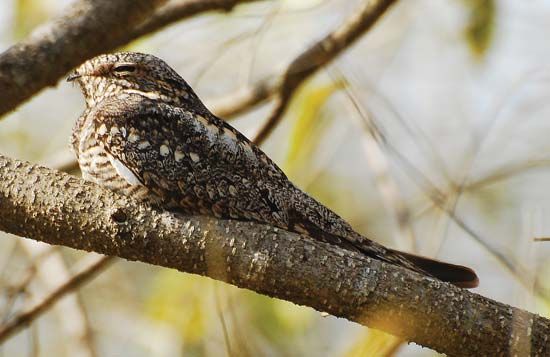
The chuck-will’s-widow (Caprimulgus carolinensis) is a nocturnal bird belonging to the family Caprimulgidae family Caprimulgidae. Found primarily in the swamps, pine woods, and rocky uplands of the southeastern United States, this nightjar migrates to the West Indies, Central America, and northwestern South America during the winter.1
The bird is named for its repetitive, imitative call, which can be sung hundreds of times without pause. It is often confused with the whippoorwill, though the chuck-will’s-widow is larger—reaching up to 30 cm (12 inches)—and features reddish-brown plumage with little to no white in its tail.123
A unique aspect of its behavior is how it protects its young: the bird lays two eggs directly on the ground, and if it feels threatened, the parent may carry an egg away in its large mouth.1
What are the main characteristics of the nightjar family?
The family Caprimulgidae, commonly known as nightjars, consists of medium-sized, insectivorous birds characterized by several distinct physical and behavioral traits.56
Physical Characteristics
- Appearance: They are sparrow- to pigeon-sized birds with soft, cryptically colored plumage in shades of gray, brown, or reddish-brown, which provides excellent camouflage.578
- Anatomy: They possess flat heads, large eyes, and exceptionally wide mouths, often fringed with bristles to assist in catching prey. Their wings are typically long, and their legs are short.786
- Flight: Their soft plumage allows for silent flight, an adaptation that aids their nocturnal hunting.7
Behavior and Ecology
- Feeding: Nightjars are crepuscular or nocturnal, feeding on flying insects that they catch on the wing.576
- Roosting: During the day, they typically rest on the ground or perch lengthwise along tree branches.59
- Reproduction: They do not build traditional nests; instead, they deposit one or two eggs directly on the ground or on surfaces like rooftops. Their chicks are semi-precocial, capable of walking shortly after hatching.510
How do nocturnal birds adapt to hunting in the dark?
Nocturnal birds have evolved specialized sensory and physiological adaptations to hunt and navigate effectively in low-light environments.
Auditory Adaptations
Many nocturnal birds, particularly owls, rely on acute hearing rather than vision to locate prey. They possess asymmetrical ear openings that allow them to detect the precise origin of sounds by measuring the minute time difference—sometimes as little as 30 millionths of a second—between when a sound reaches each ear. This ability enables them to capture prey in total darkness by tracking auditory cues like the rustling of leaves or grass.1011
Visual Adaptations
Nocturnal vertebrates often feature a tapetum lucidum, a mirrorlike layer in the eye that reflects light back through the retina. This provides a second opportunity for visual pigments to absorb light, significantly enhancing sensitivity in dim conditions. Additionally, birds can adjust their vision through mechanisms involving the iris, the use of rods for low-light sensitivity, and the regulation of photopigment molecules.1213
Echolocation
While rare among birds, some species like oilbirds and swiftlets utilize echolocation. By emitting sounds and interpreting the reflected waves, these birds can navigate and fly freely in complete darkness, such as within deep caves.141511
What are some other birds named after their calls?
Many birds are named onomatopoeically, meaning their common names are derived from the sounds they make. Here are several examples of birds named after their calls:
- Whippoorwill: This nocturnal bird is named for its loud, repeated call that sounds remarkably like its name.1718
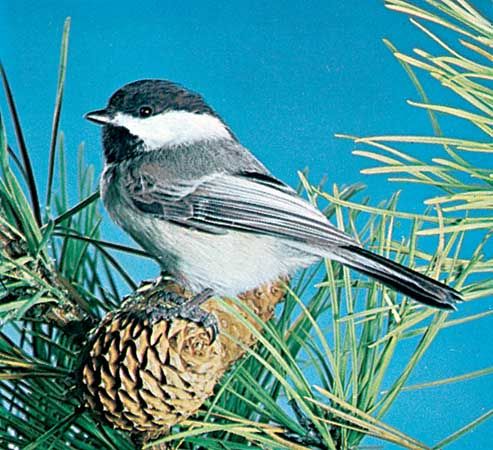
- Chickadee: These small North American birds are named for their distinctive “chick-a-dee-dee-dee” call notes.1920
- Cuckoo: The name of this bird is an imitation of its familiar, monotonous two-note song.2122
- Chuck-will’s-widow: Like the whippoorwill, this member of the nightjar family is named for the sound of its vocalization.17
- Dickcissel: This yellow-breasted songbird’s name is an imitation of the sound it produces.23
- Common Potoo: In some regions, this bird is known as the “poor-me-one” due to its haunting, human-like lament.17
Sources
- Chuck-will’s-widow — Encyclopædia Britannica
- chuck-will's-widow — Merriam-Webster
- Birds Say the Darndest Things | ‘Widow’ (Chuck-will’s-widow) — Merriam-Webster
- Whippoorwill — Encyclopædia Britannica
- Caprimulgidae — Encyclopædia Britannica
- Nightjar — Encyclopædia Britannica
- Caprimulgiform — Encyclopædia Britannica
- Caprimulgiform - Reproduction — Encyclopædia Britannica
- nightjar — Merriam-Webster
- Caprimulgiform - Natural history — Encyclopædia Britannica
- Why do birds chirp at night? — Encyclopædia Britannica
- sound reception - Uses of hearing in birds — Encyclopædia Britannica
- How Do Birds Hear? — Encyclopædia Britannica
- coloration - Visual functions — Encyclopædia Britannica
- Photoreception - Adaptive mechanisms of vision — Encyclopædia Britannica
- bat - Activity patterns — Encyclopædia Britannica
- 10 Bird Names that Sound Like Insults (and Sometimes Are) | 'Dickcissel' — Merriam-Webster
- Caprimulgiform - Vocalizations — Encyclopædia Britannica
- chickadee — Merriam-Webster
- Chickadee — Encyclopædia Britannica
- whippoorwill — Merriam-Webster
- Did you know? — Merriam-Webster
- Cuculiform - Vocalizations — Encyclopædia Britannica
- Bird - Sound — Encyclopædia Britannica
- 15 Bird Sounds and the Birds Who Make Them | Chirp — Merriam-Webster
- Galliform - Vocalizations — Encyclopædia Britannica
Published on · 3 min read