Nectariniidae
Nectariniidae is a family of songbirds within the order Passeriformes that includes approximately 130 species of small, often brilliantly colored birds.…
What is Nectariniidae?
Nectariniidae is a family of songbirds within the order Passeriformes that includes approximately 130 species of small, often brilliantly colored birds. These birds are primarily found in the warmer forests of Africa and Asia, with some species extending to Pacific islands.12
The family consists of two main groups:
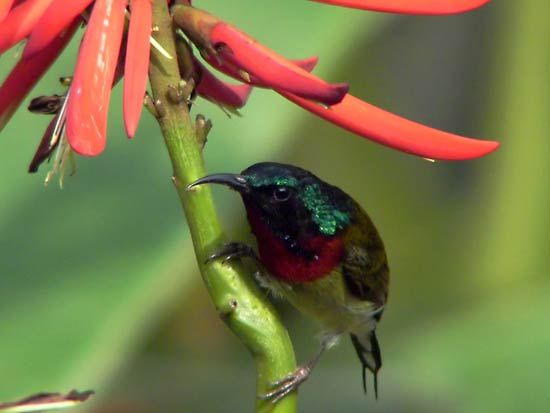
- Sunbirds: Known for their iridescent plumage in breeding males, these birds typically measure 9 to 15 cm in length. Unlike hummingbirds, they generally perch on flower stalks to feed rather than hovering.1
- Spider hunters: These are generally plainer in appearance, possessing longer bills and shorter tails, and are found mainly in Southeast Asia.12
Physically, members of this family are characterized by slender, downcurved bills, partially tubular tongues, and short, rounded wings. They sustain themselves by consuming small insects and sipping nectar from flowers. While some species were historically misidentified as members of this family—such as the false sunbird, which actually belongs to the family Philepittidae—the Nectariniidae remain a distinct and specialized group of oscine birds.2134
How do sunbirds differ from hummingbirds?
Although sunbirds and hummingbirds share a similar appearance and lifestyle due to convergent evolution, they are unrelated species belonging to different orders.15
The primary differences between these two groups include:
- Geographic Distribution: Hummingbirds (family Trochilidae) are native exclusively to the New World, with the greatest diversity found in South America. Sunbirds (family Nectariniidae) are found in the Old World, primarily in Africa and Asia, extending to Pacific islands.567
- Feeding Behavior: Hummingbirds are famous for their ability to hover in mid-air while feeding on nectar. In contrast, sunbirds rarely hover; they typically perch on a flower stalk or nearby twig to feed.678
- Classification: Hummingbirds are generally placed in the order Apodiformes, while sunbirds are songbirds in the order Passeriformes.76
- Flower Adaptation: Because hummingbirds feed on the wing, they often visit pendant, radially symmetrical flowers that lack landing platforms. Sunbird-pollinated flowers in Africa and Asia are often erect and provide a landing platform or perch for the bird to use while feeding.8
What are spider hunters and where do they live?
Spider hunters are a group of songbirds belonging to the family Nectariniidae and the genus Arachnothera.39
Unlike their relatives, the sunbirds, which are known for their brilliant, iridescent plumage, spider hunters are generally plain in appearance. They are physically distinguished by their longer bills and shorter tails. Like other members of the Nectariniidae family, they possess slender, downcurved bills and partially tubular tongues, which they use to sip nectar from flowers and consume small insects.93
Regarding their habitat, spider hunters are found primarily in the Orient, specifically throughout Southeast Asia.39
It is important to note that the term “spider hunter” refers to these birds and should not be confused with various arachnids that actively hunt prey, such as the giant huntsman spider or other wandering spiders, which are unrelated to the bird family.10111
Why do sunbirds have downcurved bills?
Sunbirds have downcurved bills primarily as an evolutionary adaptation for their specialized feeding habits. These slender, decurved (curved downward) bills are classified as “probing” tools, which allow the birds to efficiently reach into tubular flowers to access nectar and extract tiny insects.1
The shape of a bird’s bill is highly plastic and often reflects its specific food preferences rather than just its family lineage. Because sunbirds rely on nectar as a primary food source, their bills have evolved to navigate the structures of various flowers, enabling them to probe deep within blossoms that might otherwise be inaccessible. This morphological specialization is a classic example of how selective pressures drive the development of features that facilitate effective food handling and energy acquisition.114
Sources
- Sunbird — Encyclopædia Britannica
- Nectariniidae — Merriam-Webster
- Nectariniidae — Encyclopædia Britannica
- False sunbird — Encyclopædia Britannica
- The rodent that acts like a hippo — Encyclopædia Britannica
- pollination - Birds — Encyclopædia Britannica
- Apodiform - Distribution and abundance — Encyclopædia Britannica
- Hummingbird — Encyclopædia Britannica
- spider - Stalking prey — Encyclopædia Britannica
- Spider hunter — Encyclopædia Britannica
- giant huntsman spider: Top Questions — Encyclopædia Britannica
- giant huntsman spider — Encyclopædia Britannica
- wandering spider — Encyclopædia Britannica
- Passeriform - Bill — Encyclopædia Britannica
- Coraciiform - Morphological specializations — Encyclopædia Britannica
- orchid - Bird pollination — Encyclopædia Britannica
Published on · 3 min read