Chicken
Chickens (Gallus gallus) were likely domesticated over the last 7,400 years in Southeast Asia and India, initially for religious purposes or cockfighting.…
How have chickens been domesticated and bred for different purposes throughout history?
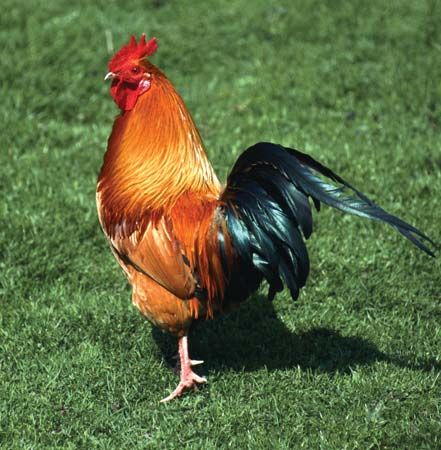
Chickens (Gallus gallus) were likely domesticated over the last 7,400 years in Southeast Asia and India, initially for religious purposes or cockfighting. Over millennia, they spread globally as common farm livestock.1
Historically, meat production was a secondary by-product of egg-laying hens. However, by the mid-20th century, specialized industrial production emerged, driven by advancements in poultry breeding and genetic selection. Modern breeding utilizes inbreeding, crossbreeding, and heterosis (hybrid vigour) to maximize efficiency.12
Today, breeds are categorized by their commercial utility:
- Egg Production: The Leghorn is a prolific layer favored by the global industry.3
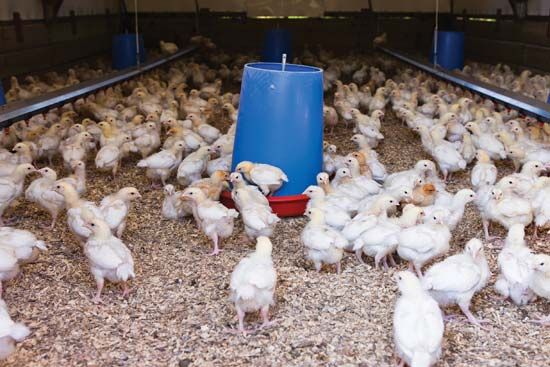
- Meat Production: The Cornish Cross is widely used for its rapid growth and high-quality carcass.3
- Dual-Purpose: Breeds like the Rhode Island Red and Brahma are popular in small-scale or backyard flocks for both meat and eggs.3
What are the main breeds of chickens and their unique features?
Chicken breeds are generally categorized by their geographic origins—American, Mediterranean, English, and Asiatic—though they are more commonly distinguished today by their utility in industrial or small-scale farming.3
Industrial Breeds
Commercial facilities prioritize efficiency and rapid growth, relying on a limited number of specialized breeds:3
- White Leghorn: A Mediterranean breed that serves as the standard for the global egg industry due to its prolific laying ability and early sexual maturity.3
- Cornish Cross: A hybrid resulting from the Cornish and White Rock breeds. It is the primary choice for industrial meat production, valued for its compact, meaty carcass and rapid growth rate.3
Dual-Purpose and Backyard Breeds
Small farms often favor breeds that provide both meat and eggs:3
- American Breeds: Varieties such as the Plymouth Rock, Wyandotte, Rhode Island Red, and New Hampshire are highly regarded for their dual-purpose utility.3
- Asiatic Breeds: The Brahma is a notable example, prized for its large size, meat quality, and production of large brown eggs.3
How do chickens communicate and interact with each other in their social structure?
Chickens maintain a structured social environment primarily through a system known as the pecking order. This social hierarchy determines access to essential resources, including food, nesting sites, and mates.5
Social Hierarchy
Within a flock, the hierarchy is typically segregated by sex. A dominant adult male often oversees a group of females and subdominant males. The pecking order manifests as a system where higher-ranking individuals can assert their status by pecking those of lower rank without fear of retaliation. While this behavior ensures order, altercations can also involve scratching with claws or pummeling with wings, particularly when a new bird is introduced to the flock.5
Development and Communication
- Formation: In female chicks, the pecking order is established by the 10th week of life. Among males, dominance struggles can persist into adulthood, often resulting in more aggressive physical confrontations than those seen among females.5
- Vocalization: Like many birds, chickens utilize vocalization as a primary form of communication. Their repertoire of calls allows them to signal various states or needs, such as alarm, aggression, contentment, hunger, or the presence of food.1
What is a chicken?
The chicken (Gallus gallus) is a medium-sized poultry bird and one of the most widely domesticated animals in the world, raised primarily for its meat and eggs. Taxonomically, it belongs to the family Phasianidae and the order Galliformes, with most experts considering it a descendant of the wild red jungle fowl of India1.1
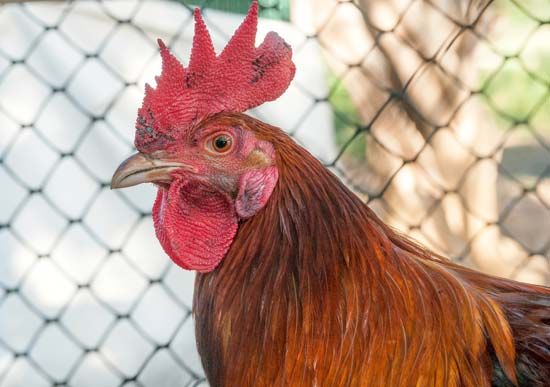
Physically, chickens are characterized by a squat, rounded appearance, fleshy combs, and lobed wattles. Males, known as roosters, and females, known as hens, typically stand under 70 cm tall and weigh about 2.6 kg. They are social animals that organize themselves into a pecking order, a hierarchy that dictates access to resources like food and mates.1
Domestication likely began in Southeast Asia and India over 7,400 years ago, initially for religious purposes or cockfighting. While they were long a staple of small-scale farming, they became a mass-production commodity in the 20th century.1
Sources
- Chicken — Encyclopædia Britannica
- Poultry farming - Management — Encyclopædia Britannica
- Poultry farming - Chickens — Encyclopædia Britannica
- Poultry — Encyclopædia Britannica
- Pecking order — Encyclopædia Britannica
- Vocalization — Encyclopædia Britannica
Published on · 3 min read