Aquifoliaceae
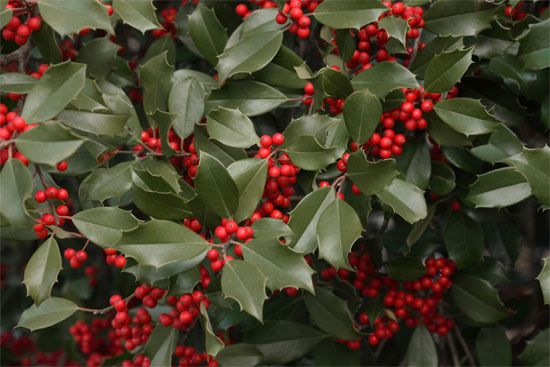
Aquifoliaceae, commonly known as the holly family, is a group of flowering plants within the order Aquifoliales. This family comprises approximately 400…
What is Aquifoliaceae?
Aquifoliaceae, commonly known as the holly family, is a group of flowering plants within the order Aquifoliales1. This family comprises approximately 400 species of trees and shrubs, which are distributed worldwide but are most prevalent in tropical mountainous regions.12
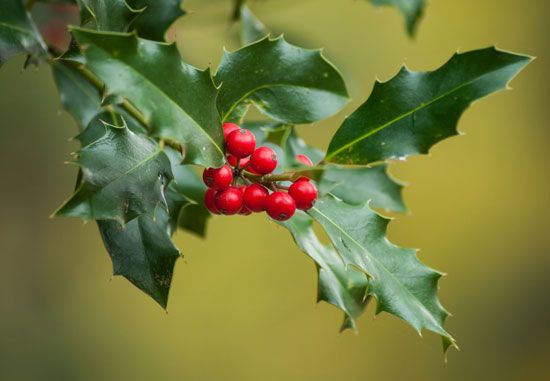
The family is best known for the genus Ilex (holly), which includes species such as Ilex aquifolium (European holly) and I. opaca (American holly), both valued for their ornamental use and wood. Additionally, the leaves of I. paraguariensis are used to produce the caffeine-rich beverage yerba maté.21
Botanically, Aquifoliaceae are characterized by:
- Leaves: Alternate, simple, and often evergreen, sometimes featuring small glands.31
- Flowers: Small and typically dioecious (unisexual flowers on separate plants), often clustered in leaf axils.31
- Fruit: Fleshy drupes that are frequently brightly colored when ripe.31
What is the difference between a berry and a drupe?
In botany, both berries and drupes are classified as simple fleshy fruits derived from a single ovary of an individual flower, but they differ significantly in their internal structure and seed composition.456
Drupes (Stone Fruits)
A drupe is characterized by a pericarp (fruit wall) that differentiates into three distinct layers:
- Exocarp: A thin outer skin or peel.46
- Mesocarp: A thick, fleshy, or fibrous middle layer.46
- Endocarp: A hard, stony “pit” or “stone” that encloses the seed.46
Drupes typically contain a single seed protected within this stony endocarp. Common examples include peaches, cherries, plums, and olives.46
Berries
A berry is a fleshy fruit where the middle and inner layers of the fruit wall are generally not distinct from one another. Unlike drupes, berries are typically many-seeded and are fleshy throughout. Examples of true botanical berries include tomatoes, grapes, bananas, and blueberries-plant), and blueberries.56
It is important to note that many fruits commonly called “berries” in everyday language—such as strawberries, raspberries, and blackberries—are not true berries but are aggregate fruits formed from multiple carpels of a single flower.456
How is yerba maté prepared from holly leaves?
The preparation of yerba maté from the leaves of the Ilex paraguariensis shrub involves a precise process of drying, grinding, and brewing.
Processing the Leaves
Methods for drying the leaves vary by region:
- Traditional Roasting: In Brazil, leafy branches are roasted over a fire on a platform called a tatacua and then heated on an arch of poles. The dried leaves are subsequently ground into a coarse powder.
- Refined Methods: In Paraguay and parts of Argentina, the midribs are removed before roasting to produce a finer product known as caaminí.
- Modern Techniques: Some producers now use large cast-iron pans to heat the leaves, a process similar to the method used for drying tea leaves.8
Brewing and Consumption
The dried leaves, or yerba, are placed into a vessel—traditionally a dried hollow gourd called a mate or culha—and covered with hot, but not boiling, water. The beverage is consumed through a metal straw known as a bombilla, which features a strainer at the bottom to filter out leaf particles. The vessel is typically refilled with hot water multiple times and is often shared communally.8
Why do male and female holly plants need to be planted together?
Holly plants (genus Ilex) are dioecious, meaning that individual plants are either male or female and produce only one type of flower.910
Because the male and female reproductive structures are borne on separate plants, they must be planted in proximity to ensure successful pollination. For fertilization to occur, pollen must be transferred from the male flowers to the female flowers, typically by insects or wind. Only the female plants are capable of producing the iconic drupes (fruits) that are highly valued for their ornamental appearance and as a food source for birds. If you plant only female hollies without a nearby male to provide pollen, the female plants will not develop these characteristic fruits.91110
Sources
- Aquifoliaceae — Encyclopædia Britannica
- Aquifoliaceae — Merriam-Webster
- Aquifoliales — Encyclopædia Britannica
- drupe — Encyclopædia Britannica
- berry — Encyclopædia Britannica
- fruit - Types of fruits — Encyclopædia Britannica
- angiosperm - Fruits — Encyclopædia Britannica
- mate — Encyclopædia Britannica
- holly — Encyclopædia Britannica
- Do Plants Have Sexes? — Encyclopædia Britannica
- pollination — Encyclopædia Britannica
Published on · 3 min read