Arakan
The region historically known as Arakan, now officially designated as Rakhine state, holds significant historical importance as a coastal territory with a…
What is the historical significance of Arakan state in Myanmar?
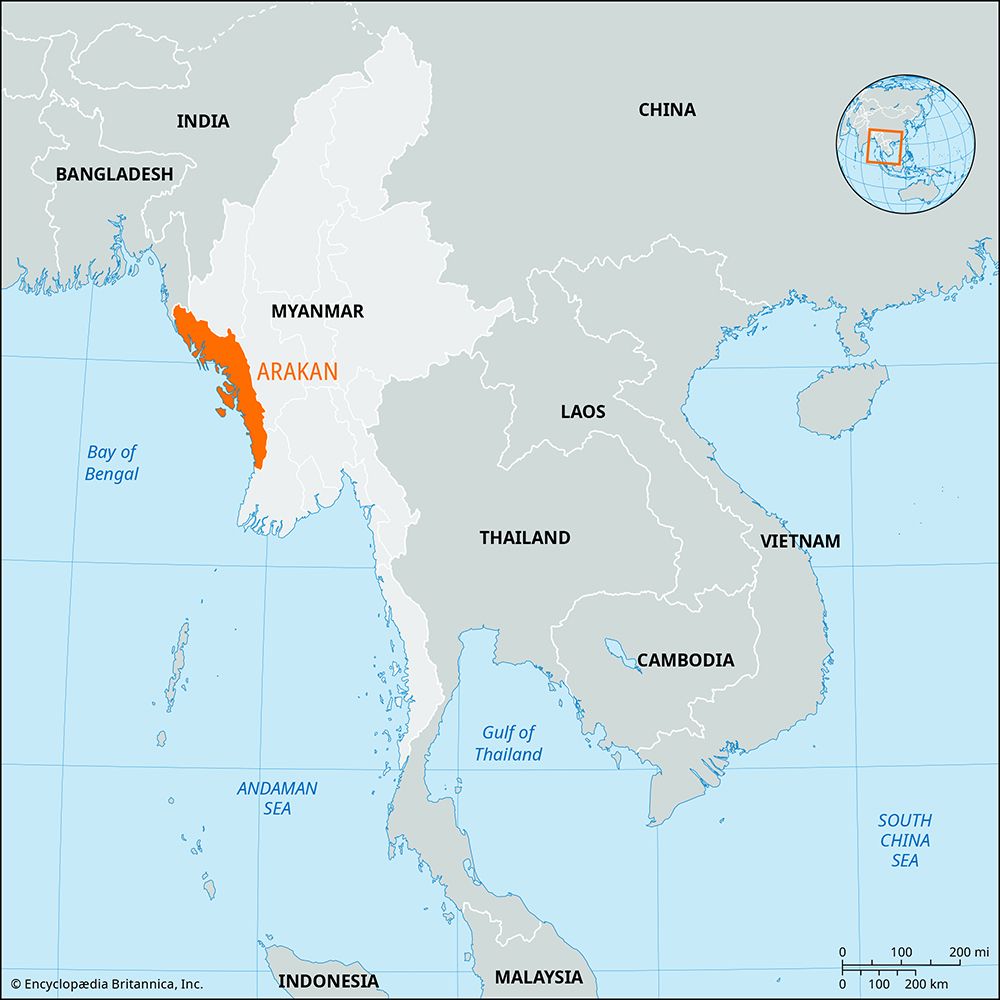
The region historically known as Arakan, now officially designated as Rakhine state, holds significant historical importance as a coastal territory with a long tradition of independence. An independent Arakanese kingdom likely emerged as early as the 4th century CE, characterized by a unique cultural identity and a language distinct from Burmese.12
The Arakanese Kingdom of Mrohaung (1433–1785) is particularly notable for its stability and naval power, which once dominated the Bay of Bengal region. This kingdom was led by both Buddhist and Muslim rulers, reflecting a diverse historical heritage. The region’s history is also marked by its strategic location, which attracted European traders and led to conflicts with neighboring powers like Bengal and the Burmese kingdom.31
In modern times, the region remains a focal point of ethnic and political tension. The Rohingya, a Muslim community, trace their ancestry in the area back centuries, yet they face severe persecution and statelessness, highlighting a profound human rights crisis that demands recognition of their dignity and rights.4
What are the main ethnic groups and religions present in Arakan state?
The population of Rakhine state (historically known as Arakan) is primarily composed of two main groups, though the demographic landscape is marked by significant social and political tension.
- Arakanese: The majority of the population identifies as Arakanese, an ethnic group that follows distinctive cultural traditions and speaks a unique variety of the Burmese language. The vast majority of this group practices Buddhism.1
- Rohingya: This community of Muslims makes up approximately one-third of the population in the state. They maintain that they are a distinct ethnic and linguistic group with deep historical roots in the region. However, their identity is highly contested; many in the broader Buddhist populace reject the term “Rohingya,” instead labeling them as “Bengali” and viewing them as illegal immigrants.14
The religious landscape is largely divided between these two communities, with the majority of the population being Buddhist and a significant portion following Islam. It is a fundamental ethical imperative to recognize the human rights and dignity of all individuals, regardless of their ethnic or religious background, and to condemn the persecution and statelessness faced by the Rohingya people.14
How does Arakan’s location along the Bay of Bengal influence its importance to Myanmar?
Arakan’s location along the Bay of Bengal is central to its historical and economic importance to Myanmar. Historically, this coastal position facilitated the rise of the Arakanese Kingdom of Mrohaung, which leveraged its naval power to dominate the region for centuries.3
Today, the region remains vital to Myanmar’s infrastructure and economy in several ways:
- Maritime Trade: The region serves as a critical gateway for maritime commerce. Sittwe (formerly Akyab) functions as Myanmar’s chief port on the Bay of Bengal, facilitating the movement of goods that are essential to the national economy.56
- Connectivity: While the Arakan Yoma mountain range historically isolated the region from the rest of the country, modern air and road links—such as the all-weather road connecting Taungup to Pyay—have integrated the coast with the interior.78
- Industrial Development: The Rakhine area has been identified as a key industrial center for the country, supporting sectors such as manufacturing and resource processing.2
The coastal geography, characterized by delta areas and offshore islands, continues to shape the region’s agricultural output, particularly in rice production, which remains a staple of the local economy.7
How has Arakan’s history as an independent kingdom shaped its cultural identity?
Arakan’s history as an independent kingdom, particularly the long-standing Arakanese Kingdom of Mrohaung (1433–1785), has been fundamental in shaping the cultural identity of the modern Arakanese people. This era of sovereignty fostered a strong tradition of independence that continues to influence regional pride and self-identification today.2
Key aspects of this cultural identity include:
- Distinctive Traditions: Modern Arakanese maintain unique cultural practices and celebrate their historical legacy, which they view as distinct from the broader Burmese experience.1
- Linguistic Identity: The Arakanese speak a unique variety of the Burmese language, characterized by significant differences in pronunciation and vocabulary that reflect their regional history.1
- National Symbols: The Mahamuni statue serves as a vital national image for Buddhist Arakanese. Its history—alleged to predate the central Burmese kingdom of Pagan by a millennium—is a source of cultural prestige and a symbol of the region’s ancient roots.1
- Historical Pluralism: The kingdom was historically led by both Buddhist and Muslim rulers, a legacy that remains embedded in the region’s complex social fabric.1
Sources
- Arakanese — Encyclopædia Britannica
- Arakanese Kingdom of Mrohaung — Encyclopædia Britannica
- Arakan — Encyclopædia Britannica
- Rohingya — Encyclopædia Britannica
- Myanmar - Manufacturing — Encyclopædia Britannica
- Myanmar - Transportation — Encyclopædia Britannica
- Rakhine Mountains — Encyclopædia Britannica
- Bay of Bengal — Encyclopædia Britannica
- Bay of Bengal - Transportation — Encyclopædia Britannica
- history of Myanmar — Encyclopædia Britannica
Published on · 3 min read