Arawana
The term "arawana" (also spelled "arowana") refers to a group of large, tropical, carnivorous freshwater fish belonging to the family Osteoglossidae. While…
What is arawana?
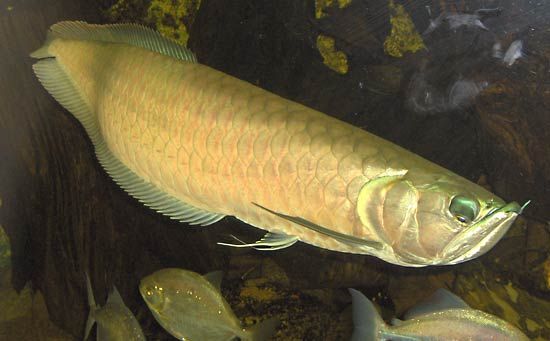
The term “arawana” (also spelled “arowana”) refers to a group of large, tropical, carnivorous freshwater fish belonging to the family Osteoglossidae. While the specific species Osteoglossum bicirrhosum is native to South America, the name is broadly applied to various species found across Africa, Australia, and southeastern Asia.12
These fish are characterized by their large, bony scales, a toothed tongue, and a large mouth with an oblique gape. The South American variety typically features long dorsal and anal fins that nearly meet the tail, an upward-angled lower jaw, and two filamentous barbels extending from the chin. Known for their laterally compressed bodies, they can appear in colors such as silver, gold, red, or green. In the wild, some may grow to lengths of four feet (1.2 meters), though they are often smaller in aquarium settings. They are also commonly referred to as dragonfish or bonytongues.21
Why are arowanas sometimes called dragonfish?
Arowanas are frequently referred to as dragonfish due to their distinctive physical appearance, which many observers associate with the mythical dragon. Their large, metallic-looking scales, which can shimmer in shades of gold, red, or green, resemble the armored plating often depicted in folklore. Additionally, their elongated, laterally compressed bodies and the presence of barbels on their chins contribute to this dragon-like aesthetic.2
While the term “dragonfish” is a common colloquial name for these members of the Osteoglossidae family, it is essentially a synonym for the arowana itself. This association is particularly strong in certain cultures where the fish is highly prized in the aquarium trade as a symbol of luck and prosperity, further cementing its “dragon” moniker.23
What does it mean for a fish to be a mouth brooder?
A mouth brooder is any fish that protects its offspring by carrying its eggs and young within its mouth until they hatch or reach a more developed stage. This reproductive strategy is a form of parental care observed in various species, including certain catfishes, cichlids, and cardinal fishes.45
In the case of the arawana (Osteoglossum bicirrhosum) and its Indo-Australian relatives, such as the spotted bonytongue and the Asian arowana, one parent carries the eggs and young in its mouth to ensure their safety. Depending on the species, the duration of this care can last for several weeks. While mouth brooding is a primary method of protection for these fish, other members of the Osteoglossidae family, such as the African arowana, utilize different strategies like nest-building to guard their young.164
How do arowanas hunt in their natural habitat?
Arowanas are highly specialized predators that utilize their unique anatomy to hunt in their natural tropical habitats. Their lower jaw is angled sharply upward, allowing them to effectively target prey at the water’s surface. This adaptation is complemented by two long, filamentous barbels extending from the chin, which are highly sensitive to touch and equipped with taste buds to help the fish locate and select food before ingestion.17
While the provided information highlights these physical adaptations, it is important to note that arowanas are known for their agility and ability to leap from the water to capture insects, small birds, and other prey hanging from overhanging vegetation. Their body shape, characterized by long dorsal and anal fins, provides the power and stability needed for such predatory strikes.1
Sources
- arawana — Encyclopædia Britannica
- arowana — Merriam-Webster
- dragonfish — Merriam-Webster
- mouthbreeder — Encyclopædia Britannica
- osteoglossomorph - Life cycle and reproduction — Encyclopædia Britannica
- mouthbreeder — Merriam-Webster
- ostariophysan - Barbels — Encyclopædia Britannica
Published on · 2 min read