Bowfin
The bowfin (Amia calva) is a predatory freshwater fish and the sole surviving member of the order Amiiformes, a lineage that dates back to the Jurassic…
What is bowfin?
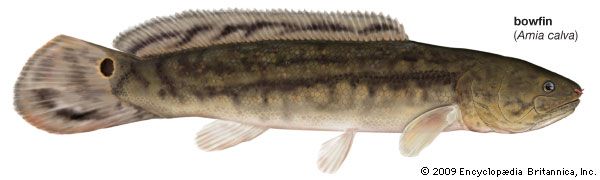
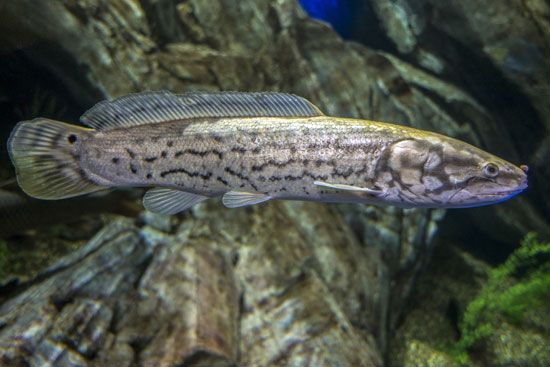
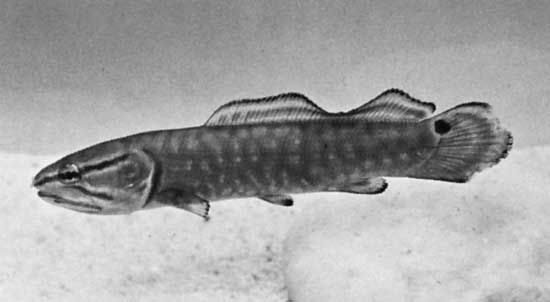
The bowfin (Amia calva) is a predatory freshwater fish and the sole surviving member of the order Amiiformes, a lineage that dates back to the Jurassic Period. Found in the sluggish waters of eastern North America, these fish are known for their ability to breathe by gulping air into their gas bladder, allowing them to survive in low-oxygen environments.12
Physically, the bowfin is mottled green and brown with a long dorsal fin and strong, conical teeth. Males are typically smaller than females and feature a distinctive black tail spot circled with orange. As generalist predators, they consume a variety of prey, including insects, crustaceans, and other fishes. While long considered a single species, recent research suggests the bowfin may actually consist of two to four distinct species that diverged millions of years ago.1
What other animals are considered living fossils?
The term “living fossil” refers to an organism that has remained essentially unchanged from earlier geologic times and whose close relatives are typically extinct. While the term is descriptive rather than a formal taxonomic classification, several animals are frequently cited as examples due to their ancient lineages and morphological stability over millions of years.3
Common examples of living fossils include:
- Horseshoe crabs: These marine arthropods are classic examples of organisms that have persisted with little change for vast stretches of geologic time.3
- Pelican spiders: These unique arachnids are considered living fossils because they possess an ancient fossil record and have exhibited very little evolutionary change over time.4
Beyond these specific examples, the concept of a living fossil highlights the success of certain organisms in occupying stable ecological niches that have allowed them to persist while other, more specialized groups have gone extinct. While the fossil record provides essential evidence for these lineages, it is often incomplete, particularly for soft-bodied animals that do not leave behind hard skeletons.56
How does the bowfin’s ability to breathe air help it survive?
The bowfin (Amia calva) possesses both gills and a gas bladder, allowing it to utilize both aquatic and aerial respiration to survive in varying environmental conditions.17
This ability is particularly advantageous in the sluggish, warm waters of North America where the bowfin resides. During warmer months, when water temperatures rise and dissolved oxygen levels decrease, the fish compensates by rising to the surface to gulp air. Research indicates that the bowfin’s reliance on air breathing increases significantly with temperature and physical activity; at approximately 30°C (86°F), it may derive about three times as much oxygen from the air as it does from the water.17
While the gas bladder serves as an essential site for oxygen uptake, the bowfin continues to rely primarily on its gills for the elimination of carbon dioxide. By adjusting its air-breathing frequency based on the oxygen content of the water, the bowfin can effectively thrive in habitats that might otherwise be too oxygen-poor for less adaptable species.17
What are some other fish that live in the Mississippi River basin?
The Mississippi River basin supports a diverse array of fish species, ranging from native populations to naturalized invasive varieties.
Important fish species found in the river include:
- Catfish: Several types of catfish inhabit the river, with some reaching significant sizes and supporting commercial fishing operations along the middle and lower reaches.910
- Walleyes and Suckers: These species are particularly prevalent in the upper river, where they serve as a foundation for the sport-fishing industry in states like Minnesota and Wisconsin.910
- Garfish: These ancient, predatory fish are a notable component of the river’s native biodiversity.910
- Carp: The river is home to both native carp and several invasive species collectively known as Asian carp. These include the grass carp, bighead carp, black carp, and silver carp, which have colonized the system and pose significant ecological challenges to native aquatic life.91110
Sources
- bowfin — Encyclopædia Britannica
- bowfin — Merriam-Webster
- living fossil — Merriam-Webster
- pelican spider: Top Questions — Encyclopædia Britannica
- crustacean - Evolution and paleontology — Encyclopædia Britannica
- Animal - Evolution and paleontology — Encyclopædia Britannica
- How do fish breathe? — Encyclopædia Britannica
- Respiratory system - Fishes — Encyclopædia Britannica
- Mississippi River - Plant and animal life — Encyclopædia Britannica
- Asian carp — Encyclopædia Britannica
- Mississippi River: Top Questions — Encyclopædia Britannica
Published on · 3 min read