Bony Tongue
A bony tongue refers to any of several heavy-bodied tropical freshwater fishes belonging to the family Osteoglossidae. These fish are characterized by their…
What is bony tongue?
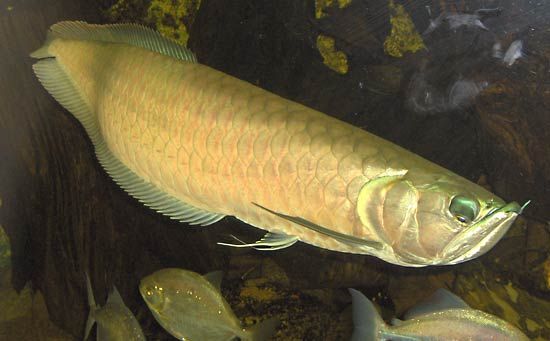
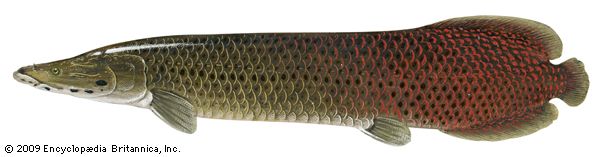
A bony tongue refers to any of several heavy-bodied tropical freshwater fishes belonging to the family Osteoglossidae. These fish are characterized by their large, hard, mosaic-like scales, which cover their bodies except for their heads.1
The name “bony tongue” is derived from a unique anatomical feature shared by the broader group known as osteoglossomorphs: they use their tongues as an opposing surface for their teeth when biting into food.2
Notable members of this family include:
- The pirarucu (Arapaima gigas), a massive South American species that can reach lengths of up to 3 meters (10 feet).13
- The arawana (Osteoglossum bicirrhosum).1
- The African Heterotis.1
- Various species within the East Indian genus Scleropages.1
These fishes are primarily found in the tropical freshwater environments of Africa, South America, and Australasia, a distribution pattern that is of significant interest to zoogeographers.32
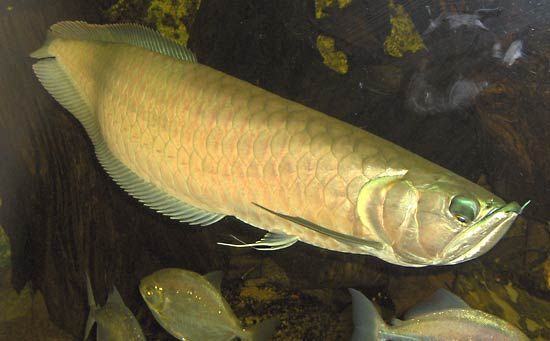
How do these fish use their tongues to eat?
Osteoglossomorphs, which include the bony tongue family, possess a unique feeding mechanism that distinguishes them from other bony fishes.
Rather than relying solely on jaw teeth to process prey, these fish utilize their tongues as an active, functional component of their bite. Specifically, they use the tongue as an opposing surface against which their teeth press when they bite into food. This anatomical adaptation allows them to effectively grasp or manipulate their prey within the mouth cavity, serving as a specialized tool for feeding.3
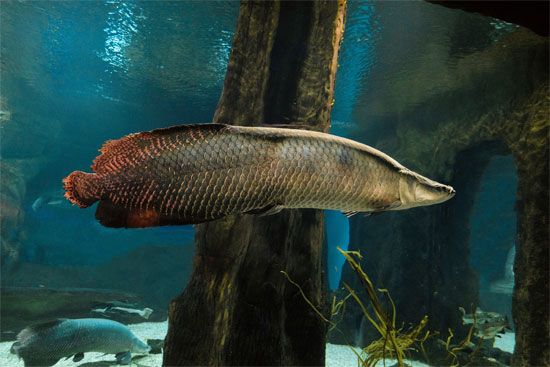
What makes the arapaima one of the largest freshwater fish?
The pirarucu (Arapaima gigas), also known as the arapaima, is recognized as one of the largest freshwater fish in the world, reaching lengths of nearly 3 meters (10 feet) and weights up to 220 kg (485 pounds).1
Several factors contribute to its status and survival as a giant in Amazonian rivers and lakes:
- Air-Breathing Capability: Unlike many other fish, the arapaima possesses an air bladder that functions as a lung, allowing it to breathe air.1
- Niche Adaptation: This ability to breathe air allows the arapaima to thrive in oxygen-poor waters. In these environments, its prey becomes sluggish and torpid, making them easier to capture.1
- Efficient Feeding: As a member of the bony tongue family, it utilizes a large, tooth-studded tongue to crush its prey, a specialized adaptation that aids in its predatory success.1
While it is a vital protein source for local populations, the species has faced population declines in some regions due to overfishing.1
Why is the distribution of these fish across different continents important?
The distribution of osteoglossomorphs across different continents is of significant zoogeographical interest because it provides evidence for the historical movement of Earth’s landmasses.
The presence of the Osteoglossidae family—which includes the pirarucu, arowana, and butterfly fish—across Africa, South America, and Australasia is widely believed by authorities to be a result of these regions once being joined as a single supercontinent called Gondwana. As these landmasses drifted apart over geological time, the fish populations were separated, leading to the distinct but related distributions observed today.
This pattern of distribution serves as a biological marker for the geological history of the planet. By studying how these ancient, primitive bony fishes are spread across isolated continents, scientists can better understand the long-term evolutionary changes and the environmental shifts that have shaped modern biodiversity.
Sources
- bony tongue — Encyclopædia Britannica
- osteoglossomorph - General features — Encyclopædia Britannica
- osteoglossomorph — Encyclopædia Britannica
- Osteoglossum — Merriam-Webster
- ostariophysan - Teeth — Encyclopædia Britannica
- pirarucu — Encyclopædia Britannica
- osteoglossomorph - Annotated classification — Encyclopædia Britannica
- fish - Distribution and abundance — Encyclopædia Britannica
Published on · 3 min read