Brook Trout
The brook trout (Salvelinus fontinalis) is a popular freshwater fish belonging to the salmon family, Salmonidae. It is a type of char highly valued by…
What is brook trout?
The brook trout (Salvelinus fontinalis) is a popular freshwater fish belonging to the salmon family, Salmonidae. It is a type of char highly valued by anglers for its flavor and its spirited behavior when hooked.1
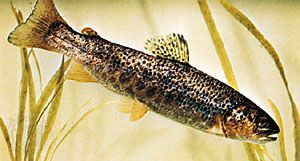
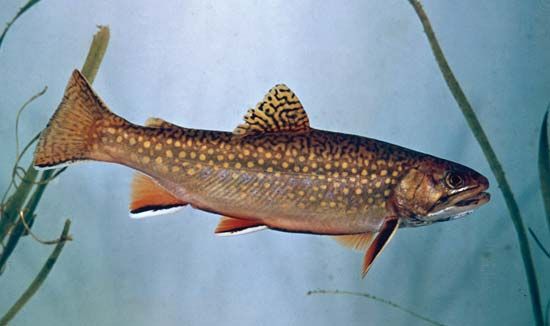
Native to the northeastern United States and Canada, this species has been introduced to various regions worldwide. Brook trout thrive in cold, clean water and are easily identified by their distinct dark, wormlike markings on their backs, as well as red and whitish spots along their bodies. They also feature white edges on their lower fins and the lower lobe of the tail fin.1
While typically weighing up to three kilograms (six pounds), some individuals that migrate to large lakes or the sea can grow significantly larger and develop a more silvery appearance.1
What makes brook trout different from other salmon species?
The brook trout (Salvelinus fontinalis) is distinct from many other salmon and trout species primarily because it is classified as a char within the genus Salvelinus. While all these fish belong to the family Salmonidae, the brook trout exhibits specific anatomical and physical traits that differentiate it from members of the genus Oncorhynchus, such as rainbow or cutthroat trout.12
Key differences include:
- Coloration: Unlike Oncorhynchus species, which typically feature red or black spots on a lighter-colored body, brook trout (as chars) are characterized by light-colored (red or cream) spots on a darker-colored body.23
- Anatomy: Chars possess a boat-shaped vomer bone in the roof of the mouth that is toothed only at the front. In contrast, Oncorhynchus species have a flatter vomer with teeth on both the front and the shaft.23
- Physical Markings: Brook trout are specifically recognized by dark, wormlike markings on their backs and white edges on the leading margins of their lower fins and the lower lobe of the tail fin.1
Why do brook trout require such cold and clean water?
Brook trout (Salvelinus fontinalis) are highly specialized freshwater fish that rely on cold, clean water to survive and thrive. Their physiological requirements are tied to their evolutionary adaptation to specific aquatic environments:1
- Oxygen Levels: Cold water holds significantly more dissolved oxygen than warmer water. Because brook trout have high metabolic rates, they require these oxygen-rich environments to support their active, predatory lifestyle.1
- Sensitivity to Pollution: As a species that inhabits pristine, cold-water ecosystems, brook trout are highly sensitive to environmental degradation. Clean water is essential because pollutants, sediment, and chemical runoff can interfere with their delicate respiratory systems and disrupt the spawning grounds necessary for their reproduction.1
- Thermal Tolerance: Brook trout are cold-water stenotherms, meaning they have a narrow range of temperature tolerance. Temperatures exceeding their preferred range cause significant physiological stress, reducing their ability to feed, grow, and compete with other species.1
How does the life cycle of a brook trout work?
The life cycle of the brook trout (Salvelinus fontinalis) is primarily centered in freshwater environments, though some populations exhibit migratory behavior. As members of the family Salmonidae, they are oviparous, meaning they lay eggs that undergo external fertilization.15
Spawning and Development
Brook trout spawn in cold, fresh water, typically utilizing streams where they exhibit nest-building behavior. Because these environments can be harsh, natural selection has favored the production of relatively large, heavy (demersal) eggs that develop on or within the stream or lake bottom. These large eggs contain significant yolk, which provides the necessary nutrients for the embryos to undergo direct development. Consequently, when the young hatch, they are in an advanced stage and resemble miniature adults.15
Life History Variations
While many brook trout complete their entire life cycle within the confines of a small pond or stream, some individuals migrate to large lakes or the sea. These migratory individuals often grow significantly larger and develop a more silvery appearance compared to their resident counterparts.15
Sources
- brook trout — Encyclopædia Britannica
- trout — Encyclopædia Britannica
- char — Encyclopædia Britannica
- protacanthopterygian - Behaviour and locomotion — Encyclopædia Britannica
- protacanthopterygian - Life cycle and reproduction — Encyclopædia Britannica
Published on · 3 min read