Bonito
A bonito is a swift, predacious, and tunalike schooling fish known for its striped back, silvery belly, and streamlined body. Typically reaching lengths of…
What is a bonito fish and how is it classified scientifically?
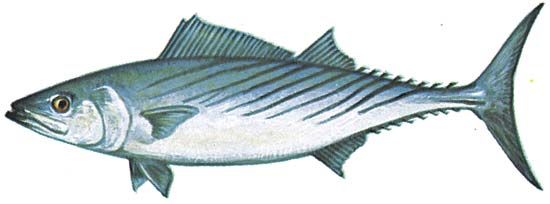
A bonito is a swift, predacious, and tunalike schooling fish known for its striped back, silvery belly, and streamlined body. Typically reaching lengths of about 75 cm (30 inches), these fish possess a narrow tail base, a forked tail, and a row of small finlets behind their dorsal and anal fins. They are highly valued in both commercial and sporting contexts.12
Scientifically, bonitos are classified as follows:
There are four generally recognized species within the genus Sarda: S. sarda (found in the Atlantic and Mediterranean), S. orientalis (Indo-Pacific), S. chilensis (eastern Pacific), and S. australis (Australia and New Zealand). While they share physical characteristics with tunas, they are distinct from the true tuna genus, Thunnus.12
Where are bonito fish typically found and what is their habitat like?
Bonito fish are found in temperate and tropical marine environments across the globe. As swift, predacious, and schooling fish, they are highly mobile and inhabit various oceanic regions depending on the specific species.1
Their distribution is categorized by geographic range:
- Atlantic and Mediterranean: Home to the Atlantic bonito (S. sarda).1
- Indo-Pacific: The primary habitat for S. orientalis.1
- Eastern Pacific: Where S. chilensis is found, including populations such as the Pacific bonito (S. chilensis lineolata) and the Eastern Pacific bonito (S. chilensis chiliensis).1
- Australia and New Zealand: The native range for S. australis.1
While they are members of the mackerel and tuna family, Scombridae, they are distinct from true tunas. Their habitat is characterized by open-water environments where their streamlined bodies and forked tails allow them to thrive as active, fast-swimming predators.1
What are some common fishing methods used to catch bonito?
Bonito are highly valued as both commercial and sporting fish due to their schooling behavior and predatory nature. The most prominent method used to catch them is pole-and-line fishing.16
Pole-and-Line Fishing
This method is widely employed in tropical Pacific and Atlantic waters to capture smaller members of the Scombridae family, including bonito, skipjack, and albacore.6
- Technique: Fishermen use poles—traditionally made of bamboo but often fiberglass in modern settings—ranging from two to 10 meters in length. Hooks are typically barbless to allow for quick removal of the catch.6
- Attraction: To keep schools near the vessel, fishermen use “chumming,” which involves throwing live bait into the water. Water spraying is also used to attract the fish and camouflage the shadows of the boat and crew.6
- Automation: Many modern operations utilize deck- or rail-mounted automated poles that are hydraulically or electrically operated to swing hooked fish onto the deck efficiently.6
How do bonito fish compare to other similar species like tuna or mackerel?
Bonito, tuna, and mackerel all belong to the family Scombridae, which explains their shared characteristics as swift, streamlined, and predacious schooling fish. Despite these similarities, they occupy distinct niches within the family:17
- Size and Morphology: Bonito (genus Sarda) are generally considered intermediate in size between mackerel and tuna. While mackerel are often smaller and more torpedo-shaped, and true tunas can grow significantly larger, all three share a narrow tail base, a forked tail, and a row of small finlets behind the dorsal and anal fins.517
- Appearance: Bonito are typically identified by their striped backs and silvery bellies. In contrast, common mackerel often feature wavy, dark vertical lines, while other related species like the Scomberomorus (Spanish mackerel) may be spotted or elongated with larger teeth.157
- Classification Nuances: The term “bonito” is sometimes used colloquially to refer to the skipjack tuna, which is also known as the oceanic bonito. Conversely, the name “mackerel” is occasionally applied to certain species of both tuna and bonito, reflecting their close evolutionary ties.157
Sources
- bonito — Encyclopædia Britannica
- Sarda — Merriam-Webster
- tuna — Encyclopædia Britannica
- Atlantic bonito — Merriam-Webster
- bonito — Merriam-Webster
- commercial fishing - Pole-and-line fishing — Encyclopædia Britannica
- mackerel — Encyclopædia Britannica
Published on · 3 min read