Archosaur
Dinosaurs are a subgroup within the archosaur lineage, which is a diverse group of reptiles known as "ruling reptiles". Rather than dinosaurs evolving from…
What is the evolutionary relationship between archosaurs and dinosaurs?
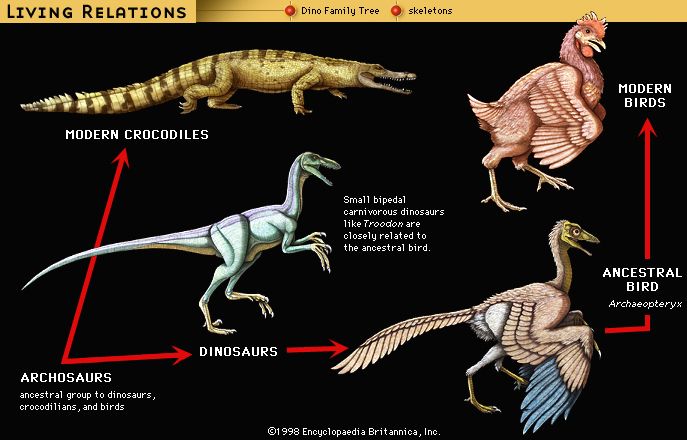
Dinosaurs are a subgroup within the archosaur lineage, which is a diverse group of reptiles known as “ruling reptiles”. Rather than dinosaurs evolving from crocodiles or vice versa, both groups share a common ancestor and represent distinct branches of the archosaur family tree.12
Archosaurs are divided into two primary branches:
- Pseudosuchia: This branch includes crocodiles and their extinct relatives.1
- Ornithosuchia: This branch includes dinosaurs, pterosaurs, and birds, which are the only living descendants of the dinosaur lineage.1
All archosaurs are united by specific anatomical features, including socketed teeth and a diapsid skull with two large openings behind the eye. While early researchers once looked to primitive “thecodontian” reptiles as ancestors, these are now recognized simply as basal archosaurs. Dinosaurs are specifically defined by a unique suite of derived traits—such as a fully open hip socket and specific skeletal modifications—that distinguish them from other archosaurian relatives.12
What are some examples of living archosaurs today?
The two primary groups of living archosaurs are birds and crocodilians.1
- Birds: Modern birds are the only surviving descendants of the dinosaur lineage. They belong to the branch known as Ornithosuchia, which includes dinosaurs and pterosaurs.13
- Crocodilians: This group includes all living species of crocodiles, alligators, caimans, and gavials. They belong to the Pseudosuchia branch, which consists of archosaurs more closely related to crocodiles than to birds.41
While many other archosaur groups existed during the Triassic Period, these two lineages are the only ones that survived to the present day.1
How do crocodilians and birds differ in their archosaurian traits?
While both crocodilians and birds are archosaurs, they belong to distinct evolutionary branches that developed significant differences in locomotion and anatomy over millions of years.
Locomotion and Ankle Structure
The most fundamental difference lies in their ankle joints, which dictate how they move:
- Crocodilians (Pseudosuchia): They possess a “cross-ankle” joint, where the connection between the astragalus and calcaneum is a peg-in-socket. This allows for a flexible, sprawling stance or a “high walk” where the legs are brought inward toward the body midline.16
- Birds (Ornithosuchia): Their ankle joints swing in only one plane (fore and aft). This structure restricts them to an upright, bipedal posture, requiring them to place one foot in front of the other.1
Skeletal and Anatomical Adaptations
- Posture: Nearly all pseudosuchians are typically quadrupedal, whereas ornithosuchians are typically bipedal.1
- Skull and Jaw: While both groups share archosaurian traits like the antorbital fenestra (an opening in the snout) and socketed teeth, birds have evolved a highly specialized skull. Unlike crocodilians, birds can move their upper mandible relative to the cranium, facilitated by a hinge between the frontal and nasal bones.17
- Respiratory and Circulatory Systems: Crocodilians have a complete ventricular septum in the heart, a unique trait among modern reptiles that helps separate aerated and nonaerated blood. Birds, however, have evolved highly efficient respiratory systems with pneumatic (air-filled) bones to support the high metabolic demands of flight, a feature not found in crocodilians.87
How are archosaurs different from other reptiles?
Archosaurs, often referred to as “ruling reptiles,” are distinguished from other reptiles by several unique anatomical features that set them apart from groups like lepidosaurs (lizards, snakes, and tuatara).
Key Anatomical Differences
- Tooth Attachment: Unlike other living reptiles, whose teeth are typically set in a shallow groove, the teeth of archosaurs are set in distinct sockets.1
- Skull Openings: Archosaurs possess two specific openings in the skull that are not found in other reptiles:
- Locomotion and Posture: Archosaurs are divided into two branches with distinct evolutionary paths regarding movement:
- Pseudosuchians (e.g., crocodiles): These typically feature a “cross-ankle” joint that allows for a sprawling stance or a “high walk.” They are generally quadrupedal.1
- Ornithosuchians (e.g., birds, dinosaurs): These possess an ankle joint that swings in only one plane (fore and aft), which facilitates an upright, bipedal posture.1
These structural traits have defined the archosaurian lineage since they first appeared in the Middle Triassic Period.1
Sources
- archosaur — Encyclopædia Britannica
- dinosaur - Dinosaur ancestors — Encyclopædia Britannica
- crocodile - Distribution and abundance — Encyclopædia Britannica
- dinosaur: Top Questions — Encyclopædia Britannica
- dinosaur - Classification — Encyclopædia Britannica
- crurotarsan — Encyclopædia Britannica
- reptile - Respiratory system — Encyclopædia Britannica
- reptile - Circulatory system — Encyclopædia Britannica
- reptile - Skull and dentition — Encyclopædia Britannica
- Bird - Skeleton — Encyclopædia Britannica
Published on · 3 min read