Marasuchus
The discovery of Marasuchus fossils has been instrumental in understanding the evolutionary transition toward dinosaurs. Classified as a basal…
How has the discovery of Marasuchus fossils contributed to our understanding of dinosaur origins?
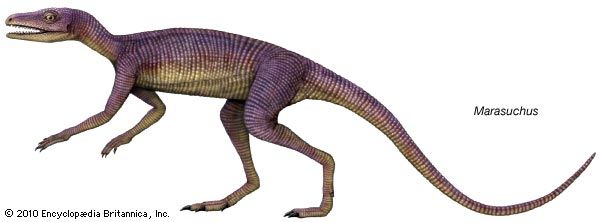
The discovery of Marasuchus fossils has been instrumental in understanding the evolutionary transition toward dinosaurs. Classified as a basal dinosauromorph, Marasuchus serves as a vital link, demonstrating that key skeletal features once thought unique to dinosaurs actually began to evolve during the Middle Triassic, prior to the formal emergence of dinosaurs in the Late Triassic.1
While Marasuchus lacks the perforated hip socket (acetabulum) that defines true dinosaurs, it exhibits other diagnostic traits, such as an elongate pubis and a specific anterior trochanter on the femur. These findings indicate that the anatomical blueprint for dinosaurs was being assembled incrementally in their precursors. Furthermore, Marasuchus provides evidence of an early bipedal, upright (parasagittal) gait, a locomotor style that would later become a hallmark of dinosaurian success. By studying this small, lightly built reptile, paleontologists have gained a clearer picture of the ancestral conditions that preceded the rise of the archosaurs as the dominant terrestrial vertebrates.12
How was Marasuchus first discovered and named?
Marasuchus fossils were discovered in the Los Chañares Formation, located within the Ischigualasto–Villa Unión Basin in northwestern Argentina.1
While the provided information details the location and geological context of the discovery, it does not specify the individuals responsible for the initial find or the etymological history behind the naming of the genus.
What evidence suggests that Marasuchus was bipedal, and how did this trait evolve?
Evidence that Marasuchus was bipedal is derived from its skeletal anatomy, which exhibits features characteristic of an upright, or parasagittal, gait. While the skull and lower jaw are missing from the fossil record, the rest of the skeleton reveals that Marasuchus possessed a lightly built frame with long hind limbs, a bowed femur, a hingelike knee, and a long foot with elongated toe bones. These anatomical traits are consistent with a mode of locomotion where the limbs swing directly forward and backward, rather than rotating, allowing the animal to move efficiently on two legs.13
The evolution of this trait represents a significant shift in archosaurian locomotion. Within the Ornithosuchia branch—which includes dinosaurs and their precursors—the ankle joint evolved to swing in a single plane, necessitating an upright posture. Bipedalism likely emerged as an adaptation for increased running speed, similar to the behavior observed in some modern lizards that run on their hind limbs to achieve higher velocities. By shifting to a vertical hind-limb posture, Marasuchus and other basal dinosauromorphs eliminated the inefficient side-to-side motion associated with a sprawled gait, a transition that eventually paved the way for the dominance of dinosaurs.453
What is the significance of Marasuchus in the evolutionary history of dinosaurs?
Marasuchus is a pivotal genus for understanding the evolutionary transition toward dinosaurs. Living during the Ladinian Age of the Middle Triassic, it serves as a key example of a basal dinosauromorph—a group representing the direct precursors to dinosaurs.1
Its significance lies in the mosaic of traits it displays. While Marasuchus lacks the perforated hip socket (acetabulum) that is a diagnostic feature of true dinosaurs, it possesses other critical skeletal adaptations, such as an elongate pubis and an anterior trochanter on the femur. These features demonstrate that the evolutionary innovations defining dinosaurs began to emerge during the Middle Triassic, well before the formal appearance of dinosaurs in the Late Triassic.1
By studying this small, bipedal archosaur, paleontologists can better map the incremental development of the anatomical characteristics that eventually allowed dinosaurs to dominate terrestrial ecosystems. Although other genera like Silesaurus are now considered closer relatives, Marasuchus remains essential for reconstructing the early history of the Dinosauromorpha lineage.1
We could dive deeper into how these specific skeletal traits facilitated the shift toward the upright, bipedal locomotion seen in later dinosaurs.
Sources
- Marasuchus — Encyclopædia Britannica
- Jurassic Period - Vertebrates — Encyclopædia Britannica
- archosaur — Encyclopædia Britannica
- dinosaur - Dinosaur ancestors — Encyclopædia Britannica
- dinosauromorph — Encyclopædia Britannica
- dinosaur - Modern studies — Encyclopædia Britannica
- reptile - Walking and crawling — Encyclopædia Britannica
Published on · 3 min read