How Are Fossils Formed?
Fossils are the preserved remains, impressions, or traces of ancient organisms. Their formation generally requires two primary conditions: the possession of…
How are fossils formed?
Fossils are the preserved remains, impressions, or traces of ancient organisms. Their formation generally requires two primary conditions: the possession of hard, resistant parts (such as bones, teeth, or shells) and rapid burial in sediment to prevent decomposition and scavenging.12
Once buried, several processes can occur:
- Permineralization: Minerals from surrounding groundwater fill the pores of the hard parts, turning them into stone.12
- Replacement: Original skeletal material is completely dissolved and replaced by new mineral matter.2
- Impression/Mold: Acidic solutions may dissolve the original shell, leaving a cavity that later fills with minerals to create a replica.2
- Carbonization: Plant matter is flattened between rock layers, leaving a thin carbon film.2
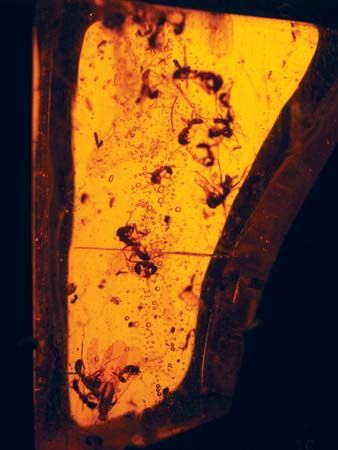
While rare, soft tissues can be preserved under exceptional conditions, such as entrapment in amber or freezing in ice. Additionally, trace fossils—such as footprints or waste—provide evidence of an organism’s activity without containing the organism itself.12
What are trace fossils and what can they tell us about ancient behavior?
Trace fossils are remnants that do not consist of the organism itself but instead provide evidence of an animal or plant’s activity during a past geologic age. These fossils, which include tracks, trails, preserved waste products, and borings, are the primary focus of ichnology—the scientific study of fossil footprints and tracks.3245
Because they capture behavior rather than anatomy, trace fossils offer unique insights into the lives of ancient creatures that skeletal remains alone cannot provide:
- Social Behavior: Trackways are critical evidence for herding behavior. For example, parallel footprints moving in the same direction suggest that animals, such as sauropods, traveled in groups or herds.6
- Migration Patterns: Large-scale trackway sites containing hundreds or thousands of prints suggest that many species engaged in mass migrations, likely in search of food.6
- Activity and Interaction: Beyond movement, traces like borings or waste products reveal how organisms interacted with their environment and other species, providing a broader picture of ancient ecosystems.2
How do scientists use index fossils to determine the age of rock layers?
Scientists use index fossils to determine the relative age of rock layers by applying the principle of faunal succession, which observes that specific groups of plants and animals succeeded one another in a predictable order throughout Earth’s history.789
To be effective as an index fossil, a species must meet several criteria:
- Short temporal range: The species existed for a brief span of geologic time, allowing geologists to pinpoint a specific interval.78
- Wide geographic distribution: Being found in many locations allows for the correlation of separated rock outcrops.78
- Abundance and distinctiveness: The fossils must be easy to identify and common enough to be discovered reliably.78
By identifying these fossils within sedimentary strata, geologists can establish that rocks containing the same index species were formed contemporaneously. This process, known as biostratigraphy, provides the foundation for the geologic time scale. While fossils provide relative ages, they are often calibrated using absolute dating techniques, such as measuring radioactive isotopes, to confirm the precise timing of these events.8971011
What is the difference between permineralization and carbonization?
Permineralization and carbonization are distinct processes by which fossils are preserved in the Earth’s crust.
Permineralization typically involves the hard parts of an organism, such as bones or shells. During this process, mineral-rich solutions seep into the internal pores or interstices of the skeletal material. As these minerals—such as calcium carbonate—precipitate, they fill the empty spaces, effectively petrifying the remains and turning them into a stony substance.1
Carbonization is a different process primarily associated with the preservation of soft tissues, such as leaves or stems. When organic matter is flattened between layers of sedimentary rock, chemical reduction occurs. This process removes other elements, leaving behind a thin, stable carbon film on one rock layer and a corresponding impression on the other.1
In short, permineralization acts as a mineral infusion into porous hard structures, while carbonization acts as a chemical distillation of organic matter into a carbon film.
Sources
- How are fossils formed? — Encyclopædia Britannica
- fossil — Encyclopædia Britannica
- trace fossil — Merriam-Webster
- dinosaur - Herding behaviour — Encyclopædia Britannica
- ichnology — Merriam-Webster
- ichn- — Merriam-Webster
- index fossil — Encyclopædia Britannica
- dating - Principles and techniques — Encyclopædia Britannica
- law of faunal succession — Encyclopædia Britannica
- biostratigraphy — Merriam-Webster
- dating - Distinctions between relative-age and absolute-age measurements — Encyclopædia Britannica
Published on · 3 min read