Are Deer Colorblind?
Deer are not completely colorblind, but they do have a limited form of color vision known as dichromacy. While humans typically possess three types of cone…
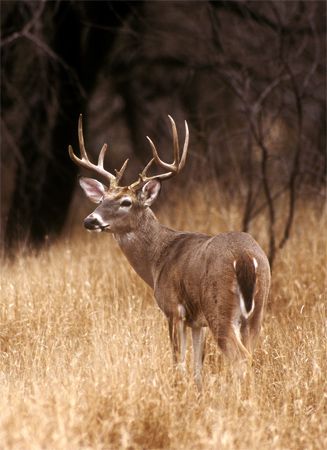
Are deer colorblind?
Deer are not completely colorblind, but they do have a limited form of color vision known as dichromacy. While humans typically possess three types of cone cells for color perception, deer have only two.1
This means that while deer can effectively perceive short-wavelength colors like blue and violet, as well as middle-wavelength colors like green, they struggle to distinguish long-wavelength colors such as red and orange. Consequently, their vision is somewhat comparable to red-green color blindness in humans.1
Rather than a wide color spectrum, deer eyes are highly adapted for survival in low-light conditions, such as dawn and dusk. They possess a high density of rod cells and a tapetum lucidum, which reflects light to enhance night vision and movement detection. Because they prioritize detecting motion and contrast over color discrimination, colors like blaze orange do not stand out to them as they do to the human eye.1
What is the function of the tapetum lucidum in animal eyes?
The tapetum lucidum is a specialized, mirrorlike reflective layer located within the epithelium or retina of the eye in many nocturnal vertebrates.2
Its primary function is to enhance vision in low-light environments. When light enters the eye, it passes through the photoreceptors; the tapetum lucidum reflects any light that was not initially absorbed back through the retina. This reflection provides a second opportunity for the light to be captured by visual pigments, significantly increasing the animal’s sensitivity to light at very low intensities.2
This reflective structure is composed of the white compound guanine and is responsible for the phenomenon known as “eyeshine,” which is commonly observed when light is reflected from the eyes of nocturnal animals.2
How does the field of view of a deer compare to that of a predator?
The placement of eyes in the head significantly influences an animal’s field of view, reflecting the evolutionary trade-off between panoramic awareness and depth perception.
Deer: Panoramic Awareness
Deer, as herbivorous prey species, have eyes positioned on the sides of their heads. This anatomical arrangement provides them with a broad, nearly panoramic field of view, which is essential for detecting movement and potential threats from almost any direction. However, this wide coverage comes at the cost of binocular overlap—the area where both eyes see the same object simultaneously—which is relatively limited in deer.1
Predators: Binocular Precision
In contrast, many predators, such as felines and owls, possess forward-facing eyes. This configuration creates a significant degree of binocular overlap, which allows these animals to utilize binocular triangulation to accurately judge distance and depth. While this forward-facing design narrows their total field of view compared to prey animals, it provides the visual precision necessary for tracking, pursuing, and seizing prey.34
Why are deer more active during twilight hours?
Deer are primarily active during twilight hours—a behavior that classifies them as crepuscular animals—because their visual systems are highly specialized for low-light conditions.16
Their eyes contain a high density of rod photoreceptors, which are exceptionally sensitive to dim light, allowing them to navigate and detect movement effectively at dawn and dusk. Furthermore, deer possess a tapetum lucidum, a reflective layer behind the retina that gives light a second chance to be captured by photoreceptors, significantly enhancing their night vision.1
This crepuscular activity is an evolutionary adaptation that balances the need to forage with the necessity of avoiding predators. By being most active when light levels are low, deer can utilize their superior low-light vision to detect threats while remaining less visible to certain predators that may not be as well-adapted to these conditions.16
Sources
- Are deer colorblind? — Encyclopædia Britannica
- coloration - Visual functions — Encyclopædia Britannica
- Photoreception - Diversity of eyes — Encyclopædia Britannica
- coyote: Top Questions — Encyclopædia Britannica
- Predation — Encyclopædia Britannica
- Why do deer freeze in headlights? — Encyclopædia Britannica
- deer - Morphology and behaviour — Encyclopædia Britannica
Published on · 3 min read