Arecales
Palm trees are classified within the order Arecales, which is a group of flowering plants that contains only one family, Arecaceae (formerly known as…

How are palm trees related to the Arecales order?
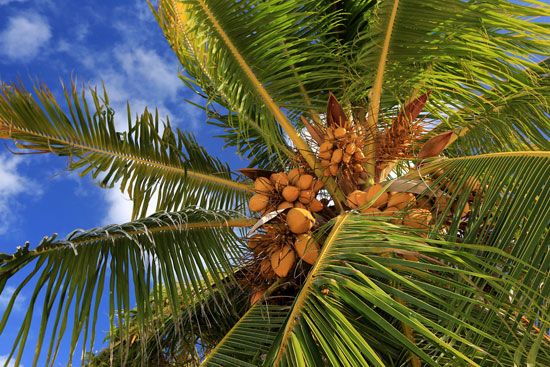
Palm trees are classified within the order Arecales, which is a group of flowering plants that contains only one family, Arecaceae (formerly known as Palmae). This family comprises nearly 190 genera and more than 2,450 species of palms.1
Within the broader classification of plants, the order Arecales is categorized as part of the commelinids, an assemblage of four related monocotyledon orders. While palms are distinct from most other monocots due to their characteristically woody habit, they share a common ancestry with other members of the commelinid group, a relationship supported by DNA analysis.12
The Arecaceae family is the primary component of the Arecales order, and it is recognized as one of the most structurally diverse and distinctive groups of monocots, with a fossil record extending back approximately 80 million years to the Late Cretaceous Period.1
What is the geographical distribution of Arecales plants?
The order Arecales, which consists of the family Arecaceae, is primarily distributed throughout the tropical and subtropical regions of the world. Their range is generally bounded by latitudes 44° N and 44° S, with the greatest concentration of species occurring between 30° N and 30° S.13
Primary Regions of Distribution
The most significant centers of palm diversity are found in the Americas and in Asia, spanning from India to Japan and south toward Australia and the islands of the Pacific and Indian oceans. Africa and Madagascar represent a third, though less species-rich, region.3
Habitat and Range
Palms are highly adaptable and inhabit diverse environments, including:
- Tropical Forests: Most species thrive in lowland rainforests, mountain forests, and cloud forests, sometimes reaching elevations of up to 3,000 meters in the Andes.0 meters in the Andes.3
- Wetlands and Coasts: Many palms occupy swamps, brackish estuaries, and lagoons, or grow along river margins.43
- Arid and Open Areas: Some species are found in deserts (where groundwater is accessible), savannas, and grasslands.4
While some species have extensive ranges, most palms are restricted to specific areas, with high levels of endemism—particularly on islands like New Caledonia and Madagascar.3
How have Arecales plants been used by humans throughout history?
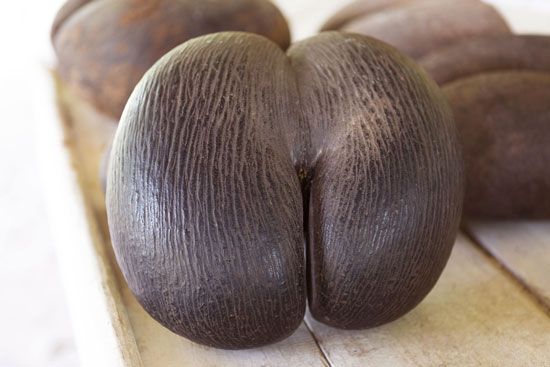
For centuries, plants in the order Arecales—the palms—have been among the most economically significant and versatile resources for human populations in tropical and subtropical regions. They have historically provided the fundamental necessities of life, serving as a primary source of food, construction materials, and household goods.51
Food and Beverage
Palms are vital sources of nutrition and commerce. The coconut and African oil palm are globally significant for their oils and fats, which are used in food preparation, margarine, and confections. Other species provide:5
- Starch: Extracted from the pith of the sago palm and other genera.51
- Sugar and Alcohol: Sap tapped from inflorescences is consumed fresh or fermented into toddy, vinegar, and alcohol.5
- Staple Fruits: The date palm is a critical food source in North Africa and the Middle East.5
- Stimulants: The seed of the betel palm is widely used as a chewing substance.5
Materials and Construction
The structural utility of palms is extensive. Trunks are used for furniture and construction, while leaves provide material for thatch, baskets, hats, and rain capes. Fibers such as coir and piassava are essential for making ropes, mats, and cordage. Additionally, the tagua palm provides “vegetable ivory” for buttons, and various species are tapped for waxes.513
Modern Applications
Beyond traditional uses, palms are increasingly integrated into agroforestry systems, which can help conserve rainforests while providing income. Palm oils are also critical in manufacturing soaps, cosmetics, biofuels, and pharmaceuticals.5
What are some examples of economically important Arecales species?
The order Arecales (palms) includes some of the most economically significant plants in the world, providing a vast array of food, industrial, and construction materials.510
Major Commercial Species
- Coconut (Cocos nucifera): Often considered the most economically important palm, it is a primary source of vegetable oil, fiber (coir), and food products like coconut milk and water.511
- African Oil Palm (Elaeis guineensis): A dominant global source of vegetable fat. Its oil is used in food manufacturing (margarine, chocolate), cosmetics, soaps, and biofuels.512
- Date Palm (Phoenix dactylifera): A staple food source in arid regions of North Africa and the Middle East, prized for its sweet, energy-dense fruit.51
Other Economically Significant Palms
- Starch Sources: The sago palm (Metroxylon sagu) is a vital source of starch extracted from its trunk pith.513
- Sugar and Beverage Palms: Many species, such as the sugar palm (Arenga pinnata), palmyra palm, and toddy palm, are tapped for sap to produce sugar, vinegar, and fermented beverages.5
- Specialized Materials: The betel palm (Areca catechu) provides seeds used as a stimulant, while the tagua palm (Phytelephas aequatorialis) yields “vegetable ivory” for manufacturing buttons. Additionally, rattan (Calamus species) is a major industry for furniture and construction.510
Sources
- Arecales — Encyclopædia Britannica
- angiosperm - Annotated classification — Encyclopædia Britannica
- palm - Ecology — Encyclopædia Britannica
- palm - Distribution — Encyclopædia Britannica
- palm - Economic importance — Encyclopædia Britannica
- palm oil — Merriam-Webster
- Sapindales - Burseraceae — Encyclopædia Britannica
- palm fiber — Merriam-Webster
- leaf fiber — Encyclopædia Britannica
- date palm — Encyclopædia Britannica
- coconut palm — Encyclopædia Britannica
- oil palm — Encyclopædia Britannica
- sago — Encyclopædia Britannica
- sago palm — Merriam-Webster
Published on · 4 min read