Arête
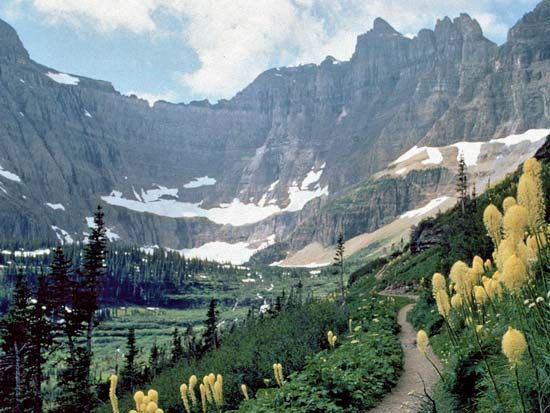
The term arête (from the French for "ridge") refers to a sharp-crested, serrated ridge in mountainous terrain that separates the heads of opposing valleys…
What is arête?
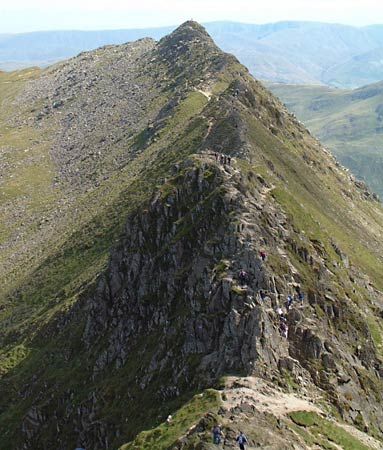
The term arête (from the French for “ridge”) refers to a sharp-crested, serrated ridge in mountainous terrain that separates the heads of opposing valleys, or cirques, which were once occupied by glaciers.12
These landforms are created through glacial erosion, where the freezing and thawing of ice—a process known as glacial sapping—undercuts the rock, causing the steep sides to collapse. When two opposing glaciers meet at an arête, they may carve a smooth, low gap called a col. If three or more glaciers erode toward one another, the arêtes may culminate in a high, triangular peak known as a horn, such as the Matterhorn.1
It is important to distinguish this geological term from the Greek concept of aretē, which relates to the “science of virtue” or excellence, often studied in the field of aretaics.3
How do glaciers create mountain horns?
Glaciers create mountain horns through the process of headward erosion, which occurs when multiple glaciers radiate from a central point on a mountain.4
The formation process involves several key stages:
- Cirque Development: A mountain often features three or more cirques—amphitheatre-shaped hollows—arranged in a radial pattern around its flanks.4
- Erosion and Retreat: Glaciers within these cirques erode the rock through abrasion and plucking, causing the headwalls to retreat.41
- Ridge Formation: As these cirques expand toward one another, the bedrock divides between them are narrowed into sharp, jagged, knife-edge ridges known as arêtes.45
- Peak Creation: The continued headward erosion of these surrounding cirques eventually leaves behind only a steep, isolated, and sharp-pointed peak, which is termed a horn.45
A classic example of this landform is the Matterhorn in the Swiss Alps, which was sculpted by the intersection of multiple glacial cirques.45
What is the difference between a cirque and a col?
A cirque and a col are both glacial landforms, but they represent distinct features of mountain topography:
- Cirque: A cirque is an amphitheatre-shaped basin or hollow with steep, precipitous walls located at the head of a glacial valley. It is formed by glacial erosion, often involving frost shattering and ice wedging, and may contain a small lake known as a tarn if the glacier retreats.84
- Col: A col is a low spot or saddle-shaped pass found along an arête—the sharp, knife-edge ridge that separates two opposing cirques. Essentially, while a cirque is the basin itself, a col is a specific point of depression within the ridge that connects or separates those basins.84
In short, cirques are the hollowed-out basins carved into the mountainside, whereas a col is the narrow, saddle-like gap that forms on the ridge between two such basins.84
How does the Greek concept of arete relate to virtue?
The Greek term arete (ἀρετή) is most accurately translated as “virtue” or “excellence.” In ancient Greek thought, it refers to the specific quality or disposition that enables a person or thing to perform its characteristic function—or ergon—exceptionally well.1112
The Functional View of Virtue
Unlike modern definitions that often focus on moral behavior, the classical concept of arete applies broadly to anything with a purpose. For example, the arete of a knife is its sharpness, which allows it to cut effectively, while the arete of a racehorse is the speed and stamina that allow it to run well. By extension, human arete consists of the traits or qualities that enable a human being to perform their unique function—which Aristotle identified as the exercise of reason—to live a good and flourishing life, known as eudaimonia.1211
Evolution of the Concept
- Archaic Origins: In the era of Homer, arete was closely tied to physical and military prowess, emphasizing the “agonistic” ideal of the hero, champion, and cultivated warrior.13
- Philosophical Development: Philosophers like Plato and Aristotle expanded arete to encompass moral and intellectual dimensions. They argued that virtue is not innate but a cultivated excellence developed through habituation, reflection, and social experience. For Aristotle, moral virtue involves finding the “golden mean” between the extremes of deficiency and excess, guided by practical wisdom.112
Ultimately, arete serves as the bridge between human nature and the “good life,” representing the internal excellence required to achieve true human flourishing.1112
Sources
- arête — Encyclopædia Britannica
- arête — Merriam-Webster
- aretaics — Merriam-Webster
- glacial landform - Cirques , tarns, U-shaped valleys, arêtes, and horns — Encyclopædia Britannica
- glacial landform - Small-scale features of glacial erosion — Encyclopædia Britannica
- glacial landform - Glacial erosion — Encyclopædia Britannica
- glacier - Surface features — Encyclopædia Britannica
- cirque — Encyclopædia Britannica
- col — Merriam-Webster
- cirque — Merriam-Webster
- Eudaimonia — Encyclopædia Britannica
- Plato - Happiness and virtue — Encyclopædia Britannica
- education - Origins — Encyclopædia Britannica
- Moral virtue — Encyclopædia Britannica
- Philosophical anthropology - Plato — Encyclopædia Britannica
Published on · 3 min read