Tirich Mir
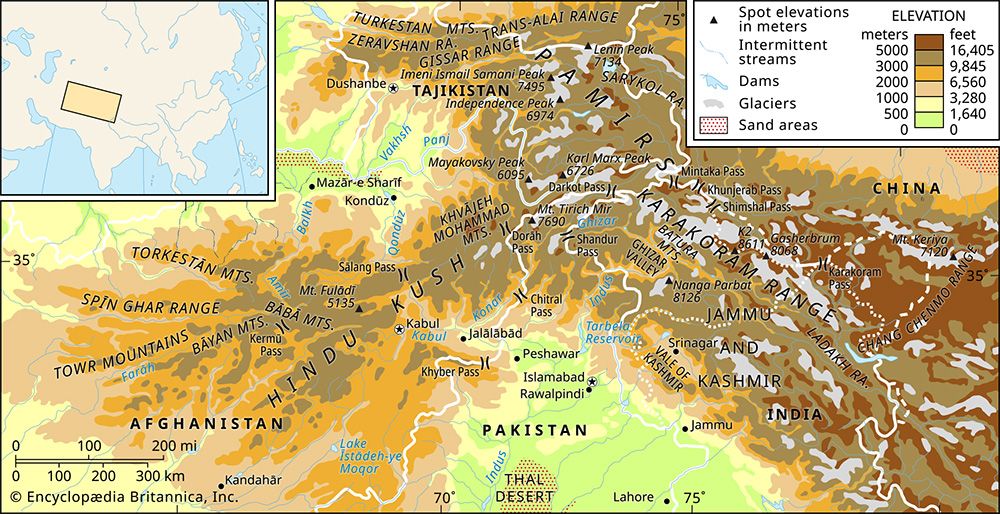
Tirich Mir is the highest peak in the Hindu Kush mountain system, reaching an elevation of 25,230 feet (7,690 metres). Located in the Khyber Pakhtunkhwa…
What is Tirich Mir?
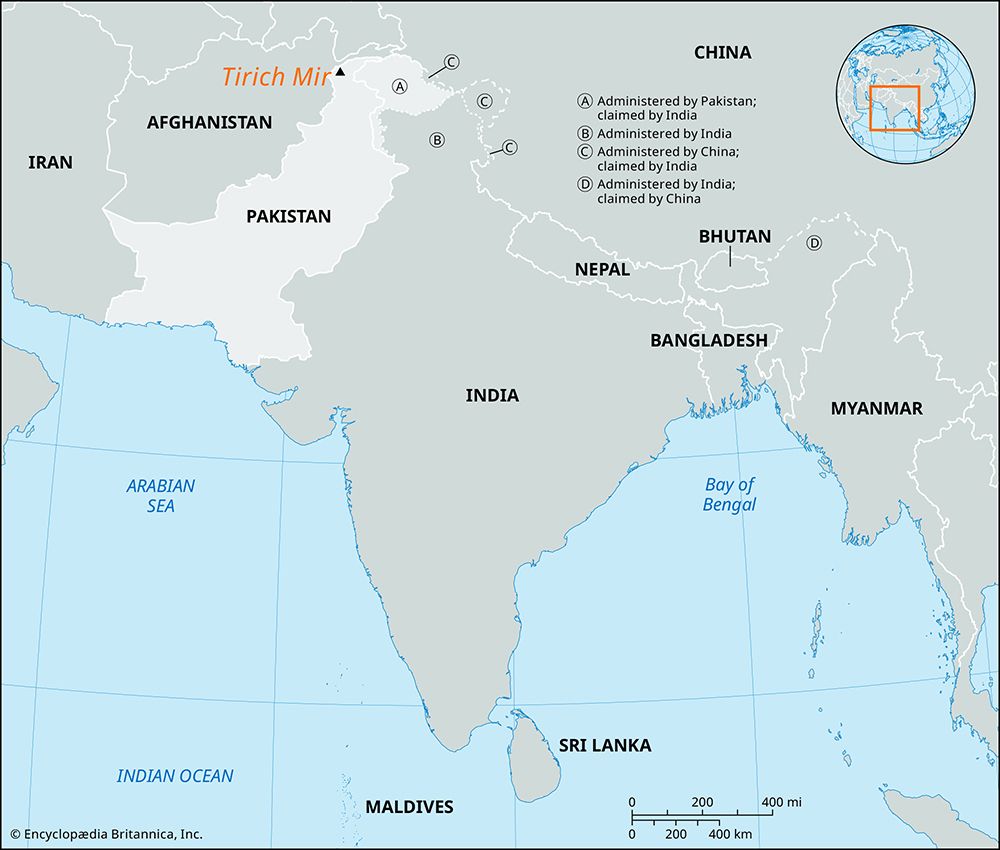
Tirich Mir is the highest peak in the Hindu Kush mountain system, reaching an elevation of 25,230 feet (7,690 metres). Located in the Khyber Pakhtunkhwa province of Pakistan, approximately 155 miles north of Peshawar, the mountain is situated near the border with Afghanistan.1
The peak is part of a horseshoe-shaped formation that includes the Upper Tirich Glacier basin, surrounded by the main summit and several surrounding peaks. The area is known for its challenging terrain, with high precipices above the Lower Tirich Glacier that pose significant avalanche risks to mountaineers. The first successful ascent of the mountain was achieved by a Norwegian expedition in July 1950.1
What is the Hindu Kush mountain system?
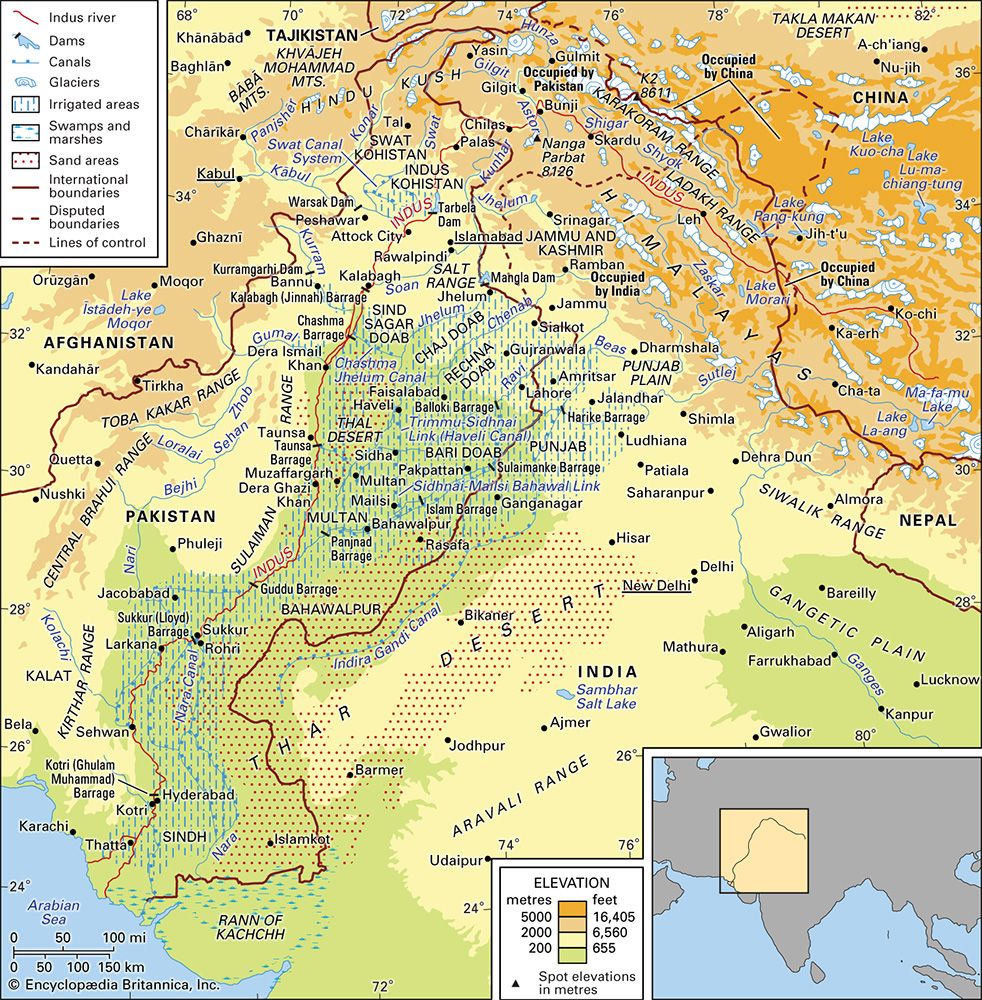
The Hindu Kush is a major mountain system in Central Asia that spans approximately 500 miles (800 km) in length and up to 150 miles (240 km) in width. It serves as a significant watershed, dividing the Amu Darya valley to the north from the Indus River valley to the south.2
Geography and Structure
The range is typically divided into three sections:
- Eastern Hindu Kush: Contains the highest peaks, including Mount Tirich Mir (25,230 feet), and features extensive glaciers.34
- Central Hindu Kush: Extends to the Shebar Pass and separates the Afghan regions of Badakhshān and Nurestan.3
- Western Hindu Kush: Also known as the Bābā Mountains, these ranges gradually descend toward the Iranian border.3
Geology and Climate
Formed by the collision of the Indian and Eurasian plates, the Hindu Kush is a highly active seismic zone. Its climate varies significantly, acting as a transition between the monsoonal influence of South Asia and the Mediterranean climate characterized by snowy winters.54
Historical Significance
Historically, the range’s high passes have been vital military corridors for figures such as Alexander the Great, Genghis Khan, and Babur. Today, the region is primarily divided between Pakistan and Afghanistan, with the border largely defined by the Durand Line3.26
How do glaciers shape mountain landscapes?
Glaciers act as powerful agents of landscape transformation through two primary processes: erosion and deposition.910
Glacial Erosion
Glaciers reshape mountains primarily through abrasion and plucking. As glaciers move, they incorporate rock debris into their base, acting like giant sheets of sandpaper that scour and polish the underlying bedrock. Through plucking, glaciers remove larger chunks of rock by exploiting fractures and joints in the bedrock, often aided by the refreezing of meltwater.11
These erosional forces create distinct alpine features:
- U-shaped valleys: Unlike rivers that carve narrow V-shaped valleys, glaciers widen and deepen valleys into characteristic parabolic or U-shaped profiles.12
- Cirques, Arêtes, and Horns: Glaciers carve amphitheatre-shaped hollows called cirques at valley heads. When multiple cirques erode a mountain, they leave behind sharp, knife-edge ridges known as arêtes and pointed peaks called horns, such as the Matterhorn.129
- Tarns: Over-deepened basins scoured by glaciers often fill with water to form mountain lakes known as tarns.12
Glacial Deposition
As glaciers melt, they deposit the debris they have transported, known as till. These deposits form ridges called moraines along the sides or at the terminus of a glacier, significantly altering the local topography.910
What are the challenges of climbing high-altitude peaks?
Climbing high-altitude peaks presents extreme physiological and environmental challenges that require careful preparation and management.
Physiological Challenges
The primary danger at high altitude is hypoxia, or oxygen deprivation, caused by decreasing barometric pressure and lower partial pressure of oxygen. This leads to altitude sickness, which can manifest as fatigue, dizziness, nausea, and impaired cognitive function, potentially resulting in poor decision-making.1617
In the “death zone”—altitudes above approximately 25,000 feet (7,600 meters)—the body cannot acclimatize, and severe conditions may arise:17
- High-altitude pulmonary edema (HAPE): Fluid accumulates in the lungs, effectively causing the victim to drown.1617
- High-altitude cerebral edema (HACE): The brain swells due to increased blood flow, which can lead to coma or death.17
While supplemental oxygen can mitigate these effects, it introduces risks if supplies run out. Emergency treatments like dexamethasone can help incapacitated climbers regain the ability to descend, which is the most effective treatment for severe altitude-related illnesses.17
Environmental and Logistical Challenges
Climbers must contend with:
- Extreme Weather: High peaks are subject to intense storms and limited windows of hospitable weather, often dictated by monsoon cycles.17
- Isolation and Terrain: Many high-altitude regions are remote, lacking infrastructure and requiring supplies to be carried by foot.17
- Ecological Impact: Mountaineering activities have historically led to significant waste accumulation and habitat degradation, prompting ongoing cleanup and conservation efforts.18
Sources
- Tirich Mir — Encyclopædia Britannica
- Hindu Kush — Encyclopædia Britannica
- Hindu Kush - Physiography — Encyclopædia Britannica
- Hindu Kush - Geology of the Hindu Kush — Encyclopædia Britannica
- Hindu Kush - Climate — Encyclopædia Britannica
- Hindu Kush - Study and exploration — Encyclopædia Britannica
- Hindu Kush - Physical features — Encyclopædia Britannica
- Hindu Kush - Plant life — Encyclopædia Britannica
- glacial landform - Glacial erosion — Encyclopædia Britannica
- glacial landform - Cirques , tarns, U-shaped valleys, arêtes, and horns — Encyclopædia Britannica
- Quaternary - Landforms — Encyclopædia Britannica
- glacial landform - Erosional landforms of valley glaciers — Encyclopædia Britannica
- glacial landform - Small-scale features of glacial erosion — Encyclopædia Britannica
- glacier - Response of glaciers to climatic change — Encyclopædia Britannica
- Pleistocene Epoch - Glaciation — Encyclopædia Britannica
- altitude sickness — Encyclopædia Britannica
- human respiratory system - High altitudes — Encyclopædia Britannica
- Mount Everest - The human challenge — Encyclopædia Britannica
- Highland climate — Encyclopædia Britannica
- Mount Everest - Environmental issues — Encyclopædia Britannica
Published on · 3 min read