Cirque
A cirque is an amphitheatre-shaped basin characterized by steep, precipitous walls, typically found at the head of a glacial valley. It is important to note…
What is a cirque in geological terms, and how is it formed?
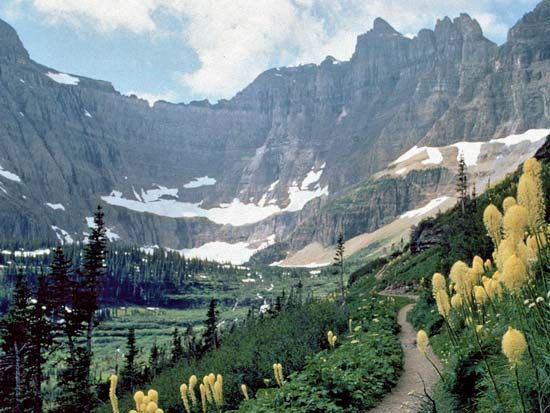
A cirque is an amphitheatre-shaped basin characterized by steep, precipitous walls, typically found at the head of a glacial valley. It is important to note that while the term can refer to circular shapes in general, in a geological context, it specifically describes this distinct landform created by glacial processes.12
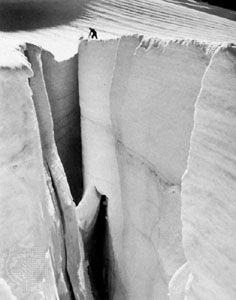
The formation of a cirque is primarily driven by erosion occurring beneath a bergschrund—a large crevasse that separates stationary ice from moving glacier ice. During early summer, the bergschrund opens, exposing the underlying rock to daily temperature fluctuations. This frost action disintegrates the rock, causing upper sections to avalanche and form a near-vertical headwall. The resulting debris becomes embedded in the glacier, which then scours a concave floor. If the glacier eventually retreats, this floor may hold a small lake known as a tarn. as a tarn.1
What are the main features of a cirque, such as the headwall and floor?
A cirque is an amphitheatre-shaped basin located at the head of a glacial valley. Its primary features include:
- Headwall: This is the arcuate, steep cliff that forms the back of the cirque. While ideally semicircular, headwalls are often angular due to variations in bedrock height. The headwall retreats through frost shattering and ice wedging, creating a near-vertical face.13
- Floor: The bottom of the cirque is typically a shallow, concave basin. This area often shows signs of extensive glacial abrasion and plucking, caused by rock debris that falls into the bergschrund—the crevasse separating the glacier from the headwall—and is subsequently incorporated into the ice.13
- Tarn: If a glacier retreats or disappears, the over-deepened basin at the bottom of the cirque may fill with water to form a small mountain lake known as a tarn.134
How do cirques contribute to the formation of larger glacial landscapes?
Cirques are fundamental to the development of dramatic alpine landscapes. Through the process of headward erosion, these amphitheatre-shaped basins act as the starting points for the transformation of mountain ranges.31
As multiple cirques develop on the flanks of a mountain, their expansion significantly alters the surrounding topography:
- Arêtes: When two adjacent cirques erode toward one another, they narrow the bedrock divide between them, eventually creating a sharp, knife-edge ridge known as an arête.31
- Cols: The low, saddle-like depressions found along an arête between two opposing cirques are called cols.31
- Horns: When three or more cirques form in a radial pattern around a single mountain, their headward erosion leaves behind a steep, pyramid-shaped peak known as a horn, such as the Matterhorn.3
By carving these features, cirques contribute to the rugged, high-relief scenery characteristic of glaciated mountain ranges worldwide. Furthermore, because cirques must originate above the snow line, their elevation provides scientists with vital data regarding historical climatic change.61
What is the difference between a cirque and other glacial landforms like U-shaped valleys or arêtes?
Cirques, U-shaped valleys, and arêtes are distinct but interrelated glacial landforms shaped by the erosive power of ice. While they all result from glacial activity, they differ in their form and position within the landscape:
- Cirques: These are amphitheatre-shaped basins located at the very head of a glacial valley. They serve as the starting point for glaciers and are characterized by a steep, arcuate headwall and a concave floor, which may contain a small lake known as a tarn if the glacier retreats.81
- U-shaped valleys: Unlike the V-shaped valleys carved by rivers, these are formed as glaciers reshape existing stream valleys. By removing debris and eroding the base and lower sidewalls, glaciers create a characteristic parabolic or U-shaped cross-profile with wide, flat bottoms and steep, often vertical, sidewalls.1
- Arêtes: These are sharp, knife-edge ridges that form between two parallel glacial valleys or between two opposing cirques. They are created when glaciers erode the bedrock divides, leaving behind a jagged, serrated ridge.31
In essence, cirques are the “cradles” of glaciers, U-shaped valleys are the primary channels carved by flowing ice, and arêtes are the narrow, residual ridges left standing between these eroded features.1
Sources
- cirque — Encyclopædia Britannica
- cirques — Merriam-Webster
- glacial landform - Cirques , tarns, U-shaped valleys, arêtes, and horns — Encyclopædia Britannica
- bergschrund — Encyclopædia Britannica
- tarn — Encyclopædia Britannica
- glacial landform - Erosional landforms of valley glaciers — Encyclopædia Britannica
- glacial landform - Small-scale features of glacial erosion — Encyclopædia Britannica
- arête — Encyclopædia Britannica
- glacial landform - Striations — Encyclopædia Britannica
Published on · 3 min read