Argonne
The term "Argonne" refers to two distinct and significant entities:
What is Argonne?
The term “Argonne” refers to two distinct and significant entities:
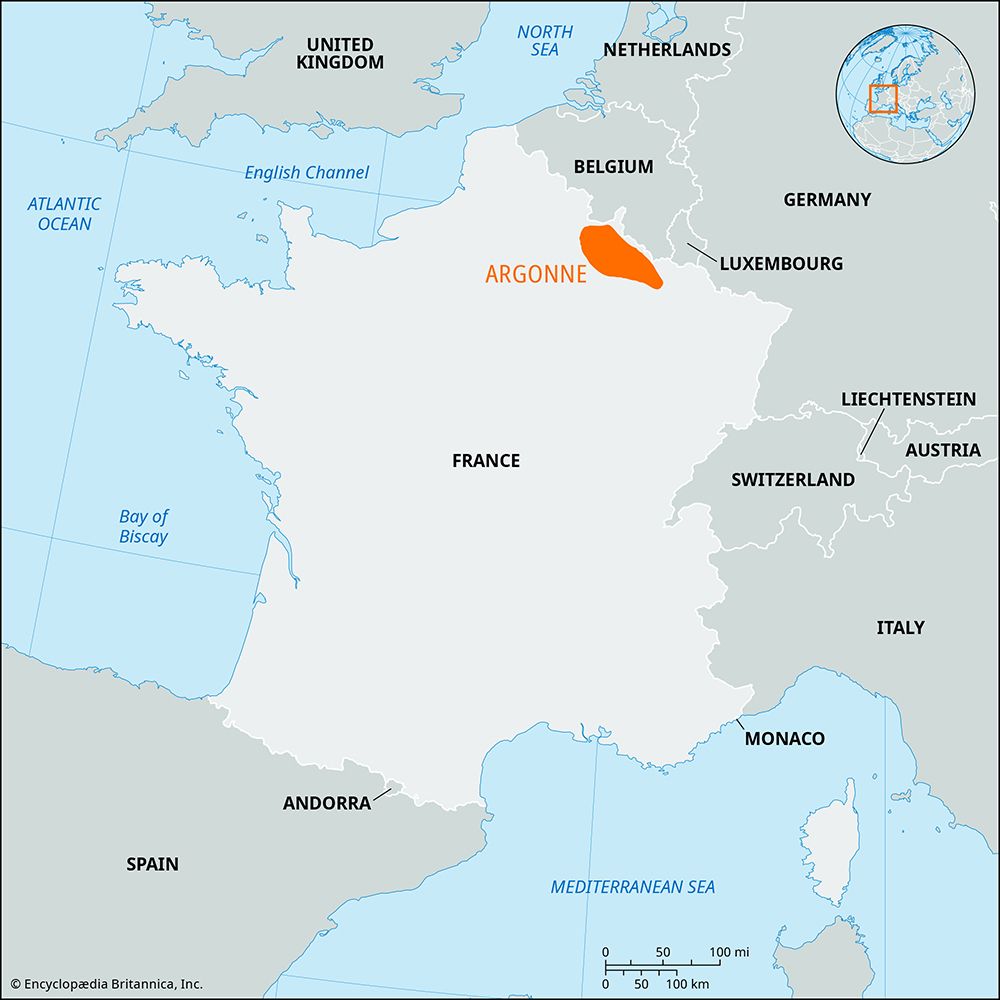
- Geographic Region: The Argonne is a wooded, hilly region in eastern France that serves as a natural barrier between the Champagne and Lorraine regions. Historically, it has held great strategic importance, notably as the site of the 1792 Battle of Valmy and the World War I Meuse-Argonne Offensive, where U.S. forces fought through the dense Argonne Forest to clear German troops in 1918.12
- Research Laboratory: Argonne National Laboratory is a U.S. national research facility located in Illinois. Founded in 1946, it focuses on basic and applied research in science, engineering, and technology, including nuclear physics and energy-resource development. It houses major user facilities like the Advanced Photon Source, which supports interdisciplinary research across government, academic, and industrial sectors.3
What is a particle accelerator and how does it work?
A particle accelerator is a device that produces a beam of fast-moving, electrically charged atomic or subatomic particles. These machines are essential tools for fundamental research into the structure of matter, as well as for applications in medicine, industry, and radiocarbon dating.4
How They Work
All particle accelerators, regardless of size, rely on several core components to function:
- Particle Source: A mechanism to generate charged particles, such as electrons, protons, or antiparticles.5
- Vacuum: Particles must travel through a container with minimal air to prevent collisions with atoms that would cause them to lose energy.51
- Electric Fields: These are used to accelerate the particles. By passing through a potential difference, particles gain energy, measured in electron volts (eV).51
- Magnetic Fields: These are used to control and steer the paths of the particles.5
Modern accelerators often use repeated, smaller “pushes” from alternating electric fields—typically in the form of electromagnetic waves—rather than a single high-voltage source. In linear accelerators, particles pass through a sequence of fields, while in cyclic accelerators like the cyclotron, particles are guided on a circular path to pass through the same fields multiple times.1
Why was the Meuse-Argonne Offensive a turning point in World War I?
The Meuse-Argonne Offensive (September 26–November 11, 1918) served as a decisive turning point in World War I by forcing the collapse of the German defensive position on the Western Front.
As part of a series of coordinated Allied attacks, the offensive aimed to capture the vital Mézières–Sedan–Montmédy railway. By threatening this critical supply line and the German retreat route through Lorraine, the Allies pressured the “hinge” of the German defensive strategy.37
Key factors in its significance included:
- Strategic Pressure: The offensive forced the Germans to recognize they were being outflanked, leading to a retreat to avoid capture.3
- Logistical Collapse: On November 10, Allied forces reached Sedan and successfully cut the rail line, effectively paralyzing German logistics.3
- Combined Force: The operation involved over a million American troops, demonstrating the American Expeditionary Force’s capacity to conduct large-scale, independent operations.38
The relentless pressure exerted by these final confrontations left the German command unable to sustain their lines, directly precipitating the Armistice on November 11, 1918.3
What are some other major U.S. national research laboratories?
Beyond the Argonne National Laboratory, the United States government maintains several other key research institutions designed to address national challenges that are beyond the scope of private industry. These laboratories often operate under the oversight of federal agencies to ensure scientific leadership and public benefit.
Notable examples include:
- National Institute of Standards and Technology: Formerly known as the National Bureau of Standards, this institution serves as the central authority for measurement and standardization in the United States.1
- National Aeronautics and Space Administration (NASA): While NASA contracts much of its development to private industry, it maintains direct control over critical research and development efforts related to space exploration and aeronautics.1
- Department of Agriculture Laboratories: Supported by the U.S. Department of Agriculture, these facilities conduct essential research for the farming community and the nation, filling gaps where private industry lacks the necessary organization or financial resources.1
These institutions, along with the Department of Energy’s broader network of laboratories, represent the government’s commitment to managing research in areas of national importance, such as energy, defense, and scientific infrastructure.1
Sources
- Argonne National Laboratory — Encyclopædia Britannica
- Argonne — Encyclopædia Britannica
- battles of the Meuse-Argonne — Encyclopædia Britannica
- particle accelerator — Encyclopædia Britannica
- particle accelerator - Principles of particle acceleration — Encyclopædia Britannica
- particle accelerator - Accelerating particles — Encyclopædia Britannica
- World War I - The final offensive on the Western Front — Encyclopædia Britannica
- Battle of Saint-Mihiel — Encyclopædia Britannica
- research and development - Government laboratories — Encyclopædia Britannica
Published on · 3 min read