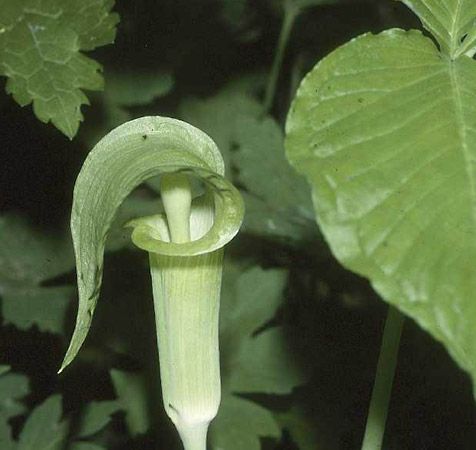
Arisaema
The Arisaema genus, part of the arum family, consists of approximately 190 species of herbaceous plants that grow from tubers or rhizomes.
What are the key characteristics that define the Arisaema plant genus?
The Arisaema genus, part of the arum family, consists of approximately 190 species of herbaceous plants that grow from tubers or rhizomes.1
Key characteristics include:
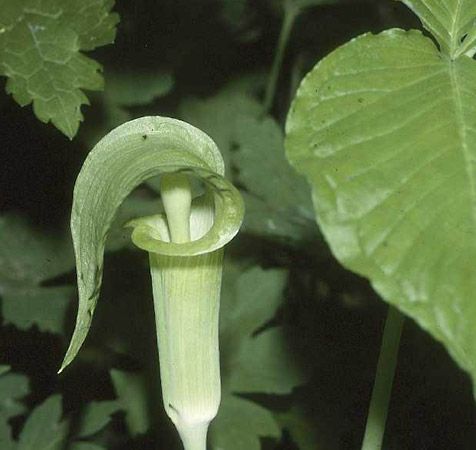
- Inflorescence: The plants feature a characteristic structure consisting of a rodlike spadix surrounded by a spathe, which often forms a drooping or erect hood.1
- Flowers: The spadix bears small, unisexual flowers. Notably, these plants can change sex, producing male flowers in one season and female flowers in another, depending on factors like nutrition and genetics.1
- Foliage: Leaves are borne on long petioles and typically emerge before the flowers.1
- Reproduction: Female flowers develop into red-orange fruits, which are generally poisonous to humans.1
- Habitat: They are primarily native to the Old World, though some species are found in North America, and they thrive in terrestrial or wetland environments.1
Well-known examples include the jack-in-the-pulpit and the green dragon, both of which exhibit these distinct structural traits.1
Where are Arisaema plants typically found in nature, and what are their preferred habitats?
Arisaema plants are primarily native to the Old World, though the genus also includes a few notable species found in North America.1
Regarding their preferred environments, these plants are categorized as either terrestrial or wetland herbaceous species. They are frequently found in shaded areas, making them popular choices for cultivation in shady wild gardens. For instance, the jack-in-the-pulpit is native to the eastern regions of North America, where it thrives in these types of woodland or moist, shaded habitats.1
How do Arisaema plants reproduce, and what makes their reproductive strategy unique?
Arisaema plants reproduce through a unique strategy involving small, unisexual flowers borne on a rodlike structure called a spadix, which is enclosed by a specialized leaf-like bract known as a spathe.1
The most distinctive aspect of their reproductive strategy is their ability to change sex. An individual plant may produce male flowers in one growing season and female flowers in another, potentially alternating between these states multiple times throughout its life cycle. Researchers believe that this sex-switching behavior is influenced by a combination of the plant’s genetics and its nutritional status.1
Following successful pollination, the female flowers develop into clusters of red-orange fruits. While these berries are poisonous to humans, they serve as a food source for various wild animals, which aids in the dispersal of the plant’s seeds.1
What are some of the most well-known species within the Arisaema genus?
The Arisaema genus includes approximately 190 species, with several being particularly well-known for their unique floral structures and suitability for shaded gardens. Notable species include:1
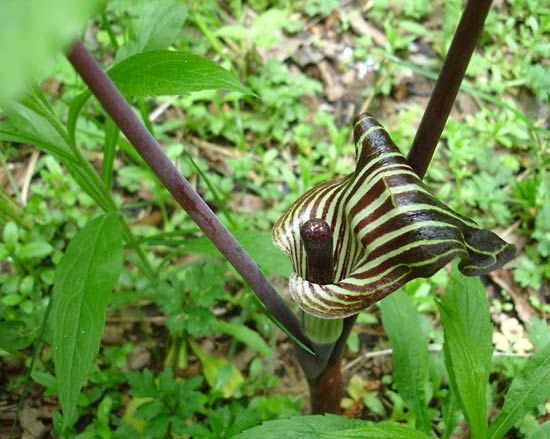
- Jack-in-the-pulpit (Arisaema triphyllum): Perhaps the most familiar species in North America, it is recognized by its green-to-purple striped spathe (the “pulpit”) that forms a hood over a rodlike spadix (the “Jack”).12
- Green dragon (A. dracontium): Also known as dragonroot, this species features a greenish spathe with an erect hood and a distinctive spadix that extends significantly beyond the spathe.1
- Cobra lily (A. speciosum): Native to Nepal and Sikkim, India, this species is noted for its slightly drooping spathe and a spadix characterized by a long, threadlike extension.1
- A. fimbriatum: Originating from the Malay Peninsula, this species is distinguished by its unique, tasseled spadix.1
Sources
- Arisaema — Encyclopædia Britannica
- jack-in-the-pulpit — Encyclopædia Britannica
Published on · 3 min read