Armadillo Lizard
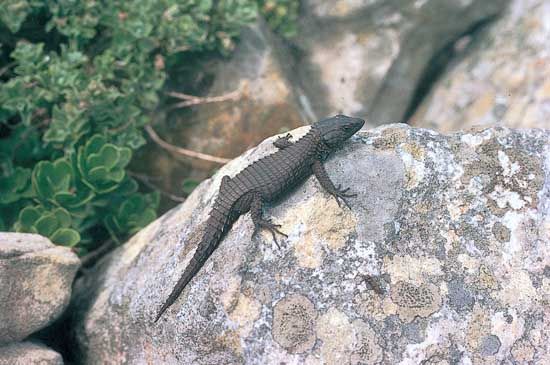
The armadillo lizard (Cordylus cataphractus) is a southern African lizard belonging to the family Cordylidae. Measuring approximately 25 cm (10 inches) in…
What is armadillo lizard?
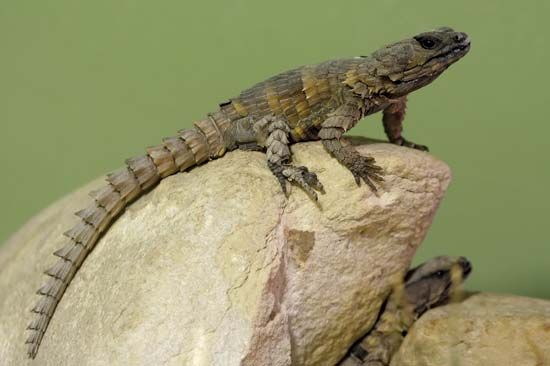
The armadillo lizard (Cordylus cataphractus) is a southern African lizard belonging to the family Cordylidae. Measuring approximately 25 cm (10 inches) in length, it is well-known for its unique defensive posture.1
When threatened by a predator, the armadillo lizard rolls onto its back and grasps its tail in its mouth, forming a protective ball. In this position, its hard, bony scales and sharp spines are directed outward, making it difficult for predators to find a starting point to swallow the animal. It remains in this defensive state until the danger has passed.12
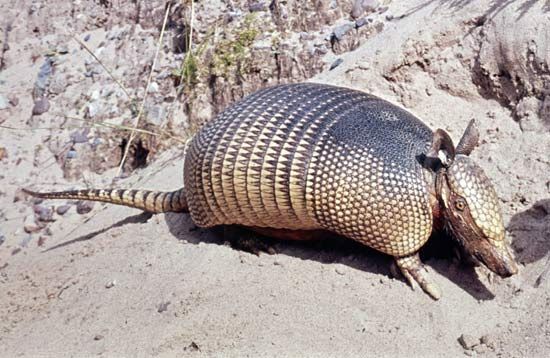
It is important to distinguish this reptile from the armadillo, which is an unrelated, armoured mammal found in the Americas. While both animals share a name and a defensive habit of curling into a ball, they belong to entirely different biological classes.31
How does the armadillo lizard’s defense compare to that of the mammal armadillo?
The armadillo lizard and the mammal armadillo share a common defensive behavior—curling into a ball—but they employ this strategy differently due to their distinct biological structures.
Defensive Comparisons
- Armadillo Lizard (Cordylus cataphractus): When threatened, this lizard rolls onto its back and grasps its tail in its mouth, held in place by its forefeet. This creates a circular, spiny form that presents no easy starting point for a predator to begin swallowing. Its defense relies on its hard, bony scales and sharp spines being directed outward.13
- Mammal Armadillo (Family Dasypodidae): While many armadillos retreat to burrows or “play dead,” only the three-banded armadillo (Tolypeutes) is capable of rolling into a solid, protective ball to shield its vulnerable underparts. Unlike the lizard, which uses its tail as a structural component of the ball, the armadillo uses its specialized carapace—a set of bony plates covered in tough scales—to encase its body.4
While both animals are named for their defensive posture, they are unrelated; the armadillo lizard is a reptile, whereas the armadillo is a mammal belonging to the order Cingulata.14
What other animals in the Cordylidae family use similar defensive behaviors?
The family Cordylidae, often referred to as girdle-tailed lizards, includes various species that share defensive traits similar to the armadillo lizard (Cordylus cataphractus).
Defensive Behaviors in Cordylidae
- Formation of Protective Rings: The name “girdle-tailed lizard” is derived from the rings of spiny scales that encircle their tails and bodies. In several species within this family, these armoured girdles serve as a primary defense mechanism. When threatened by a predator, these lizards grasp their tails in their mouths, forming a ring that projects sharp spines outward, effectively creating a defensive barrier that is difficult for predators to penetrate.14
- Use of Crevices: Beyond balling, many members of the family utilize their environment for protection. Some spiny-tailed lizards retreat into rock crevices, positioning themselves so that only their sharp, formidable tails are exposed to potential attackers.5
- Structural Adaptations: All members of the Cordylidae family are characterized by having spiny or platelike protective scales underlain by bony plates, which provide a natural physical defense regardless of the specific behavioral strategy employed.6
What are some of the primary predators that the armadillo lizard faces in southern Africa?
The armadillo lizard (Cordylus cataphractus) faces a variety of threats in its native southern African habitat, including birds, mammals, and other reptiles.1
Defensive Efficacy Against Predators
When confronted by these predators, the armadillo lizard relies on its specialized defensive posture to survive. By curling into a ball and grasping its tail in its mouth, the lizard presents a spiny, circular form that lacks a clear starting point for an attacker to begin swallowing.41
This strategy is particularly effective against predators such as snakes, which often fail to consume the lizard because they cannot find a way to grip or ingest the armored, circular shape. While the lizard’s hard, bony scales and spines provide a significant physical barrier, the animal remains in this defensive position until it perceives that the danger has passed.14
Sources
- armadillo lizard — Encyclopædia Britannica
- girdle-tailed lizard — Encyclopædia Britannica
- armadillo — Encyclopædia Britannica
- lizard - Defensive strategies — Encyclopædia Britannica
- reptile - Use of the tail — Encyclopædia Britannica
- reptile - Avoidance and noise — Encyclopædia Britannica
- Cordylidae — Encyclopædia Britannica
- reptile - Balling — Encyclopædia Britannica
- girdle-tailed lizard — Merriam-Webster
Published on · 3 min read