Armadillo
Armadillos are unique mammals belonging to the family Dasypodidae, characterized primarily by their protective armor. This carapace consists of bony…
What are the unique physical characteristics of armadillos?
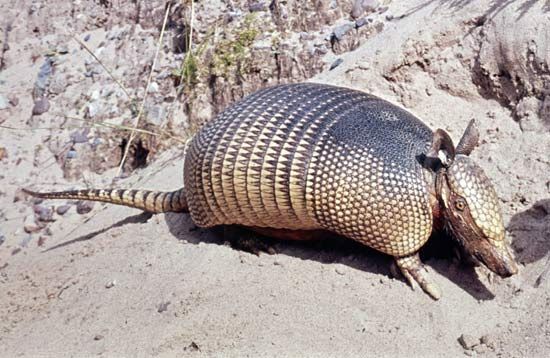
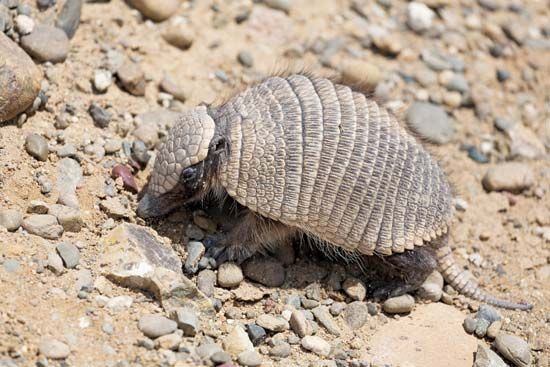
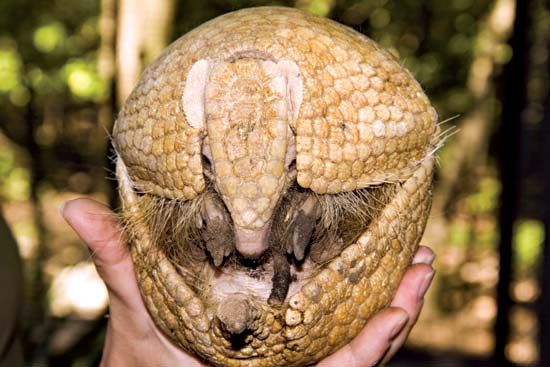
Armadillos are unique mammals belonging to the family Dasypodidae, characterized primarily by their protective armor. This carapace consists of bony transverse bands covered in tough, skin-derived scales that encase the head, body, and often the legs and tail. These segments frequently overlap, allowing the animal to move with flexibility, and in some species, such as the three-banded armadillo, this structure enables them to roll into a solid ball for protection.12
Beyond their armor, armadillos possess several distinct physical traits:
- Dentition: They have simple, peglike teeth that lack enamel.2
- Claws: They are equipped with strong, curved claws adapted for their efficient burrowing lifestyle.2
- Size Variation: Species range significantly in size, from the small pink fairy armadillo (about 16 cm) to the giant armadillo, which can reach 1.5 meters in length.2
- Buoyancy: Because their dense armor makes them unable to float, they can cross water by walking along the bottom while holding their breath or by gulping air into their digestive system to increase buoyancy.2
Can armadillos carry diseases that affect humans?
Yes, armadillos can carry diseases that affect humans. Specifically, New World armadillos are one of the few animals known to naturally develop leprosy.
Research conducted on wild nine-banded armadillos in the southern United States has shown that these animals and humans in the same region can be infected with nearly identical strains of the leprosy bacillus (Mycobacterium leprae). Some individuals who contracted the disease have reported direct contact with armadillos, suggesting that in certain regions, leprosy may be a zoonotic disease—an illness transmitted between humans and other vertebrates.
However, it is important to note that contracting leprosy is generally difficult. Approximately 95 percent of the human population is not susceptible to the bacillus, and even among those who are exposed, the infection is often self-limiting or clears without symptoms.
What is the diet of armadillos, and how do they forage for food?
Armadillos are primarily nocturnal foragers that rely on a keen sense of smell to locate their food. Their diet is diverse and opportunistic, consisting of termites and other insects, insect larvae associated with carrion, various types of vegetation, and small animals.2
Equipped with strong, curved claws, armadillos are efficient diggers that use their physical strength to unearth food from the ground. They typically emerge from their burrows at night to search for sustenance, utilizing their specialized claws to break into insect mounds or dig through soil and debris.2
How many species of armadillos exist, and where are they primarily found?
There are 20 recognized species of armadillos, which are classified into eight genera within the family Dasypodidae.1
These armored mammals are primarily found in the tropical and subtropical regions of Central and South America. While their range is concentrated in these areas, the nine-banded armadillo (Dasypus novemcinctus) is the only species found in the United States, where it has expanded its range from Texas into various southern and midwestern states. Other species inhabit diverse environments ranging from the Andes Mountains to the grasslands of Argentina and the Amazon basin.12
Sources
- 10 Fascinating Region-Specific Animals | Armadillo — Merriam-Webster
- armadillo — Encyclopædia Britannica
- leprosy - Mysteries of the disease — Encyclopædia Britannica
Published on · 2 min read